Packaging Claims Testing

Your packaging competes on a crowded shelf. Test it like one.

Get AI-powered consumer reactions — shelf attention, purchase intent, claims performance, and competitive positioning — in minutes, not weeks.

The old way is broken

Packaging research used to mean weeks of waiting and guesswork

6–8 week research cycles

By the time insights come back, the design has already gone to print — or the window has closed.

$30K+ per study

Traditional focus groups and shelf intercepts are expensive enough that only final packaging gets tested — if at all.

Surveys that miss real behavior

What people say they'll buy in a survey rarely matches what they actually grab off a shelf. You need simulated buying behavior, not stated preferences.

No room to iterate

When testing is expensive and slow, teams ship the design that felt best in a boardroom — not the one that wins with consumers.

The BluePill Way

Test any packaging element in minutes.

Define your target shopper, and get a complete analysis report covering shelf performance, consumer sentiment, claims resonance, and competitive positioning.

Results in minutes, not months

Test multiple variants for the cost of 1 study

Simulate real category buyers, switchers & skeptics

Get actionable fixes, not just scores

Run shelf tests against actual competitors

What's inside a BluePill report

Every report covers multiple layers of analysis

Not just scores — context, consumer voices, specific fixes, and competitive benchmarking.
Shopper conversion

Shelf test

Front panel score

Winning patterns

Competitive analysis

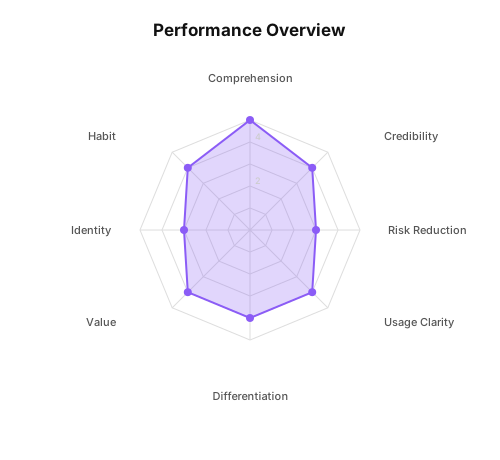
8 critical jobs packaging must accomplish to convert shoppers into buyers

B

Overall Grade

Good — Minor improvements needed

5/5

Instant Comprehension

Shopper understands the product within 5 seconds

4/5

Proof & Credibility

Certifications, claims, and trust signals are present

4/5

Usage Certainty

Shoppers know how and when to use the product

4/5

Instant Comprehension

Clear ownable value versus competitors

4/5

Value Justification

Price point feels earned by what's on pack 4/5 Habit Formation

4/5

Habit Formation

Packaging signals routine and repeat purchase

3/5

Identity & Values

Brand personality resonates with target audience

3/5

Risk Reduction

Guarantees and transparency reduce purchase anxiety

"The 11g of added sugars and 560mg of sodium completely disqualify this for my daily health management."

Shopper concern — Risk Reduction gap identified

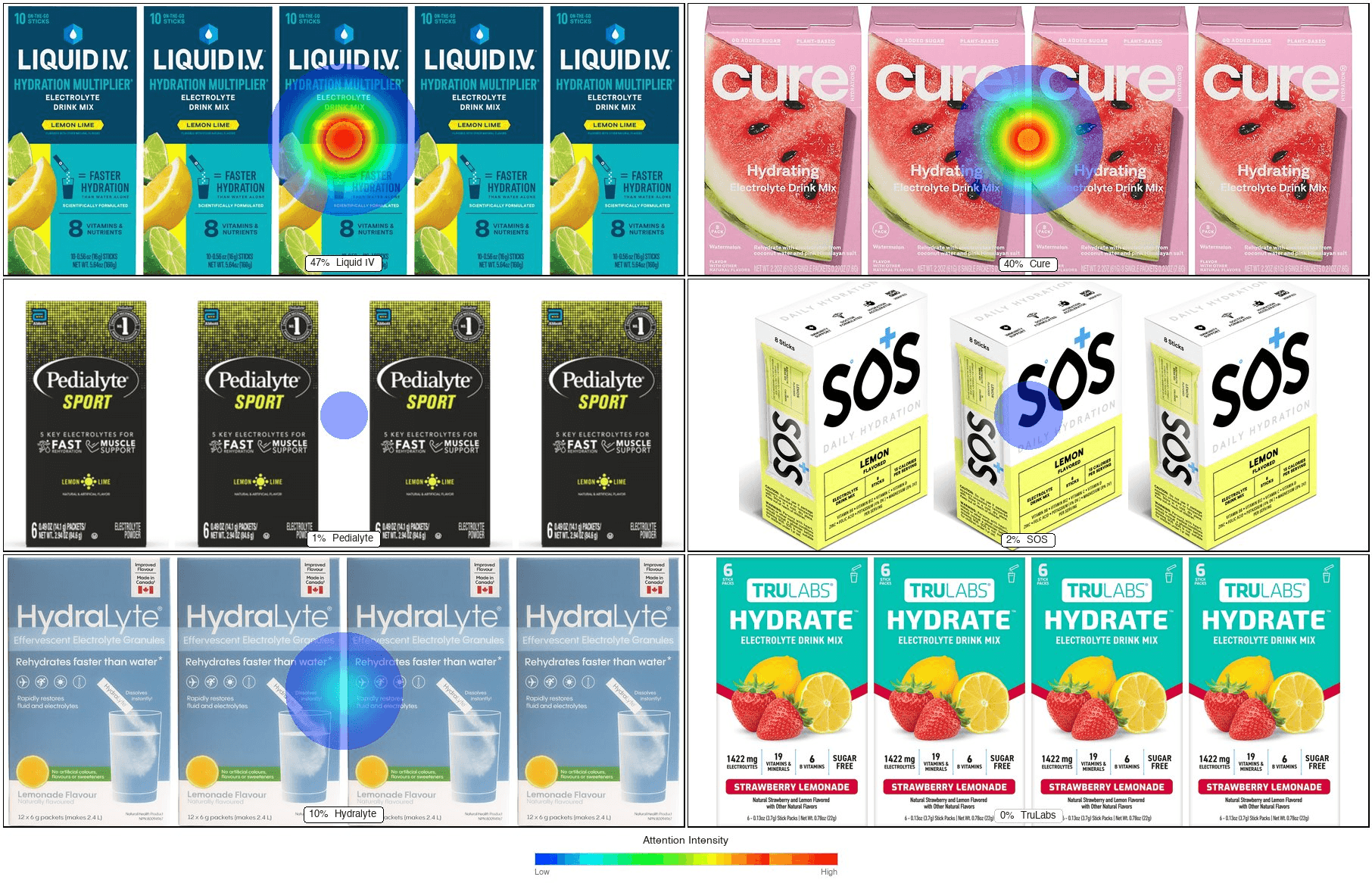
Shelf Attention Heatmap

Visual showing which products caught consumer attention first on shelf

*Position-based. Results may vary depending on shelf placement.

Shelf attention

First-look data

Your Brand

46.6%

Brand A

40.4%

Brand B

9.6%

Brand C

2.1%

Brand D

1.4%

What drew attention

Bright colors

46.6%

Fruit imagery

40.4%

Brand familiarity

9.6%

Bold text

2.1%

94

/100

+16 pts above norm

Category norm: 77

Key elements driving purchase intent

1

Brand Name & Logo

93%

2

Faster Hydration Claim

93%

3

On-The-Go Sticks Callout

93%

4

Dark Blue Background & Layout

93%

5

Scientifically Formulated Badge

93%

"The claim 'FASTER HYDRATION THAN WATER ALONE' is the core promise, and it's stated clearly and confidently."

AI Consumer — on the key front panel claim

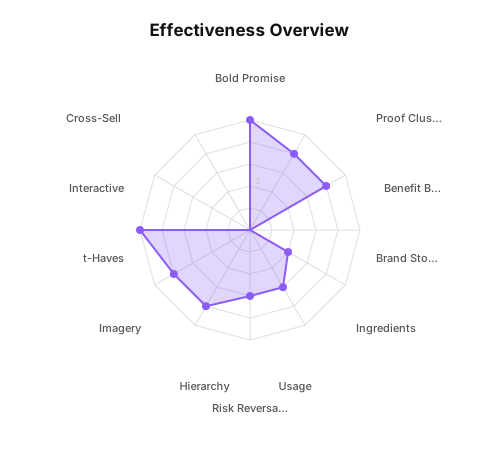
Strong patterns (4–5/5)

Single Bold Promise

5/5

Category Must-Haves

5/5

Proof Cluster

4/5

Benefit Bullets

4/5

Visual Hierarchy

4/5

Emotional Imagery

4/5

Missing or weak patterns

Brand Story Block — Not present

No mission, origin, or emotional narrative. Add a brief statement explaining who Liquid I.V. was built for and why.

Interactive Elements — Not present

No QR code, social handle, or digital touchpoint to extend the relationship post-purchase.

Ingredient Transparency — 2/5

Dense all-caps paragraph with chemical names. Restructure into scannable bullets with plain-language explanations.

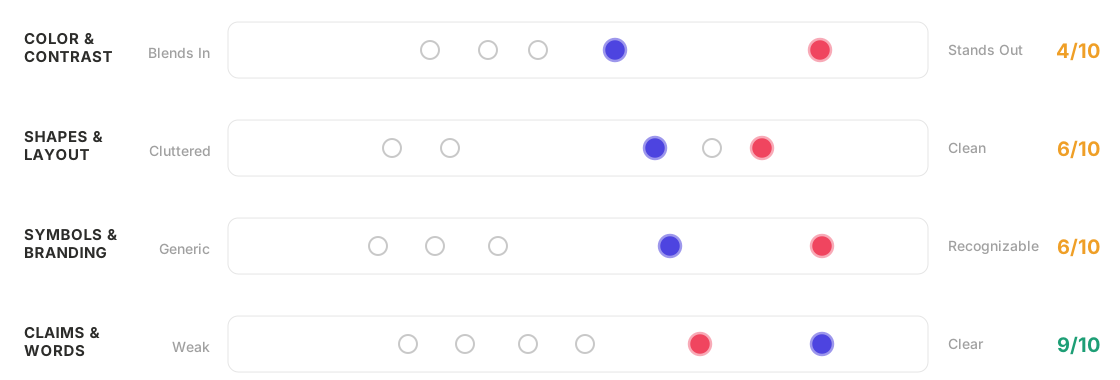
How your brand compares with key competitors

Position on each dimension relative to category

You

Leader (Brand A)

Others

Competitive Takeaway

Competitive Threats

Category leaders are successfully utilising modern, lifestyle-driven aesthetics and oversized imagery to stand out on shelf, while prominently featuring explicit claims on their front panels to address key consumer deal-breakers head-on.

Your Advantages

Your brand establishes immediate, highly trusted clinical authority combined with a strong visual signature that dominates the shelf and drives the highest initial shopper attention in the category.

Borrowable Equities

Brand A's oversized, realistic imagery and clear front-panel health transparency callout provide a highly effective method for balancing appeal with credibility — a pattern worth borrowing.

The Tradeoff

The fundamental tension in this category is balancing medical-grade efficacy cues against natural, refreshing lifestyle appeal — without making the product feel like a synthetic supplement.

Shopper conversion

Shelf test

Front panel score

Winning patterns

Competitive analysis

8 critical jobs packaging must accomplish to convert shoppers into buyers

B

Overall Grade

Good — Minor improvements needed

5/5

Instant Comprehension

Shopper understands the product within 5 seconds

4/5

Proof & Credibility

Certifications, claims, and trust signals are present

4/5

Usage Certainty

Shoppers know how and when to use the product

4/5

Instant Comprehension

Clear ownable value versus competitors

4/5

Value Justification

Price point feels earned by what's on pack 4/5 Habit Formation

4/5

Habit Formation

Packaging signals routine and repeat purchase

3/5

Identity & Values

Brand personality resonates with target audience

3/5

Risk Reduction

Guarantees and transparency reduce purchase anxiety

"The 11g of added sugars and 560mg of sodium completely disqualify this for my daily health management."

Shopper concern — Risk Reduction gap identified

How it works

From upload to insights in minutes

01

Upload your packaging

Images, concept boards, shelf mockups, PDPs — any format works

01

Upload your packaging

Images, concept boards, shelf mockups, PDPs — any format works

02

Define your shopper

Category buyers, switchers, skeptics, loyalists — or your exact target segment

02

Define your shopper

Category buyers, switchers, skeptics, loyalists — or your exact target segment

03

Add competitors (optional)

Run a shelf simulation against real competitors for attention and positioning data

03

Add competitors (optional)

Run a shelf simulation against real competitors for attention and positioning data

04

AI consumers react

Simulated personas evaluate every element — front panel, claims, back panel, and shelf presence

04

AI consumers react

Simulated personas evaluate every element — front panel, claims, back panel, and shelf presence

05

Get your full report

Scores, consumer quotes, prioritised fixes, and competitive benchmarks — ready to act on

05

Get your full report

Scores, consumer quotes, prioritised fixes, and competitive benchmarks — ready to act on

Six layers of analysis

Deeper than any survey. Faster than any focus group.

Every report covers your packaging from every angle a real shopper would encounter it.

Shopper conversion checklist

8 critical jobs your packaging must accomplish to convert a browser into a buyer — scored individually with specific guidance on gaps.

Example output

"Risk Reduction: 3/5 — packaging lacks a satisfaction guarantee and the dense ingredient list creates friction for health-conscious buyers."

Winning patterns analysis

Evaluation against 12 patterns used by top-performing CPG brands — from bold promise to brand story to interactive elements.

Example output

"Brand Story Block: Not present. Add a brief, emotionally grounded statement on the back panel explaining brand mission."

Shelf attention heatmap

See which product on the shelf catches eyes first, what visual elements drive attention, and where your packaging sits in the competitive hierarchy.

Example output

"Liquid I.V. captured first attention from 46.6% of consumers. Primary driver: bright color contrast + strong brand familiarity."

Front & back panel deep-dive

Element-by-element analysis of what's driving and blocking purchase intent — with ranked impact scores and verbatim consumer reactions.

Example output

"Front panel score: 94/100 (+16 pts above norm). Top driver: brand name & logo at 93% purchase intent impact."

Competitive benchmarking

Your packaging scored against competitors on color & contrast, layout, branding, and claims — with a clear read on where rivals outperform you.

Example output

"Cure's 0g Added Sugar callout on the front panel directly addresses the #1 purchase anxiety this packaging fails to resolve."

Prioritised recommendations

Every gap comes with a High / Medium / Low impact label and a specific, actionable fix — not vague advice, but exactly what to change and why.

Example output

"HIGH IMPACT — Increase visual contrast of back panel text. Allows shoppers to read usage instructions without frustration."

Who uses it

Built for every team that touches packaging decisions

Brand & design teams

Get consumer reactions on concepts before committing to production. Test 10 design directions in an afternoon.

Compare variant designs side by side

See which visual elements drive attention

Validate redesigns before launch

Consumer insights teams

Run more studies, faster. Use BluePill to narrow options before commissioning expensive human studies.

Simulate category buyers, switchers, skeptics

Get quantitative scores with qualitative rationale

Benchmark against real competitors

Marketing & claims teams

Test how your claims land before they're set in stone. Find out which messages actually move purchase intent.

Validate "organic", "premium", "clinically proven"

Identify claims that create trust vs. skepticism

See how claims compare vs. competitors

FAQ's

Common questions

Are AI consumers a replacement for real human research?

No — and we're transparent about that. AI consumers are best for rapid iteration: narrowing 10 concepts to 3, identifying obvious gaps, and getting directional signal fast. For high-stakes final packaging, many teams validate with human studies after using BluePill to shortlist. You get the speed of AI with the rigour of human validation where it matters most.

How long does a full packaging test take?

Most tests complete within minutes. A full report — including shopper conversion checklist, shelf test, front panel analysis, competitive benchmarking, and prioritised recommendations — is typically ready in under 10 minutes.

How long does a full packaging test take?

Most tests complete within minutes. A full report — including shopper conversion checklist, shelf test, front panel analysis, competitive benchmarking, and prioritised recommendations — is typically ready in under 10 minutes.

What file formats can I upload?

Images (PNG, JPG), PDFs, concept boards, shelf mockups, and slides. You can upload front panels, back panels, all sides, and full shelf renders. The more you provide, the more complete the analysis — but a single front-panel image is enough to get started.

What file formats can I upload?

Images (PNG, JPG), PDFs, concept boards, shelf mockups, and slides. You can upload front panels, back panels, all sides, and full shelf renders. The more you provide, the more complete the analysis — but a single front-panel image is enough to get started.

Can I test specific claims or just full packaging?

Both. You can upload a complete packaging design for a full analysis, or isolate specific elements — a claim, a badge, an ingredient callout — and get targeted feedback on how that element performs with your target shopper persona.

Can I test specific claims or just full packaging?

Both. You can upload a complete packaging design for a full analysis, or isolate specific elements — a claim, a badge, an ingredient callout — and get targeted feedback on how that element performs with your target shopper persona.

What categories does this work best for?

BluePill is used across CPG, food & beverage, health & wellness, beauty & personal care, and household products. Any product category where packaging influences the purchase decision — which is most of them — is a strong fit.

What categories does this work best for?

BluePill is used across CPG, food & beverage, health & wellness, beauty & personal care, and household products. Any product category where packaging influences the purchase decision — which is most of them — is a strong fit.

Can I compare multiple designs in one study?

Yes. You can run head-to-head comparisons between variants — different colorways, different claims hierarchies, different label formats — and get comparative scoring to identify the strongest performer before committing.

Can I compare multiple designs in one study?

Yes. You can run head-to-head comparisons between variants — different colorways, different claims hierarchies, different label formats — and get comparative scoring to identify the strongest performer before committing.

See your packaging through a consumer's eyes. In minutes.

Book a 30-minute demo and we'll run a live packaging test on one of your products — no prep needed.

Ask thousands of AI consumers what they think — instantly, with validated accuracy.

Quick links

Ask thousands of AI consumers what they think — instantly, with validated accuracy.

Quick links