100ร— faster insights at 10% of the cost

Stop asking consumers what they might do. Watch what they do.

BluePill's Cognitive Predictive Engine simulates how real consumer segments think, reason, and decide โ€” giving you purchase intent scores, segment reactions, friction analysis, and strategic recommendations in minutes, not months.

The old way is broken

You're either getting depth or breadth. Never both.

Qualitative gives depth, not scale

Focus groups surface rich reasoning โ€” but 12 people isn't a segment. You can't base a launch decision on a room.

Surveys give breadth, not the "why"

Quant panels tell you what consumers said they'd do. They don't capture the cognitive patterns that actually drive the transaction.

Generic AI lacks ground truth

LLMs can generate plausible-sounding responses โ€” but without anchoring to real consumer data, the insights are educated guesses, not bankable predictions.

Consumers aren't rational actors

Traditional research treats buyers as logical. Real consumers are messy โ€” swayed by price fluctuations, social proof, and environmental context. Standard methods don't model that.

The BluePill Way

Cognitive Predictive Engine โ€” not just another LLM wrapper

We anchor LLM intelligence against established quantitative methods to decode the social and cognitive signaling patterns of your target consumers. The result is a model that doesn't just guess โ€” it predicts.

Cognitive Signaling Data: how consumers think before buying

nK Benchmark: your concept interrogated by a validated digital twin population

Bidirectional modelling of the Halo Effect โ€” quantified, not guessed

90% individual directional match with real human respondents

92.6% accuracy at the population level โ€” data-validated

Test 20 concepts for the cost of one traditional panel study

What's inside a concept report

Every report covers multiple layers of analysis

Not just scores - segment level insights, top friction points and purchase drivers.
Executive summary

Segment breakdown

Friction & drivers

Key insights

Competitive Takaway

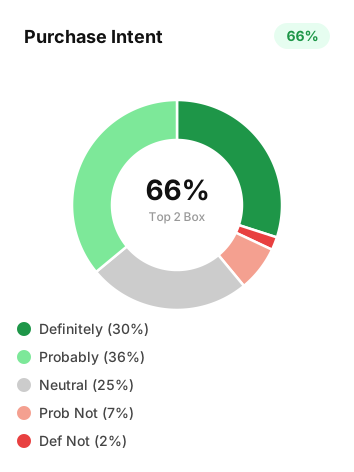
Purchase Intent

Above norm

3.8

/5

Top 2 Box 66%

Norm 3.65

+0.19

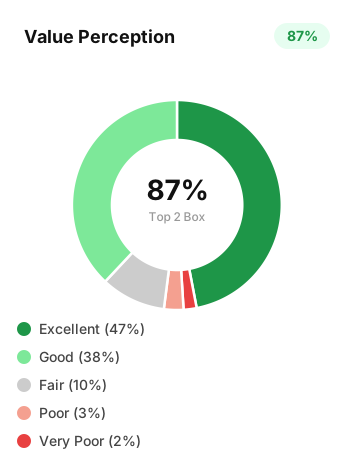
Value Perception

Above

4.3

/5

Top 2 Box 87%

Norm 3.70

+0.61

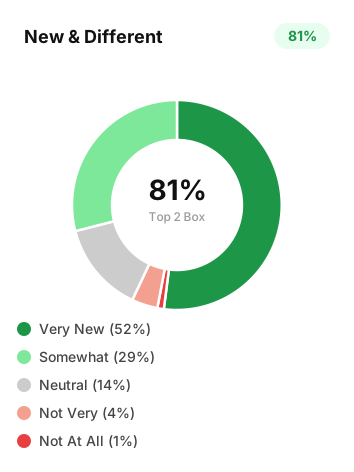
New & Different

Above norm

4.3

/5

Top 2 Box 81%

Norm 3.66

+0.68

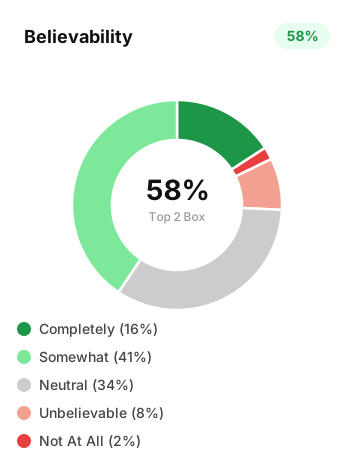
Believability

Below norm

3.7

/5

Top 2 Box 58%

Norm 3.95

+0.28

Top-line verdict

Consumers really liked that Olipop Raspberry Sherbet felt new and different, and they thought it was a good value at $2.49 โ€” but they struggled to believe the prebiotic fiber claims. Mothers and teenagers had similar overall interest levels (74โ€“77%), but mothers questioned whether the benefits were real while teenagers were more hesitant about actually buying it despite liking the concept.

Executive summary

Segment breakdown

Friction & drivers

Key insights

Competitive Takaway

Purchase Intent

Above norm

3.8

/5

Top 2 Box 66%

Norm 3.65

+0.19

New & Different

Above norm

4.3

/5

Top 2 Box 81%

Norm 3.66

+0.68

Value Perception

Above

4.3

/5

Top 2 Box 87%

Norm 3.70

+0.61

Believability

Below norm

3.7

/5

Top 2 Box 58%

Norm 3.95

+0.28

Top-line verdict

Consumers really liked that Olipop Raspberry Sherbet felt new and different, and they thought it was a good value at $2.49 โ€” but they struggled to believe the prebiotic fiber claims. Mothers and teenagers had similar overall interest levels (74โ€“77%), but mothers questioned whether the benefits were real while teenagers were more hesitant about actually buying it despite liking the concept.

The methodology

How we model the "Messy Human"

Traditional research treats consumers as rational actors. We treat them as dynamic agents โ€” swayed by price, social proof, and environmental context. That's what makes our predictions bankable.

Cognitive Signaling Data

We extract how consumers think before buying a product โ€” not just whether they like it. The reasoning patterns, mental comparisons, and emotional associations that precede a purchase decision.

The nK Benchmark

Your concept is interrogated by a digital twin population representing the cognitive strengths and biases of real-world buyers โ€” anchored to quantitative data, not synthetic hallucinations.

Bidirectional Halo Modelling

We don't just measure if they like it โ€” we encode how they think about it. By quantitatively modelling the Halo Effect, we simulate purchase intent with surgical precision.

Operational lifecycle โ€” Lab concept to market leader

Step 1 ยท Onboarding

Validated Baseline

Supply baseline and establish the validated consumer twin population for your category

Step 2 ยท Execution

Unlimited Testing

Inject any number of variables โ€” price, environment, social proof โ€” into the simulation

Step 3 ยท Optimisation

Over-the-Air Updates

Population models stay current with shifting market trends and new segment extractions

Step 4 ยท Evolution

Continuous Learning

Move from a one-off test to a continuous improvement loop tracked via internal metrics

How it works

From concept brief to full report in minutes

01

Describe your concept

Upload a brief, concept board, product description, or positioning statement โ€” whatever stage you're at

01

Describe your concept

Upload a brief, concept board, product description, or positioning statement โ€” whatever stage you're at

02

Define your segments

Choose custom segments - demographics, attitudes, category behaviors

02

Define your segments

Choose custom segments - demographics, attitudes, category behaviors

03

AI consumers evaluate

Synthetic consumer twins react to your concept across all 4 core metrics โ€” scoring, reasoning, and surfacing objections

03

AI consumers evaluate

Synthetic consumer twins react to your concept across all 4 core metrics โ€” scoring, reasoning, and surfacing objections

04

Friction & drivers ranked

Every barrier and motivator is extracted, categorised, and ranked by frequency across your target segments

04

Friction & drivers ranked

Every barrier and motivator is extracted, categorised, and ranked by frequency across your target segments

05

Get your full report

Executive summary, segment breakdown, friction analysis, key insights, and strategic recommendations โ€” all in one shareable report

05

Get your full report

Executive summary, segment breakdown, friction analysis, key insights, and strategic recommendations โ€” all in one shareable report

What every report covers

Deeper than any survey. Faster than any focus group.

Six layers of analysis in every concept report โ€” from top-line scores to strategic recommendations.

4 core metric scores

Purchase Intent, Value Perception, New & Different, and Believability โ€” each benchmarked against category norms with Top 2 Box distributions.

Segment-by-segment breakdown

Every metric broken down by segment โ€” ranked by purchase intent, with top strength, primary friction, and a key insight per audience.

Friction & purchase driver analysis

Every barrier and motivator extracted, categorised, and ranked by frequency โ€” so you know exactly what to fix and what to amplify.

Strategic key insights

The patterns that explain the numbers โ€” named, framed, and actionable. Not what consumers said, but what it means for how you position the product.

Strongest signal & biggest risk

A clear two-sentence read on where the biggest opportunity is and what could sink the concept โ€” for easy executive communication.

Multi-concept comparison

Test 2โ€“10 concepts side by side in a single study, compare PI scores, segment reactions, and friction themes to identify the strongest direction.

Proven accuracy

We tested AI twins against real humans. The results speak for themselves.

We showed 3 real products to real people and AI consumer twins of those same people. Here's what happened.

90%

Individual directional match with what each real human respondent said

92.6%

Accuracy at the population level โ€” data-validated, not estimated

9.4x

Better than random at correctly identifying the winning and losing concept

โœ“ 100% rank order across 3 blind products โ€” the AI picked the same best and worst product as real humans

BluePill vs. the alternatives

Feature

Traditional Testing

Generic AI Testing

BluePill

Turnaround

Extended cycles

Accelerated

Accelerated

Depth

Surface-level "Likes"

Synthetic hallucinations

Deep Cognitive Anchoring

Reliability

High (but slow)

Low (unanchored)

High (Data-Validated)

The "Halo Effect"

Ignored

Guessed

Quantitatively Modeled

Feature

Traditional Testing

Generic AI Testing

BluePill

Turnaround

Extended cycles

Accelerated

Accelerated

Depth

Surface-level "Likes"

Synthetic hallucinations

Deep Cognitive Anchoring

Reliability

High (but slow)

Low (unanchored)

High (Data-Validated)

The "Halo Effect"

Ignored

Guessed

Quantitatively Modeled

Who uses it

Built for every team that kills or greenlights concepts

Brand & innovation teams

Test more ideas earlier in the funnel โ€” before expensive development work locks you into the wrong direction.

Screen 20 concepts to find the 3 worth developing

Understand which segment to lead with

Get language that resonates before briefing creative

Consumer insights teams

Run directional concept tests in hours โ€” then use the findings to focus expensive human research where it matters most.

Benchmark concepts against category norms

Identify friction before committing to positioning

Supplement quant panels with rapid qualitative signal

Marketing & strategy teams

Understand how consumers mentally frame your concept โ€” and use that to write better positioning, claims, and launch messaging.

Find the framing that moves purchase intent

Identify claims that create vs. destroy believability

Know which segment to lead your launch with

FAQ's

Common questions

How finished does my concept need to be?

Not finished at all. You can test a rough positioning statement, a product brief, a concept board, or a fully developed product description. The more detail you provide, the richer the consumer reactions โ€” but a paragraph describing the concept and its key claim is enough to get meaningful scores.

How are the consumer twins calibrated?

BluePill's synthetic consumer twins are built from behavioral, attitudinal, and category-specific shopper data. Each twin has a defined demographic profile, purchasing psychology, and category relationship โ€” so when they react to your concept, they're reasoning from a realistic consumer mindset, not a generic average.

How are the consumer twins calibrated?

BluePill's synthetic consumer twins are built from behavioral, attitudinal, and category-specific shopper data. Each twin has a defined demographic profile, purchasing psychology, and category relationship โ€” so when they react to your concept, they're reasoning from a realistic consumer mindset, not a generic average.

What's the difference between this and a survey?

Surveys capture stated preference โ€” what people say they'll do. BluePill's synthetic consumers simulate behavioural reasoning โ€” why they'd actually buy or reject. You get the friction points, the mental comparisons they're making, the specific language that helps or hurts believability. That's a layer of insight surveys can't surface.

What's the difference between this and a survey?

Surveys capture stated preference โ€” what people say they'll do. BluePill's synthetic consumers simulate behavioural reasoning โ€” why they'd actually buy or reject. You get the friction points, the mental comparisons they're making, the specific language that helps or hurts believability. That's a layer of insight surveys can't surface.

Can I test multiple concepts head-to-head?

Yes. You can run 2โ€“10 concepts in a single study and get comparative scores across all 4 metrics, by segment. This is particularly useful for early-stage screening where you need to reduce a large set of ideas to a shortlist before investing in development.

Can I test multiple concepts head-to-head?

Yes. You can run 2โ€“10 concepts in a single study and get comparative scores across all 4 metrics, by segment. This is particularly useful for early-stage screening where you need to reduce a large set of ideas to a shortlist before investing in development.

How many segments can I test against?

You can test against multiple segments of your audience. Choose custom segments built around demographics, attitudes & behaviors or category relationships relevant to your brand.

How many segments can I test against?

You can test against multiple segments of your audience. Choose custom segments built around demographics, attitudes & behaviors or category relationships relevant to your brand.

What categories does this work for?

BluePill concept testing is used across food & beverage, health & wellness, personal care, household products, and CPG broadly. Any category where consumer perception of the concept drives trial and adoption is a strong fit โ€” which is most of FMCG.

What categories does this work for?

BluePill concept testing is used across food & beverage, health & wellness, personal care, household products, and CPG broadly. Any category where consumer perception of the concept drives trial and adoption is a strong fit โ€” which is most of FMCG.

See your Concept through a consumer's eyes. In minutes.

Book a 30-minute demo and we'll run a live concept test on one of your brief - no prep needed.