Learn how advertising research helps brands test campaign ideas, ad messages, claims, creative hooks, and audience reactions before spending media budget.
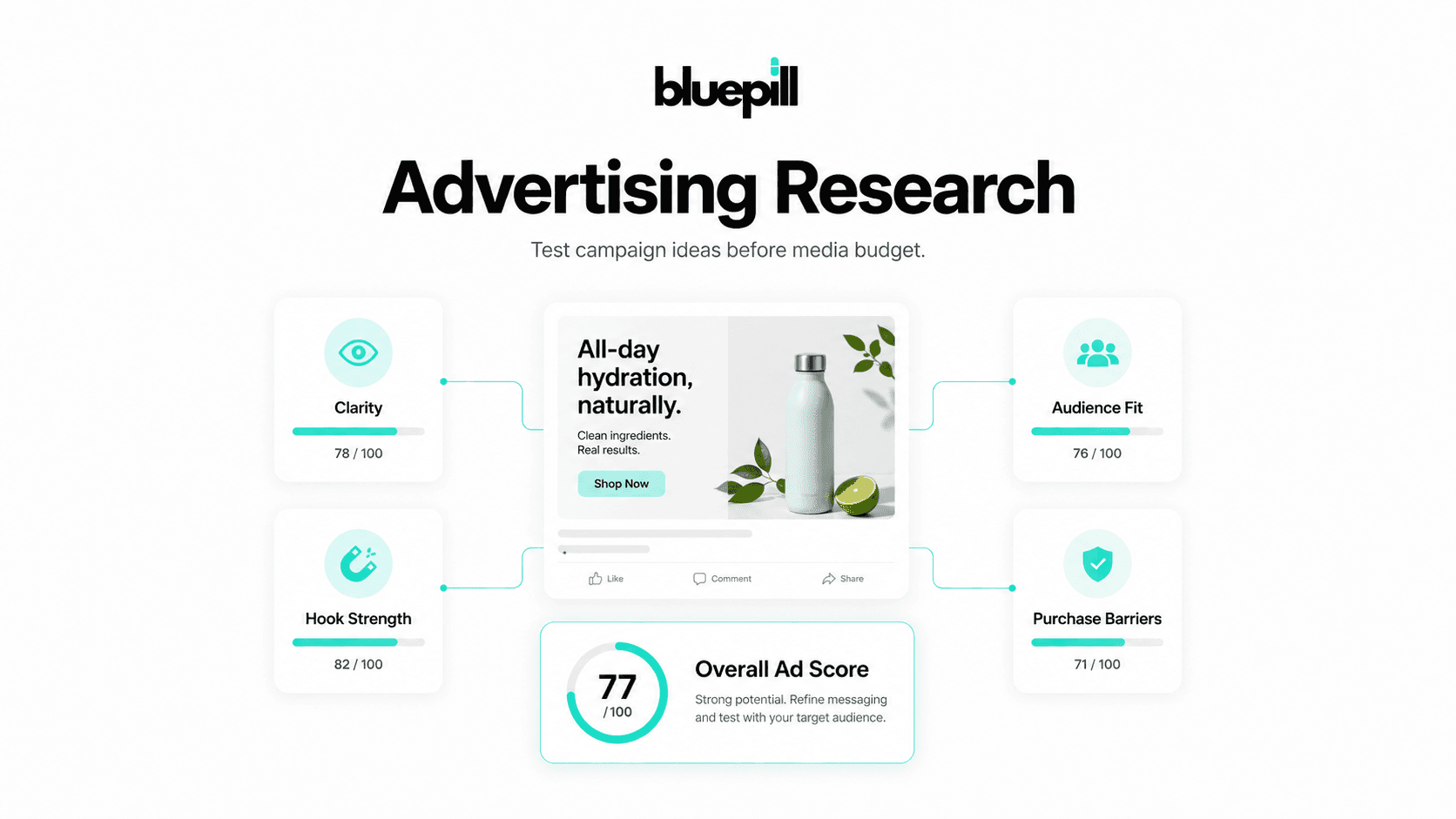
Media budget should not be the first place a brand tests whether a campaign idea works.
By the time an ad is live, the brand is already paying to learn.
Sometimes that is useful. Performance data can show which ads get clicks, which audiences convert, and which channels create revenue.
But many campaign problems begin before the first impression is served.
The message may be unclear.
The claim may not feel believable.
The creative hook may attract attention but not purchase intent.
The audience may not care enough.
The product benefit may not be obvious.
The landing page may not continue the ad story.
The campaign may look strong internally but fail with real consumers.
This is why advertising research matters.
Advertising research helps brands test campaign ideas before spending media budget. It helps teams understand whether consumers notice, understand, trust, and respond to an ad idea before it goes live.
For consumer brands, this can reduce wasted spend and improve campaign quality.
In the AI era, advertising research can also happen faster. Teams can now use AI consumer panels, synthetic personas, and behavioral simulations to test ad hooks, claims, messages, creative routes, landing page copy, and audience reactions before launching paid media.
That is where BluePill helps.
BluePill lets brands ask AI consumers what they think about campaign ideas, ad messages, claims, product concepts, landing pages, packaging, and buying decisions. It helps marketing, brand, growth, and insights teams improve campaigns before media spend begins.
What Is Advertising Research?
Advertising research is the process of testing and understanding how consumers respond to advertising ideas before, during, or after a campaign.
For pre-launch campaign planning, advertising research helps answer:
Is the campaign idea clear?
Does the message create interest?
Does the claim feel believable?
Does the ad communicate the right benefit?
Does the creative hook match the audience need?
What would consumers remember?
What would make them click, consider, or buy?
What would stop them from acting?
Which audience responds best?
Which ad idea should be tested in market first?
Advertising research is not only about choosing the prettiest creative.
It is about understanding whether the campaign can move a consumer closer to a decision.
Why Advertising Research Matters Before Media Spend
A campaign can fail even with good media buying.
A brand may reach the right audience, but with the wrong message.
That is expensive.
If the ad does not explain the product clearly, consumers may ignore it.
If the claim sounds exaggerated, consumers may distrust it.
If the creative is entertaining but disconnected from the product, it may drive weak traffic.
If the landing page does not support the ad promise, conversion may drop.
If the audience does not feel the problem strongly, the campaign may struggle to create action.
Advertising research helps identify these risks earlier.
It gives teams a chance to fix the idea before spending heavily on media.
Start With the Campaign Decision
Before testing ads, define the decision.
Are you choosing between campaign ideas?
Are you testing ad hooks?
Are you deciding which product benefit to lead with?
Are you testing claims?
Are you identifying the right audience?
Are you preparing paid social creative?
Are you improving landing page messaging?
Are you deciding whether a campaign is ready to launch?
The research should match the decision.
If the decision is about the hook, compare hooks.
If the decision is about the claim, test believability.
If the decision is about audience, compare segment reactions.
If the decision is about conversion, test the ad and landing page together.
Good advertising research is focused.
It does not ask whether people like an ad in general. It asks whether the ad helps the brand achieve the campaign goal.
Test the Core Message
The message is the heart of the campaign.
Before testing visuals or formats, test whether the core message works.
Ask:
What is the main idea you take away?
Is the message easy to understand?
Does it feel relevant to you?
Does it make the product more interesting?
Does it clearly explain the benefit?
What feels confusing?
What would you remember from this message?
A message can sound strong internally and still fail with consumers.
For example, a brand may say “clean energy for modern life,” but consumers may not understand what clean energy means, when they would use it, or why it is better than coffee or energy drinks.
BluePill helps teams test campaign messages with AI consumers before launch, making it easier to see what is clear, vague, memorable, or confusing.
Test the Creative Hook
The creative hook is what gets attention.
It may be a headline, opening line, visual, problem statement, comparison, founder story, customer pain point, or bold claim.
A good hook should do more than stop the scroll. It should attract the right audience and connect to the product.
Ask:
What grabs your attention first?
Does this hook make you want to learn more?
What do you think the ad is about?
Does the hook connect clearly to the product?
Does it feel fresh or familiar?
Does it attract the right kind of buyer?
Would this make you click, watch, or ignore?
This matters because attention without relevance can waste media budget.
An ad may get clicks because it is entertaining, but if it attracts the wrong audience or creates the wrong expectation, conversion may suffer.
BluePill can help teams compare multiple hooks before choosing what to test in paid media.
Test Claim Believability
Claims often drive advertising performance.
But a claim only helps if consumers believe it.
Ask:
What does this claim mean to you?
Is the claim believable?
What makes it believable or unbelievable?
What proof would you need?
Does the claim make you more interested?
Does it sound specific or generic?
Does it feel exaggerated?
This is especially important in categories like food, beverage, beauty, wellness, healthcare, personal care, and CPG.
Claims like “supports gut health,” “clean energy,” “clinically inspired,” “better-for-you,” “premium quality,” or “science-backed” can create interest, but they can also create skepticism if not supported.
BluePill helps teams test claims with AI consumers before putting them into ads, packaging, landing pages, or campaign copy.
Test Audience Fit
Not every campaign idea works for every audience.
A message that works for premium buyers may not work for price-sensitive shoppers.
A functional claim may work for expert category users but confuse light buyers.
A family-focused message may work for parents but not for individual buyers.
A proof-led message may work for skeptical consumers but feel too technical for others.
Advertising research should test campaign ideas by segment.
Ask:
Who does this ad feel made for?
Does this message feel relevant to you?
Which type of consumer would respond most?
Who would ignore this campaign?
What would make this more relevant to your needs?
BluePill helps teams simulate campaign reactions across different AI consumer segments. This helps marketers understand which audience should receive which message before media spend begins.
Test Product Understanding
An ad can be interesting but still fail if consumers do not understand the product.
This is common with new products, emerging categories, functional benefits, and technical claims.
Ask:
What do you think this product is?
What problem does it solve?
Who do you think it is for?
When would someone use it?
What makes it different from alternatives?
What would you still need to know?
If consumers cannot explain the product after seeing the campaign idea, the ad may need clearer communication.
BluePill can help teams test whether AI consumers understand the product from the campaign message alone.
Test Emotional Response
Advertising is not only rational.
A campaign can create curiosity, trust, excitement, relief, confidence, comfort, aspiration, or urgency.
It can also create doubt, confusion, skepticism, indifference, or irritation.
Ask:
How does this ad make you feel?
Does it create curiosity?
Does it create trust?
Does it feel relevant to your life?
Does it feel honest?
Does it feel memorable?
Does anything feel off or forced?
Emotional response matters because consumers often act based on how a message feels, not just what it says.
For example, a skincare campaign may need reassurance. A snack campaign may need appetite appeal. A wellness campaign may need credibility. A premium product may need desire and trust.
Test Differentiation
A campaign should help the brand stand apart.
If the ad sounds like every competitor, it may not create strong recall or preference.
Ask:
Does this campaign feel different from other brands in the category?
What makes it stand out?
What does it remind you of?
Does the difference matter?
Would this make you consider switching?
What would make it more distinctive?
Differentiation is especially important in crowded markets where claims and visuals often become similar.
BluePill can help teams test whether a campaign idea feels meaningfully different or just slightly different.
Test Purchase Barriers
Advertising research should not only ask what people like.
It should ask what may stop them from acting.
Ask:
What would stop you from clicking?
What would stop you from buying?
What feels unclear?
What feels hard to believe?
What information is missing?
What concern would you have?
What would make you more confident?
Purchase barriers are often the most actionable part of advertising research.
If the issue is unclear value, improve the benefit.
If the issue is trust, add proof.
If the issue is price, improve value communication.
If the issue is use case, make the buying moment clearer.
If the issue is differentiation, sharpen the comparison.
BluePill helps teams identify these barriers before ads go live.
Test Ad and Landing Page Together
A campaign does not end with the ad.
If the ad creates interest but the landing page does not continue the story, conversion can suffer.
Before spending media budget, test the full journey.
Ask:
Does the landing page match the ad promise?
Is the product explained clearly after the click?
Does the page answer the questions raised by the ad?
Is the claim supported with enough proof?
Is the offer clear?
What would stop someone from converting?
What information is missing?
This is especially important for ecommerce, DTC, SaaS-like consumer products, waitlists, pre-orders, and lead generation campaigns.
BluePill can help teams test ad and landing page messaging together with AI consumers before launch.
Test Multiple Campaign Routes
Teams often debate different creative directions.
One route may be emotional.
One may be functional.
One may be problem-led.
One may be proof-led.
One may be price-led.
One may be comparison-led.
One may be founder-led.
One may be lifestyle-led.
Advertising research helps compare these routes before media spend.
Ask:
Which route is clearest?
Which route feels most believable?
Which route creates the strongest interest?
Which route best fits the brand?
Which route feels most different?
Which route would make you more likely to act?
BluePill is useful here because teams can test several routes quickly and understand which ideas deserve production or paid testing.
What to Measure in Advertising Research
A good advertising research study should measure more than liking.
Useful measures include:
Attention
Message clarity
Product understanding
Relevance
Claim believability
Emotional response
Differentiation
Brand fit
Purchase intent
Click intent
Consideration
Trust
Recall
Objections
Audience fit
Landing page continuity
The right metrics depend on the campaign goal.
If the goal is awareness, measure recall and brand linkage.
If the goal is consideration, measure relevance, trust, and product understanding.
If the goal is conversion, measure purchase barriers, offer clarity, and landing page fit.
Use AI Before A/B Testing
A/B testing is valuable, but it happens in market.
That means the brand is paying to learn.
Advertising research can improve what goes into the A/B test.
Instead of testing random ad variants, teams can use BluePill to identify stronger hypotheses first.
For example:
Which hook is clearest?
Which claim feels believable?
Which benefit creates interest?
Which audience responds best?
Which objection should the ad address?
Which landing page message supports the ad best?
Then the team can run paid tests with stronger creative variants.
AI research does not replace A/B testing. It makes A/B testing more intelligent.
When to Use Human Advertising Research
AI consumer testing is useful for early campaign development, but human research still matters in some cases.
Use human advertising research when you need:
Final campaign validation
Statistical confidence
Brand lift measurement
Ad recall measurement
Sensitive category feedback
Large audience benchmarking
Post-campaign effectiveness
Real media exposure data
The best workflow is often AI first, then human validation or in-market testing.
Use BluePill to refine campaign ideas early. Then use human research, A/B testing, or performance data to validate.
Common Advertising Research Mistakes
One common mistake is asking only which ad people like.
Liking an ad is not the same as buying.
Another mistake is testing creative without testing the claim.
A beautiful ad can fail if the claim is not believable.
Another mistake is testing ads without the landing page.
The post-click experience matters.
Another mistake is ignoring audience differences.
Different segments may respond to different messages.
Another mistake is relying only on media data.
Performance data shows what happened after launch. Pre-launch research helps improve what goes live.
Another mistake is testing too late.
If production and media plans are already locked, research may reveal problems that are difficult to fix.
How BluePill Helps With Advertising Research
BluePill helps teams test campaign ideas before spending media budget.
Teams can use BluePill to test:
Ad hooks
Campaign messages
Brand claims
Creative routes
Landing page copy
Audience segments
Purchase barriers
Competitive comparisons
Product understanding
Trust signals
Offer language
For marketing teams, BluePill improves campaign quality before launch.
For brand teams, it helps ensure the message supports positioning.
For growth teams, it creates stronger A/B testing hypotheses.
For insights teams, it gives fast consumer feedback before media spend.
For innovation teams, it helps connect product concepts with go-to-market messaging.
A Practical Advertising Research Workflow
A strong workflow can look like this:
Start with the campaign goal.
Know whether the campaign is meant to drive awareness, consideration, trial, purchase, signups, or repeat.
Define the audience.
Be clear about who the campaign is trying to move.
Test the core message.
Check clarity, relevance, and product understanding.
Test claims.
Understand believability and proof needs.
Test creative hooks.
Compare what gets attention and connects to the product.
Test barriers.
Find what would stop action.
Test landing page continuity.
Make sure the post-click experience supports the ad promise.
Test by segment.
Identify which audience responds best.
Refine creative and copy.
Improve weak areas before production or media spend.
Validate in market.
Use A/B testing, conversion data, brand lift, or human research where needed.
Final Takeaway
Advertising research helps brands test campaign ideas before spending media budget.
It helps teams understand whether consumers notice, understand, trust, remember, and respond to campaign messages.
For consumer brands, this can reduce wasted media spend and improve campaign performance before launch.
In the AI era, advertising research can happen earlier and faster.
BluePill helps brands ask AI consumers what they think about ad hooks, claims, campaign messages, landing pages, audience fit, and purchase barriers before launching paid media.
The best campaigns are not only creative.
They are tested, understood, and improved before the media budget starts working.
Related Blogs
May 29, 2026
Message Testing: How to Find the Best Claim, Hook, or Value Proposition
May 29, 2026
AI Personas: How Brands Use Synthetic Consumers for Faster Research

May 29, 2026
Advertising Market Research: How to Validate Ads Before Launch
May 29, 2026