Learn how message testing helps brands find the best claim, hook, and value proposition before launching campaigns, packaging, product pages, or new products.
A product can be strong and still fail if the message is weak.
Consumers may not understand what the product does.
They may not care about the benefit.
They may not believe the claim.
They may not see why the product is different.
They may not feel enough reason to click, buy, try, or switch.
This is why message testing matters.
Message testing helps brands understand which claim, hook, or value proposition is most likely to connect with consumers before launch.
For consumer brands, this can shape many important decisions.
What should go on the front of pack?
What should the ad headline say?
Which benefit should lead the campaign?
Which claim feels most believable?
Which message will make people click?
Which value proposition makes the product worth buying?
Which audience responds best?
Without message testing, teams often choose messaging based on internal preference.
The founder likes one line.
The brand team prefers another.
The agency likes the clever hook.
The product team wants to highlight features.
The sales team wants stronger claims.
Leadership wants the safest option.
But consumers decide differently.
They care about clarity, relevance, trust, proof, price, and whether the product solves a real problem.
In the AI era, message testing can happen much earlier. Teams can now use AI consumer panels, synthetic personas, and behavioral simulations to test claims, hooks, value propositions, landing page copy, packaging copy, and campaign ideas before spending on human research or media.
That is where BluePill helps.
BluePill lets brands ask AI consumers what they think about claims, hooks, value propositions, packaging messages, campaign messages, and purchase decisions. It helps teams find the strongest message before launch.
What Is Message Testing?
Message testing is the process of evaluating different messages to understand which one is clearest, most relevant, most believable, and most likely to influence consumer action.
It can be used to test:
Product claims
Ad hooks
Value propositions
Campaign headlines
Packaging copy
Landing page copy
Product descriptions
Email subject lines
Social ad copy
Retail messages
Website hero copy
Brand positioning statements
The goal is not only to find the message people like.
The goal is to find the message that helps consumers understand, trust, remember, and act.
A good message should answer:
What is this?
Why should I care?
Why should I believe it?
Why is it better or different?
Why should I act now?
Why Message Testing Matters
Many product and campaign problems are actually message problems.
A product may be relevant, but the message may not explain the use case.
A claim may be true, but consumers may not understand it.
A campaign may get attention, but not create buying interest.
A package may look good, but the front-of-pack message may not communicate the main benefit.
A landing page may get traffic, but not convince visitors to convert.
Message testing helps brands catch these problems early.
It shows which words create clarity, which claims create trust, which hooks create interest, and which value propositions create stronger purchase intent.
For brand, marketing, innovation, and insights teams, this can reduce wasted effort and improve launch confidence.
Claim vs Hook vs Value Proposition
Before testing messages, it helps to separate three different message types.
Claim
A claim is a specific statement about the product or brand.
Examples:
High protein
Low sugar
Supports gut health
Clinically tested
Made with clean ingredients
Gentle on sensitive skin
No artificial flavors
Ready in 5 minutes
Better hydration without added sugar
Claims often appear on packaging, ads, product pages, and retail materials.
A claim needs to be clear, believable, and supported by proof where needed.
Hook
A hook is the message that grabs attention.
It is often used in ads, landing pages, social posts, and campaign creative.
Examples:
Tired of the afternoon crash?
A healthier snack your kids will actually eat.
Skincare that does not make sensitive skin nervous.
The breakfast cereal that keeps up with busy mornings.
Clean energy without the sugar crash.
A hook needs to stop the right consumer and make them want to know more.
Value Proposition
A value proposition explains why the product is worth choosing.
It connects the product, benefit, audience, and reason to believe.
Examples:
A high-protein, low-sugar breakfast cereal for busy mornings when you need something filling, fast, and easy.
A gentle barrier repair cream for sensitive-skin consumers who need hydration without irritation.
A clean energy drink for office workers who want afternoon focus without the sugar crash.
A value proposition should make the product feel clear, relevant, different, and worth buying.
Start With the Consumer Decision
Before testing messages, define the decision you need the message to support.
Are you trying to choose a front-of-pack claim?
Are you testing ad hooks before media spend?
Are you choosing the hero message for a landing page?
Are you improving a product concept?
Are you repositioning a brand?
Are you trying to increase purchase intent?
Are you trying to reduce confusion or skepticism?
The testing criteria should match the decision.
For packaging, clarity and claim visibility may matter most.
For ads, attention and relevance may matter most.
For landing pages, trust and conversion barriers may matter most.
For product concepts, relevance and purchase intent may matter most.
For brand positioning, differentiation and believability may matter most.
Message testing works best when the goal is clear.
Test for Clarity First
The first job of a message is to be understood.
If consumers do not understand the message, it does not matter how clever it is.
Ask:
What does this message mean to you?
What product do you think this is about?
What benefit is being communicated?
Who do you think this message is for?
What feels unclear or confusing?
This is especially important for new categories, functional benefits, technical claims, and innovative products.
For example, a message like “clean energy” may sound attractive, but consumers may not know whether it means caffeine, hydration, vitamins, no sugar, or something else.
BluePill helps teams test message clarity by asking AI consumers to explain the message in their own words.
Test for Relevance
A clear message still needs to matter.
Relevance means the consumer feels the message connects to a real need, problem, desire, or buying moment.
Ask:
Does this message feel relevant to you?
What problem does it speak to?
When would this matter in your life?
Does it make the product feel more useful?
Who would care most about this message?
For example, “high protein” may be relevant to fitness consumers, but “keeps you full through busy mornings” may be more relevant to office workers or parents.
The best message is often not the most impressive one.
It is the one that connects to the consumer’s real situation.
Test for Believability
A message can be clear and relevant but still fail if consumers do not believe it.
This is especially true for claims around health, beauty, wellness, performance, sustainability, science, quality, or functional benefits.
Ask:
Is this message believable?
What makes it believable?
What makes it hard to believe?
What proof would you need?
Does this claim feel specific or vague?
Does the brand have permission to say this?
For example:
“Supports gut health” may need ingredient or scientific support.
“Clinically inspired” may need explanation.
“Better-for-you” may feel too broad.
“Premium quality” may need packaging or proof.
“Clean energy without the crash” may need a clear reason to believe.
BluePill helps brands test believability before claims are used on packaging, ads, landing pages, or retail materials.
Test for Differentiation
Consumers already see many similar messages.
In crowded markets, a message needs to give the brand a reason to stand apart.
Ask:
Does this message feel different from competitors?
What does it remind you of?
Does the difference matter?
Would this make you consider switching?
What makes this message more or less memorable?
Differentiation does not mean being different for the sake of being different.
The message must be different in a way consumers care about.
For example, “healthy snack” may be too generic.
“A healthier snack your kids will actually eat” is more specific.
“Functional beverage” may be broad.
“Afternoon focus without the sugar crash” is clearer and more occasion-led.
BluePill helps teams test whether a message feels meaningfully different or just familiar.
Test for Purchase Motivation
A message should move the consumer closer to action.
This does not always mean immediate purchase. It may mean interest, consideration, click intent, trial, signup, or willingness to learn more.
Ask:
Does this message make you more interested?
Would this make you click or learn more?
Would this make you consider buying?
Would this make you choose the product over another option?
What part of the message is most motivating?
This helps teams avoid messages that sound nice but do not change behavior.
A message can be liked and still not move the buyer.
The strongest messages usually create a reason to act.
Test for Audience Fit
Different messages work for different segments.
A claim that works for one audience may fail with another.
For example:
Parents may respond to trust and child acceptance.
Fitness consumers may respond to protein and performance.
Premium buyers may respond to quality and proof.
Price-sensitive shoppers may respond to value.
Skeptical buyers may respond to evidence.
Convenience-driven buyers may respond to simplicity.
Ask:
Who does this message feel made for?
Does it feel relevant to this segment?
Which audience would respond most?
Which audience would ignore it?
How should this message change for another segment?
BluePill helps teams test messages across AI consumer personas, making it easier to identify which audience responds best and why.
Test for Emotional Response
Good messages often create an emotional reaction.
They can make consumers feel understood, reassured, excited, curious, confident, relieved, or motivated.
They can also create doubt, confusion, skepticism, or indifference.
Ask:
How does this message make you feel?
Does it create trust?
Does it create curiosity?
Does it feel honest?
Does it feel too exaggerated?
Does it feel memorable?
For food, emotion may come from appetite and enjoyment.
For beauty, it may come from confidence and reassurance.
For wellness, it may come from trust and control.
For premium products, it may come from quality and aspiration.
For family products, it may come from safety and care.
Message testing helps ensure the emotional signal matches the brand’s goal.
Test for Objections
The best message testing does not only collect positive reactions.
It also finds objections.
Ask:
What would stop you from believing this message?
What feels unclear?
What feels exaggerated?
What information is missing?
What concern would you have before buying?
What would make this message stronger?
Objections are useful because they show what needs to change.
If consumers do not believe the claim, add proof.
If they do not understand the benefit, simplify the language.
If the message feels generic, make it more specific.
If the price feels high, strengthen the value story.
If the use case is unclear, connect the message to a real moment.
BluePill helps teams identify these objections early.
How to Test Product Claims
When testing claims, focus on clarity, relevance, believability, proof, and purchase influence.
Useful questions include:
What does this claim mean to you?
Is this claim easy to understand?
How believable is it?
What proof would you need?
Does it make the product more appealing?
Does it feel different from other claims in the category?
Would this claim make you more likely to buy?
A good claim should not only sound strong internally.
It should help the consumer make a decision.
How to Test Ad Hooks
When testing hooks, focus on attention, relevance, product connection, and action.
Useful questions include:
Would this hook make you stop and pay attention?
What do you think the ad is about?
Does the hook feel relevant to you?
Does it connect clearly to the product?
Would it make you click, watch, or learn more?
Does it attract the right audience?
A hook should not only create curiosity.
It should create useful curiosity.
If the hook attracts people who will never buy, it may waste media spend.
How to Test Value Propositions
When testing value propositions, focus on whether the full product story works.
Useful questions include:
What do you think this product offers?
Who is it for?
What problem does it solve?
Why would someone choose it?
What makes it different?
Is the reason to believe strong enough?
Would you consider buying it?
What would stop you?
A strong value proposition connects the consumer, problem, benefit, product, and proof.
It should make the buying reason easy to understand.
Example: Message Testing for a CPG Snack Brand
Imagine a brand is launching a better-for-you snack.
Possible messages include:
High-protein snack for busy days.
Clean ingredients, real taste.
A healthier snack your kids will actually eat.
Better-for-you snacking without compromise.
Keeps you full between meals.
Each message speaks to a different audience or motivation.
BluePill can help test which message works best for parents, fitness consumers, office snackers, premium buyers, and price-sensitive shoppers.
The team may learn that “clean ingredients” is attractive but not enough, while “a healthier snack your kids will actually eat” creates stronger relevance among parents.
That insight can guide packaging, ads, and retail messaging.
Example: Message Testing for a Beauty Brand
A skincare brand may test messages like:
Gentle barrier repair for sensitive skin.
Clinically tested hydration.
Stronger skin barrier in a simpler routine.
Skincare that calms, hydrates, and protects.
Premium care for stressed skin.
Each message has a different angle.
Sensitive-skin buyers may respond to reassurance.
Premium buyers may want proof.
Minimalist users may prefer simplicity.
Skeptical buyers may need evidence.
BluePill can help test which message feels believable and motivating for each segment.
Example: Message Testing for an Ecommerce Brand
An ecommerce or DTC brand may test:
Website hero copy
Product page headlines
Ad hooks
Offer language
Subscription messaging
Cart abandonment messages
Review-led proof points
For example, a subscription product may test:
Never run out again.
Save time with monthly delivery.
Your routine, restocked automatically.
Flexible subscription with easy cancellation.
Each message may reduce a different friction.
BluePill can help test which message makes consumers feel more confident before the brand sends paid traffic to the page.
Use AI Before Human Validation
AI consumer panels are useful for early message testing because teams can compare many options quickly.
With BluePill, teams can test:
Claims
Hooks
Value propositions
Packaging copy
Landing page copy
Campaign messages
Ad headlines
Audience-specific messages
Purchase objections
Proof points
This helps teams identify what is worth validating with real consumers.
AI is especially useful when the team has many message options and needs to narrow them before a human study or campaign test.
When Human Message Testing Still Matters
AI message testing is useful for early exploration, but human research still matters when decisions are high-stakes.
Use human research when you need:
Final message validation
Statistical confidence
Brand tracking
Campaign effectiveness measurement
Retailer-ready evidence
Regulatory or legal support
Sensitive category feedback
In-market performance measurement
The best workflow is often AI first, then human validation or A/B testing.
Use BluePill to improve messages early. Then validate the strongest options with human research or market data where needed.
A Practical Message Testing Workflow
A practical workflow can look like this:
Start with the decision.
Know whether you are testing claims, hooks, value propositions, packaging copy, or campaign messages.
Define the audience.
Be clear about who the message needs to move.
Create message options.
Write different routes based on benefit, use case, proof, emotion, price, or audience need.
Test clarity.
Check whether consumers understand the message.
Test relevance.
See whether it connects to a real need.
Test believability.
Understand what proof is needed.
Test motivation.
Identify whether the message creates interest or action.
Test objections.
Find what feels weak, vague, or hard to believe.
Analyze by segment.
See which audience responds best.
Refine the strongest messages.
Improve language, proof, specificity, and use case.
Validate where needed.
Use human research, A/B testing, or campaign data for final confidence.
Common Message Testing Mistakes
One common mistake is choosing the cleverest message.
Clever is not always clear.
Another mistake is asking only which message people like.
Liking is not the same as purchase motivation.
Another mistake is not testing believability.
A message can be attractive but not trusted.
Another mistake is testing messages without a target audience.
Different segments respond differently.
Another mistake is ignoring objections.
Objections reveal what needs to be fixed.
Another mistake is testing too late.
Message testing is most useful before packaging, campaigns, and landing pages are finalized.
How BluePill Helps With Message Testing
BluePill helps teams test claims, hooks, and value propositions faster with AI consumers.
Teams can use BluePill to test:
Product claims
Ad hooks
Campaign messages
Value propositions
Packaging copy
Landing page copy
Product descriptions
Audience-specific messages
Proof points
Purchase barriers
Competitive comparisons
For brand teams, BluePill helps sharpen positioning and claims.
For marketing teams, it improves campaign messages before media spend.
For innovation teams, it helps strengthen product concepts.
For ecommerce and DTC teams, it improves landing pages and conversion messaging.
For insights teams, it reduces research bottlenecks and helps decide what needs deeper validation.
Final Takeaway
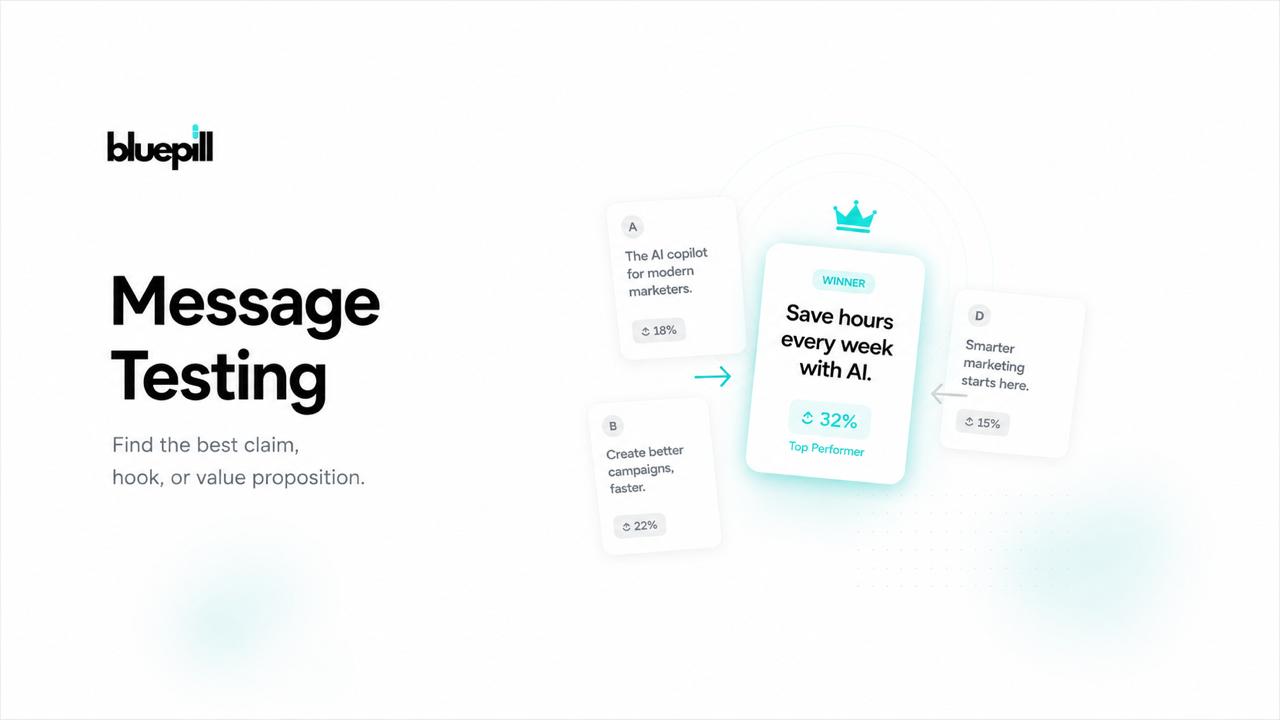
Message testing helps brands find the best claim, hook, or value proposition before launch.
The best message is not always the most creative or internally preferred one.
It is the message consumers understand, care about, believe, remember, and act on.
For consumer brands, message testing can improve packaging, campaigns, landing pages, product pages, claims, and launch strategy.
In the AI era, teams can test messages earlier and faster.
BluePill helps brands ask AI consumers what they think about claims, hooks, value propositions, and purchase barriers before spending on human research, production, or media.
The strongest messages do not only sound good.
They make the buying reason clear, believable, and worth acting on.
Related Blogs
May 29, 2026
Message Testing: How to Find the Best Claim, Hook, or Value Proposition
May 29, 2026
AI Personas: How Brands Use Synthetic Consumers for Faster Research

May 29, 2026
Advertising Market Research: How to Validate Ads Before Launch
May 29, 2026