Learn how AI personas and synthetic consumers help brands test product concepts, packaging, claims, messages, and purchase barriers faster before human validation.
Consumer research is becoming faster.
Brand teams no longer want to wait weeks to understand whether a product idea is clear.
Marketing teams want to know whether a campaign message will connect before media spend.
Innovation teams want to screen more product ideas before choosing what to build.
Packaging teams want to know whether shoppers understand the pack before production.
Insights teams want to support more decisions without slowing the business down.
This is why AI personas are becoming important.
AI personas, also called synthetic consumers, help brands simulate how different types of consumers may respond to product concepts, packaging, claims, messages, pricing, and purchase decisions.
They are not a replacement for every human research study.
But they are very useful when teams need fast, early feedback before spending on full surveys, focus groups, panels, production, or media.
For consumer brands, this can change how research works.
Instead of testing only a few ideas late in the process, teams can test many ideas earlier. They can identify confusion, weak claims, unclear benefits, price concerns, and purchase barriers before the idea becomes expensive to change.
That is where BluePill helps.
BluePill lets brands ask AI personas what they think about products, packaging, claims, campaign messages, pricing, and buying decisions. It helps teams understand likely consumer reactions faster, so they can improve ideas before launch or human validation.
What Are AI Personas?
AI personas are synthetic representations of consumer types.
They are designed to simulate how different consumers may think, react, question, compare, and make purchase decisions.
For example, a brand may want to test reactions from:
Busy parents
Premium skincare buyers
Fitness-focused consumers
Price-sensitive shoppers
Skeptical buyers
Office snackers
Review-led ecommerce shoppers
Functional beverage users
Competitor loyalists
First-time category buyers
Each AI persona can respond to the same product idea differently.
One persona may care about trust.
Another may care about price.
Another may care about proof.
Another may care about convenience.
Another may care about taste.
Another may care about whether the product fits a routine.
This makes AI personas useful for early consumer research.
They help teams understand not only whether an idea sounds good, but which type of consumer may care and why.
What Are Synthetic Consumers?
Synthetic consumers are AI-generated consumer respondents used to simulate feedback.
They can be used to test product ideas, messages, claims, packaging, and buying scenarios before running research with real people.
A synthetic consumer can help answer:
What do you think this product is?
Who do you think it is for?
Which benefit stands out?
Is the claim believable?
What would make you hesitate?
What would you compare this with?
Would you consider buying it?
What price feels reasonable?
What proof would you need?
What would make this more appealing?
The value is speed and flexibility.
Teams can test several ideas quickly, ask follow-up questions, compare audience reactions, and refine the strongest directions before formal validation.
Why Brands Are Using AI Personas
Brands are using AI personas because traditional research can be slow for early-stage decisions.
Human research is still important, especially for final validation. But not every early question needs a full human study.
A brand may need quick feedback on:
Ten product concepts
Six claims
Four packaging directions
Five campaign messages
Three audience segments
Several landing page headlines
Multiple price-value stories
Testing all of this with traditional human research can take time and budget.
AI personas help teams explore more options before narrowing.
This reduces reliance on internal opinion.
Instead of choosing ideas only because the team prefers them, brands can pressure-test how different synthetic consumers may respond.
AI Personas Help Test Product Concepts
One of the strongest use cases for AI personas is concept testing.
Before launch, a product concept needs to be clear, relevant, believable, differentiated, and connected to a real buying occasion.
AI personas can help test:
Do consumers understand the product?
Does the product solve a real problem?
Which audience finds it most relevant?
What benefit stands out?
Does the idea feel different from competitors?
What would stop purchase?
Which concept should move forward?
For example, a CPG brand may have multiple snack ideas.
BluePill can help test those ideas with AI personas representing parents, fitness consumers, office snackers, premium buyers, and price-sensitive shoppers.
The team may learn that parents respond strongly to trust and child acceptance, while fitness consumers care more about protein and satiety.
That insight can help the team choose the strongest concept and audience.
AI Personas Help Test Claims
Claims can strongly influence consumer decisions.
But a claim only works if consumers understand and believe it.
AI personas can help test:
What does this claim mean?
Is it clear?
Is it believable?
Does it need proof?
Does it feel specific or vague?
Does it make the product more interesting?
Could it create skepticism?
This is especially useful for categories like food, beverage, beauty, wellness, healthcare, personal care, and CPG.
For example:
“Supports gut health” may need explanation.
“Clean energy” may need a clearer use case.
“Clinically inspired” may need proof.
“Better-for-you” may feel too generic.
“High protein” may need a specific amount.
BluePill helps teams test claim interpretation before claims are used on packaging, ads, product pages, or retail materials.
AI Personas Help Test Packaging
Packaging is often the first thing shoppers see.
It needs to communicate quickly.
AI personas can help test:
What do shoppers notice first?
Do they understand what the product is?
Which claim stands out?
Does the packaging feel trustworthy?
Does it feel premium, healthy, fun, clinical, or affordable?
Does it support the price?
Would it stand out against competitors?
What feels confusing?
For CPG and retail brands, this can be very useful before production.
A package may look strong internally but fail if consumers do not understand the product or miss the main benefit.
BluePill helps packaging and brand teams test packaging reactions earlier, when design changes are still possible.
AI Personas Help Test Campaign Messages
Marketing teams can use AI personas to test campaign ideas before media spend.
This helps avoid paying to learn basic message problems.
AI personas can evaluate:
Ad hooks
Headlines
Campaign messages
Product claims
Landing page copy
Offer language
Audience fit
Purchase barriers
Competitive comparisons
They can help answer:
What is the main takeaway?
Is the message clear?
Does it feel relevant?
Does it make the product more interesting?
What would stop someone from clicking or buying?
Which audience responds best?
For example, a brand may test three campaign routes:
A functional benefit message
An emotional lifestyle message
A proof-led message
BluePill can help identify which route feels clearest, most believable, and most likely to create action for each audience segment.
AI Personas Help Identify Purchase Barriers
One of the most useful parts of synthetic consumer research is finding objections early.
Positive feedback can feel good, but objections help improve the idea.
AI personas can help reveal barriers like:
The product is unclear.
The claim feels vague.
The price feels high.
The brand lacks trust.
The packaging does not explain enough.
The use case is weak.
The product feels too similar to competitors.
The buyer needs reviews or proof.
The message does not create urgency.
These barriers are useful because they show what needs to change.
If the issue is clarity, simplify the message.
If the issue is trust, add proof.
If the issue is price, improve the value story.
If the issue is weak use case, connect the product to a clearer occasion.
BluePill helps teams identify these issues before launch.
AI Personas Help Compare Segments
Different consumers respond differently to the same idea.
Averages can hide the strongest opportunity.
A product may not appeal to everyone, but it may perform strongly with one high-intent segment.
AI personas help teams compare segment-level reactions.
For example:
Parents may care about safety and child approval.
Fitness consumers may care about protein and performance.
Premium buyers may care about quality and proof.
Price-sensitive shoppers may care about value.
Skeptical buyers may need evidence.
Convenience buyers may need simplicity.
BluePill helps brands understand which segment has the strongest reason to buy and which message may work best for that segment.
AI Personas Help Improve Survey Design
AI personas can also help before human research.
Before launching a human survey, teams can use AI personas to test whether the questions and stimuli are clear.
They can help identify:
Confusing concept language
Leading survey questions
Missing answer options
Weak claims
Unclear pricing context
Likely objections
Segment differences
Questions that need better wording
This makes human research stronger.
Instead of fielding a survey with unclear concepts or weak questions, teams can improve the research design first.
AI Personas Help Prepare Human Research
AI personas are especially useful before human validation.
A good workflow is:
Use AI personas to explore.
Improve the idea.
Use human research to validate.
This helps brands avoid wasting human research budget on weak or unclear ideas.
For example, a brand may use BluePill to test ten concepts, identify the strongest three, refine the claims, and then validate those three with real consumers.
This gives the human study better inputs.
When AI Personas Are Most Useful
AI personas are most useful when teams need fast directional feedback.
Use AI personas when you need to:
Screen product concepts
Compare claims
Test packaging routes
Improve campaign messages
Identify purchase barriers
Explore audience fit
Test landing page copy
Compare use cases
Prepare human research
Understand early price-value reactions
Explore competitive comparisons
They are especially valuable when ideas are still flexible.
The earlier teams use AI personas, the more useful the feedback becomes.
When AI Personas Should Not Replace Human Research
AI personas are useful, but they should not replace every research method.
Use human research when you need:
Final launch validation
Statistical confidence
Real respondent data
Retailer-ready evidence
Product usage feedback
Taste, texture, or fragrance testing
Sensitive human experiences
Regulatory or legal support
Brand tracking
In-market behavior measurement
For example, AI personas can react to a flavor concept, but they cannot taste the product.
They can evaluate whether a skincare claim sounds believable, but real human testing may still be needed for final validation.
They can simulate purchase intent, but actual in-market behavior remains the strongest proof.
AI Personas vs Traditional Personas
Traditional personas are often static profiles.
They may describe a consumer as:
Age
Income
Lifestyle
Motivations
Media habits
Pain points
Shopping behavior
These personas can be useful, but they often sit in a slide deck.
AI personas are more interactive.
Teams can ask them questions.
They can show them a product concept.
They can ask how they interpret a claim.
They can test whether packaging feels clear.
They can compare messages.
They can ask what would stop purchase.
They can explore how different personas respond to different ideas.
This makes AI personas more useful for day-to-day decision-making.
AI Personas vs Human Panels
AI personas and human panels serve different roles.
AI personas are better for speed, exploration, and iteration.
Human panels are better for validation, statistical confidence, and real consumer data.
AI personas help answer:
What should we improve?
Which ideas are worth testing?
What objections may appear?
Which segment may respond best?
Human panels help answer:
Are we confident enough to move forward?
How many real consumers respond this way?
Which option performs best at scale?
The strongest workflow often uses both.
Example: AI Personas for a CPG Brand
Imagine a CPG brand launching a better-for-you snack.
The team can use BluePill to test the product concept with AI personas like:
Busy parents
Fitness consumers
Office snackers
Premium ingredient buyers
Price-sensitive shoppers
Skeptical buyers
The team may learn:
Parents care about whether kids will eat it.
Fitness consumers want clearer protein benefits.
Premium buyers want ingredient proof.
Price-sensitive shoppers question value.
Skeptical buyers need reviews or claims support.
This helps the brand sharpen product positioning, claims, packaging, and launch audience.
Example: AI Personas for a Beauty Brand
A beauty brand may use AI personas to test a new skincare product.
Personas may include:
Sensitive-skin consumers
Ingredient-conscious buyers
Premium skincare users
Minimalist routine users
Skeptical buyers
Anti-aging buyers
The brand can test:
Which claim feels believable
Which packaging route creates trust
Which audience sees the strongest need
What proof is required
What price feels acceptable
What would stop purchase
BluePill can help identify whether the strongest audience is sensitive-skin buyers, premium users, or another segment.
Example: AI Personas for an Ecommerce Brand
An ecommerce or DTC brand may use AI personas to improve conversion.
Personas may include:
First-time visitors
Cart abandoners
Review-led buyers
Discount-driven buyers
Subscription-ready buyers
Premium buyers
Lapsed customers
The brand can test:
Product page clarity
Offer language
Trust signals
Reviews and proof
Price-value perception
Subscription messaging
Cart abandonment objections
This helps teams improve pages and campaigns before driving paid traffic.
How BluePill Helps With AI Personas
BluePill helps brands use AI personas for faster consumer research and decision support.
Teams can use BluePill to test:
Product concepts
New SKUs
Packaging designs
Brand claims
Campaign messages
Ad hooks
Landing page copy
Customer segments
Purchase barriers
Competitive alternatives
Price-value perception
Use cases
Flavor and variant ideas
For insights teams, BluePill reduces research bottlenecks.
For brand teams, it sharpens positioning and claims.
For innovation teams, it helps screen and prioritize ideas.
For marketing teams, it improves campaign messages before media spend.
For ecommerce and DTC teams, it helps identify conversion and repeat purchase barriers.
BluePill is especially useful before human research because it helps teams decide what deserves deeper validation.
A Practical AI Persona Research Workflow
A practical workflow can look like this:
Start with the business decision.
Know whether you are testing a concept, claim, package, message, price, or audience.
Define the consumer groups.
Choose personas that reflect real buyer types, behaviors, and purchase barriers.
Test the stimulus.
Show the product concept, packaging, claim, campaign message, or landing page.
Ask decision-focused questions.
Explore clarity, relevance, believability, purchase intent, price-value fit, and barriers.
Compare persona responses.
Look for which audience responds strongest and why.
Refine the idea.
Improve unclear language, weak claims, missing proof, packaging hierarchy, or message focus.
Validate where needed.
Use human research for final confidence when the decision is high-stakes.
Launch and measure.
Use real behavior, sales, conversion, repeat purchase, and reviews to keep improving.
Common Mistakes With AI Personas
One common mistake is treating AI personas as final proof.
They are best for fast learning, not every final decision.
Another mistake is creating personas that are too generic.
A persona like “young consumer” is less useful than “first-time category buyer who needs proof before switching.”
Another mistake is asking vague questions.
Better questions focus on clarity, relevance, trust, barriers, and purchase behavior.
Another mistake is ignoring human validation.
For major launch decisions, human research still matters.
Another mistake is using AI personas too late.
They are most useful when the product, claim, message, or package can still change.
Final Takeaway
AI personas help brands use synthetic consumers for faster research.
They make it easier to test product concepts, packaging, claims, messages, pricing, audience fit, and purchase barriers before launch.
For consumer brands, AI personas can reduce research bottlenecks, support faster iteration, and help teams make better decisions earlier.
BluePill helps teams bring this workflow into product, brand, marketing, innovation, ecommerce, and insights decisions.
AI personas should not replace every human study.
But they can help teams ask better questions, improve ideas faster, and decide what deserves deeper validation.
The best use of AI personas is not to avoid research.
It is to make research faster, sharper, and more useful before the market makes the decision for you.
Related Blogs
May 29, 2026
Message Testing: How to Find the Best Claim, Hook, or Value Proposition
May 29, 2026
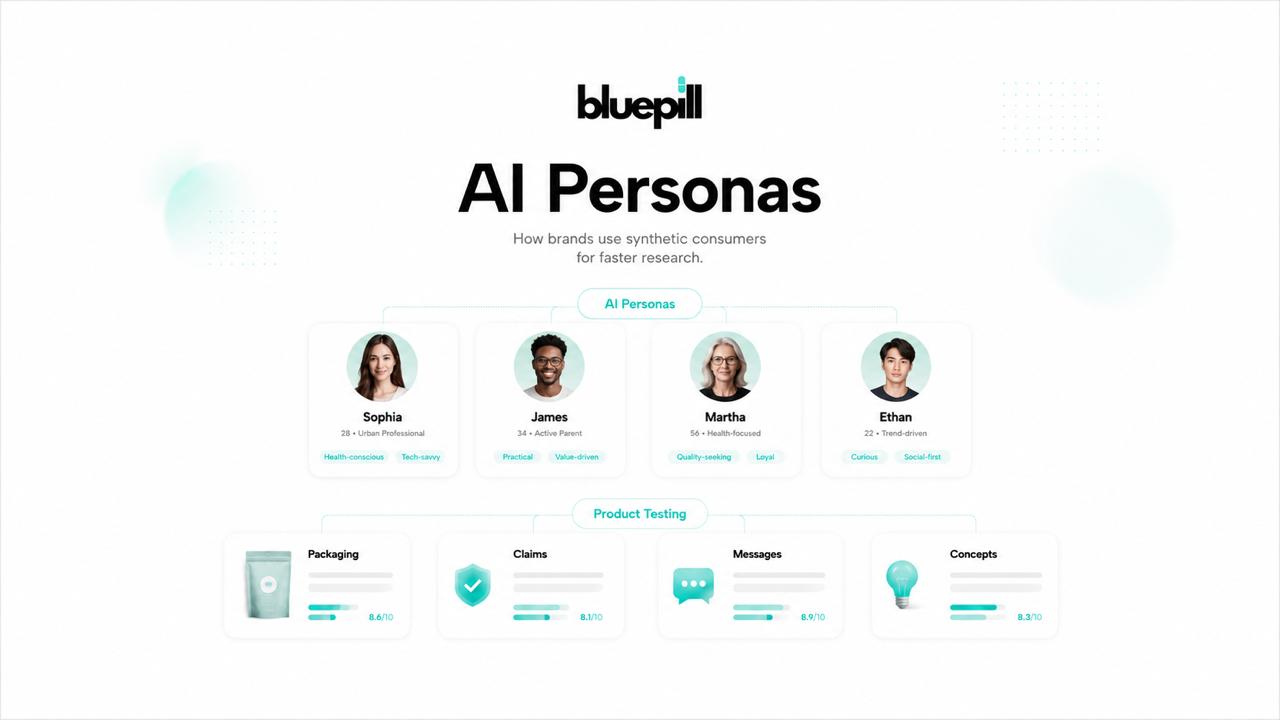
AI Personas: How Brands Use Synthetic Consumers for Faster Research

May 29, 2026
Advertising Market Research: How to Validate Ads Before Launch
May 29, 2026