Competitive market analysis finds positioning gaps where consumer need exists but competitors aren't clearly owning it. Spot the gap, test it, then own it.
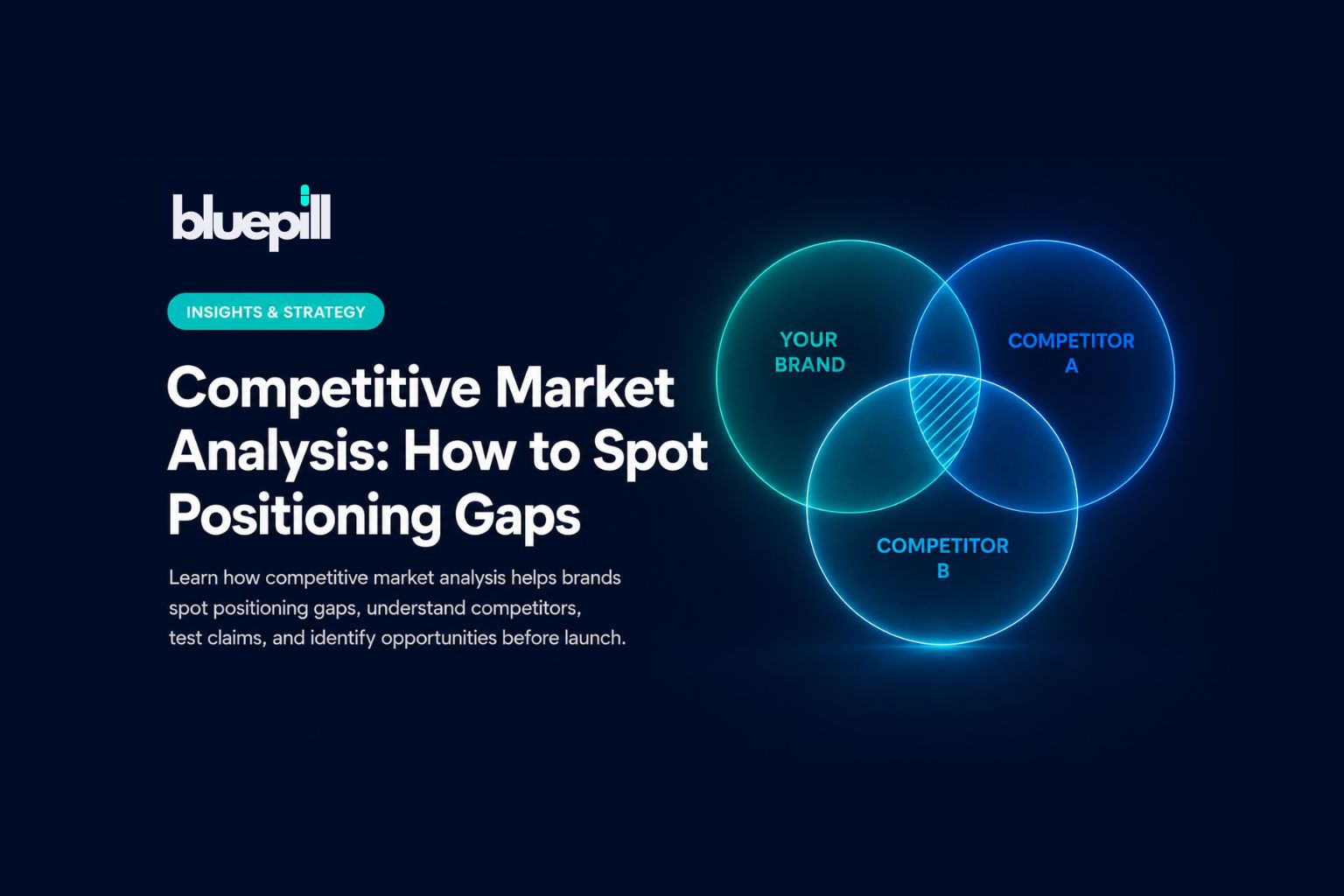
Most markets are crowded; brands making claims, products on the shelf, competitors running ads, messages consumers have already heard. That makes positioning hard. A brand may believe it's different but consumers may see it as similar. A product may have a strong benefit but competitors are already using the same language. A package may look attractive but blend into the category. A claim may sound clear internally but shoppers may not see why it matters.
This is why competitive market analysis matters. It helps brands understand the landscape before making product, packaging, claims, and campaign decisions — what competitors are saying, what they're not saying, where consumers are dissatisfied, and where the brand may have room to own a clearer position. The goal isn't to copy competitors. The goal is to spot positioning gaps; opportunities to stand for something that matters to consumers but isn't being clearly owned by anyone else.
In the AI era, teams can go one step further. They can identify competitive gaps through market analysis, then use AI consumer panels and synthetic personas to test whether those gaps actually matter to buyers. That's where BluePill helps; brands can ask AI consumers what they think about product concepts, packaging, claims, messages, campaigns, and buying decisions, so teams can test whether a positioning gap is clear, believable, relevant, and strong enough to influence purchase before launch.
What Is Competitive Market Analysis?
Competitive market analysis is the process of studying competitors to understand how a brand can compete more effectively. It usually looks at competitor products, pricing, claims, messaging, packaging, audience targeting, channels, customer reviews, brand positioning, strengths and weaknesses, category trends, consumer complaints, and market gaps.
For consumer brands, it should answer practical questions:
• Who are we competing with?
• What do they promise?
• What do consumers believe about them?
• What claims are overused?
• What needs are underserved?
• Where do shoppers feel disappointed?
• Where can we be meaningfully different?
• Which position can we credibly own?
It's not only about knowing the competition; it's about finding where your brand can win.
What Is a Positioning Gap?
A positioning gap is a space in the market where consumer need exists, but competitors aren't clearly or credibly owning that need. For example:
• A snack category may be full of healthy claims, but few brands may strongly own taste.
• A skincare category may be full of science-led claims, but few brands may feel simple and trustworthy.
• A beverage category may talk about energy, but few brands may connect energy to a specific use case like afternoon focus.
• A wellness category may talk about natural ingredients, but few brands may provide enough proof.
• An ecommerce category may offer convenience, but few brands may make the experience feel premium or personal.
A positioning gap doesn't mean there are no competitors. It means there's still room to be more specific, more credible, more relevant, or more memorable.
Why Positioning Gaps Matter
A positioning gap gives a brand a reason to exist. Without a clear gap, the brand sounds like everyone else; consumers don't understand what makes the product different, retailers don't see why the product deserves space, campaigns struggle to create attention, packaging blends into the category, claims feel generic, and price becomes the main comparison.
Strong positioning helps a brand avoid becoming interchangeable. It gives consumers a clearer reason to choose:
• "Healthy snack" is broad. "Healthy snack that kids actually want to eat" is more specific.
• "Premium skincare" is broad. "Barrier repair for sensitive skin without a complicated routine" is more specific.
• "Functional drink" is broad. "Clean afternoon energy without the sugar crash" is more specific.
The sharper the positioning, the easier it becomes to build product, packaging, claims, and campaigns around it.
Start With the Category Map
The first step is to map the category. List the main competitors and organize them by how they position themselves; what benefit they lead with, what claims they use, what audience they speak to, what price tier they occupy, what packaging cues they use, what emotional territory they own, what proof they provide, and what channels they dominate.
In a better-for-you snack category, for example, competitors may cluster around high protein, low sugar, clean ingredients, indulgent taste, kids and family, fitness and performance, premium ingredients, and value and affordability. Once you map the category, you can start to see where it's crowded and where there may be open space.
Study Competitor Messaging
Competitor messaging reveals what brands believe consumers care about. Look at websites, product pages, ads, packaging, Amazon listings, retail descriptions, emails, social content, and landing pages; paying attention to headlines, claims, taglines, benefit language, proof points, product descriptions, customer promises, calls to action, repeated phrases, and emotional language.
Ask: What are competitors saying most often? Which claims are repeated across the category? Which messages feel generic? Which feel specific? Which brands sound similar? Which has the clearest promise? What's missing from the conversation?
If every brand says "clean," "better-for-you," "premium," "natural," or "science-backed," those words may no longer be enough. A positioning gap may exist in making the promise more specific or more emotionally meaningful.
Study Competitor Claims
Claims are one of the clearest ways to understand category positioning. For consumer brands, common claims include high protein, low sugar, clinically tested, clean ingredients, dermatologist recommended, sustainable packaging, no artificial flavors, gut health support, long-lasting energy, premium quality, family safe, fast acting, plant-based, and science-backed.
The goal isn't just to list claims. It's to understand which are crowded, which are credible, and which may still have room for differentiation:
• Which claims are most common?
• Which are most specific?
• Which have proof?
• Which feel vague?
• Which may consumers doubt?
• Which are competitors not using?
• Which connect to a real buying need?
Study Packaging Cues
Packaging shows how competitors want to be perceived; premium, natural, clinical, fun, family-friendly, scientific, affordable, minimal, bold, traditional, healthy, indulgent, sustainable, effective. Look at the visual language across the category:
• Do most packages look similar?
• Are competitors using the same colors?
• Are claims placed in the same way?
• Does the category feel cluttered or minimal?
• Which products stand out? Which look trustworthy?
• Which look confusing? Which look premium but hard to understand?
Packaging gaps are powerful. If all products in a category look clinical, there may be room for a warmer, more human brand. If all look playful, there may be room for a trusted and premium design. If all use the same health cues, there may be room for stronger taste appeal. AI consumer panels help test whether a packaging direction feels meaningfully different or just different for the sake of it.
Study Customer Reviews
Customer reviews are one of the best sources for positioning gaps. Competitor messaging shows what brands promise. Reviews show what customers actually experience.
Look for repeated patterns: what customers praise, what they complain about, what they wish was better, what disappointed them, what made them repeat, what made them switch, what words they use, what problems remain unsolved.
• If many reviews praise health benefits but complain about taste, taste may be a positioning opportunity.
• If reviews praise results but complain about irritation, gentleness may be a gap.
• If reviews praise price but complain about quality, premium reliability may be a gap.
• If reviews praise convenience but complain about trust, credibility may be a gap.
The strongest positioning gaps often sit inside repeated customer frustration.
Study the Audience Each Competitor Serves
A positioning gap may exist in the audience, not the benefit. Competitors may all be speaking to the same broad group while ignoring a more specific segment:
• Who is each competitor clearly targeting?
• Beginners or experts?
• Premium buyers or value buyers?
• Parents or individuals?
• Fitness consumers or casual users?
• Younger or older consumers?
• Health-focused buyers or taste-led buyers?
• Sensitive-skin users or beauty enthusiasts?
Sometimes the best opportunity isn't a new benefit but a clearer audience. A skincare brand may not need to own all of "hydration"; it may own hydration for sensitive skin. A snack brand may not need to own all of "healthy snacking"; it may own healthy snacking for busy parents.
Study Price and Value Positioning
Pricing is part of positioning. A brand's price tells consumers something about quality, accessibility, premium value, or everyday use. Competitive analysis should include price points, pack sizes, bundles, subscriptions, discounting, premium tiers, value tiers, trial formats, retail pricing, and promotional strategy.
Ask: Where does the market feel premium? Where does it feel value-driven? Are there price gaps? Are premium products justifying their price clearly? Are value products sacrificing trust? Is there room for affordable premium, or for a specialist premium product?
A positioning gap may exist when consumers want better quality but can't justify current premium options, or when they want trust and proof but premium brands feel too expensive.
Look for Overcrowded Positions
A positioning gap often becomes visible when you identify overcrowded positions. If every brand in a category says "natural," natural isn't a strong differentiator by itself. If every brand says "science-backed," consumers may start to question what that really means. If every brand uses minimalist packaging, minimalism doesn't stand out anymore. If every brand speaks to Gen Z, another high-value audience may be underserved.
The goal isn't to avoid popular benefits, sometimes popular benefits matter because consumers care about them. The goal is to find a more specific way to own the benefit.
Look for Underserved Needs
After identifying crowded areas, look for needs that aren't being addressed well. These appear in customer complaints, search behavior, social conversations, review patterns, retailer feedback, sales objections, category forums, customer support themes, and competitor weaknesses.
• What do consumers keep asking for?
• What are they frustrated by?
• What do competitors under-explain?
• What do competitors overpromise?
• Where is trust missing? Clarity missing? Convenience missing? Emotional relevance missing?
An underserved need becomes valuable only if it matters enough to influence purchase. That's why the gap should be tested.
Test Whether the Gap Matters
Not every gap is worth owning. Sometimes a gap exists because consumers don't care about it. If no competitor is talking about a specific feature, it may be an opportunity; or it may simply mean the feature doesn't matter to buyers.
• Do consumers care about this gap?
• Does it solve a real problem?
• Is it easy to understand?
• Is it believable?
• Does it make the product more relevant?
• Does it increase purchase intent?
• Which audience cares most?
• What proof is needed?
This is where AI consumer testing earns its place; pressure-testing gap hypotheses with synthetic personas before committing to a positioning strategy.
Test Whether Your Brand Can Own the Gap
A positioning gap is only useful if your brand can credibly own it:
• Do we have the product truth to support this position?
• Can we prove the claim?
• Does our packaging support the position?
• Does our price make sense?
• Does our brand have permission to say this?
• Can we deliver consistently?
• Will consumers believe us?
A brand can't credibly own "clinical efficacy" without proof. It can't own "premium quality" if the packaging and product experience feel basic. It can't own "affordable everyday use" if the price is too high. A strong positioning gap connects market opportunity, consumer need, and brand credibility.
Example: Spotting a Gap in Better-for-You Snacks
A brand entering the better-for-you snack category runs competitive analysis. Most competitors talk about high protein, low sugar, clean ingredients, plant-based, no artificial flavors, and "better-for-you snacking." Customer reviews show a repeated complaint: many healthy snacks don't taste good enough.
The positioning gap: a better-for-you snack that doesn't feel like a compromise on taste. But the team should test it. Do consumers care enough about taste to override health considerations? Does the product deliver? Does the claim feel believable? Does the packaging communicate both taste and health? Which audience responds best? AI consumer panels test these versions of the positioning before launch.
Example: Spotting a Gap in Skincare
A skincare brand studying barrier repair products finds competitors using ceramides, clinical claims, dermatologist language, hydration benefits, science-backed positioning, and minimalist packaging. Reviews show consumers are confused by technical language and worried about irritation.
The gap: barrier repair skincare for sensitive skin, explained simply and backed by proof. This combines a product benefit, audience, emotional need, and proof requirement. The next step is testing whether consumers understand the positioning, believe it, and see it as different from existing options.
Example: Spotting a Gap in Functional Beverages
A beverage brand exploring functional drinks finds competitors talking about energy, hydration, focus, vitamins, natural caffeine, low sugar, adaptogens, and clean ingredients. But customer reviews and social comments suggest consumers are overwhelmed by functional claims and want a clearer use case.
The gap: a clean afternoon focus drink for workdays, without the sugar crash. More specific than "functional beverage," and it connects product, moment, benefit, and consumer need. Test for clarity, relevance, and purchase intent before committing.
How to Turn a Positioning Gap Into Strategy
Once a gap is identified and tested, it should influence the full brand strategy; product concept, audience focus, benefit hierarchy, packaging design, claims, proof points, campaign message, retail pitch, landing-page copy, pricing story, and content strategy.
A positioning gap isn't just a tagline. It should guide how the brand shows up across every consumer touchpoint. If the gap is "healthy snack that kids actually want to eat," the brand should support that idea through product flavor, packaging, parent-focused claims, child acceptance proof, retail messaging, and campaign creative. If the gap is only used in one campaign line, it won't be strong enough.
Common Competitive Analysis Mistakes
• Copying the market leader. Market leaders may win on scale, distribution, trust, or history. Copying their message makes a smaller brand look weaker.
• Focusing only on product features. Positioning gaps often come from emotions, trust, occasions, audience focus, or proof not only features.
• Ignoring customer reviews. Reviews reveal where competitor promises aren't fully working.
• Choosing a gap that consumers don't care about. A gap must be tested for relevance and purchase impact.
• Choosing a position the brand can't credibly own. Positioning must match product truth and brand capability.
How BluePill Helps With Competitive Market Analysis
BluePill moves teams from competitive analysis to consumer validation. After identifying possible positioning gaps, teams can test how AI consumers respond; to product concepts, positioning statements, packaging routes, brand claims, campaign messages, audience segments, purchase barriers, competitive comparisons, proof points, and price-value perception.
This answers the questions that matter: Is the positioning gap clear? Does it matter to consumers? Is it believable? Which segment responds best? Does it increase purchase intent? What objections appear? What proof is needed? How does it compare with competitors?
For brand teams, this sharpens positioning. For innovation teams, it prioritizes product ideas. For marketing teams, it improves campaign strategy. For insights teams, it reduces uncertainty before deeper validation.
When to Validate With Human Research
AI consumer testing is useful for early positioning work, but human research still matters for high-stakes decisions. Use human research when you need:
• Final positioning validation
• Statistical confidence
• Retailer-ready evidence
• Real product usage feedback
• Large-scale segmentation
• In-market measurement
• Campaign effectiveness measurement
The best workflow is usually AI first, then human validation; test and refine possible positioning gaps early with AI, validate the strongest direction with human research when stakes warrant it.
A Practical Competitive Market Analysis Workflow
A strong workflow:
• Map the category : list competitors, claims, pricing, packaging, and audiences.
• Identify crowded positions : find where brands sound similar.
• Study customer reviews : look for repeated complaints, unmet needs, and trust gaps.
• Identify possible gaps : write clear positioning hypotheses.
• Test the gaps : use AI consumer panels to see whether the gap is relevant, believable, and motivating.
• Refine the positioning : adjust the claim, audience, proof, or message.
• Validate where needed : use human research for final confidence.
• Apply across the brand : use the positioning to guide product, packaging, claims, campaigns, and retail strategy.
Final Takeaway
Competitive market analysis helps brands understand the market — but its real value comes from spotting positioning gaps: meaningful spaces where consumer need exists and competitors aren't clearly or credibly owning it.
For consumer brands, these gaps shape product strategy, packaging, claims, messaging, pricing, audience focus, and campaigns. But not every gap is worth pursuing. The gap must matter to consumers, be easy to understand, feel believable, and fit what the brand can credibly deliver.
The strongest brands don't only study competitors to see what others are doing. They study competitors to find what consumers still need; then test whether they can own that space better.
Frequently Asked Questions
What is competitive market analysis?
Competitive market analysis is the process of studying competitors; their products, pricing, claims, messaging, packaging, audiences, channels, and customer reviews; to understand how a brand can compete more effectively. Its real value isn't knowing what competitors do; it's spotting where they're not clearly meeting consumer needs.
What is a positioning gap?
A positioning gap is a space in the market where consumer need exists, but competitors aren't clearly or credibly owning that need. It doesn't mean there are no competitors; it means there's room for a brand to be more specific, more credible, more relevant, or more memorable than the alternatives.
How do you find a positioning gap in a competitive market?
Map the category, study competitor messaging, claims, and packaging, read customer reviews carefully (they reveal where promises aren't being met), study which audiences are over- or under-served, and identify crowded positions where every brand sounds similar. The gap usually shows up at the intersection of a repeated consumer frustration and an area where competitors aren't being specific enough.
How do you know if a positioning gap is worth pursuing?
Not every gap is worth owning. A gap is worth pursuing only when consumers actually care about it (test it), the brand can credibly own it (product truth, proof, packaging, and price all support the claim), and the claim translates into purchase intent; not just interest. Test the gap with AI consumer panels before building an entire strategy around it.
How does AI consumer testing fit into competitive market analysis?
AI consumer panels accelerate the test phase; once a positioning gap is identified through competitive analysis, AI consumers can react to the proposed claims, packaging, and messages quickly, across multiple segments, before any human research budget is committed. The strongest workflow is: analyze competitors, identify possible gaps, test with AI, refine, validate the survivors with human research.
Related Blogs
May 29, 2026
Message Testing: How to Find the Best Claim, Hook, or Value Proposition
May 29, 2026
AI Personas: How Brands Use Synthetic Consumers for Faster Research

May 29, 2026
Advertising Market Research: How to Validate Ads Before Launch
May 29, 2026