The best concept testing questions go beyond preference; they test clarity, relevance, believability, price, and what would stop the consumer from buying.
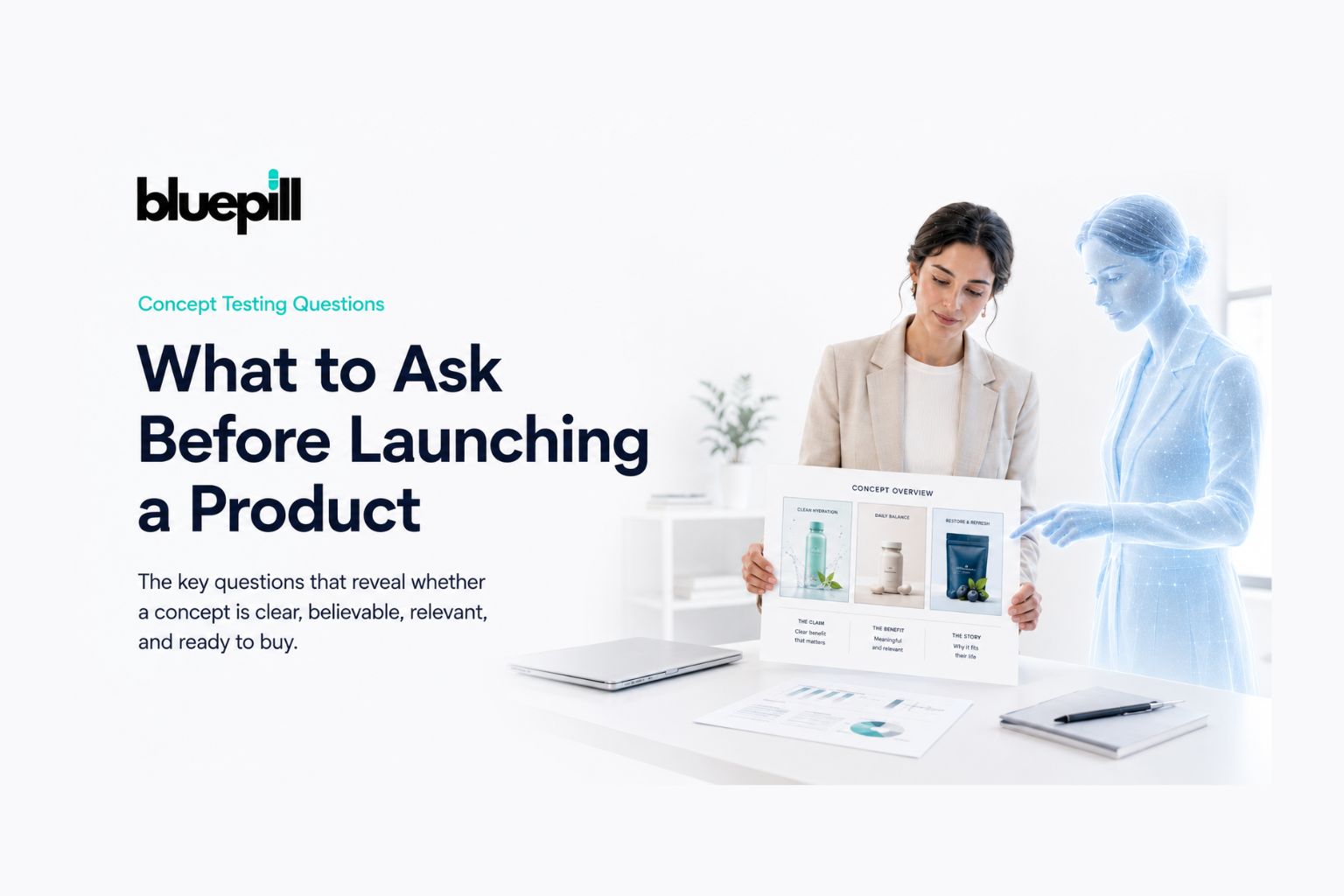
A product idea can sound strong inside a meeting room — the team likes it, the founder believes in it, the brand team thinks the positioning is clear, the product team thinks the benefit is obvious, sales thinks the market is ready. But consumers don't see the product through the same lens. They see it quickly, compare it with what they already buy, question the claim, notice the price, judge the package, and decide whether the product fits their life.
That's why concept testing matters before launching a product. Concept testing tells you whether an idea is clear, relevant, believable, different, and likely to drive purchase before the brand invests in production, packaging, inventory, retail, or media. But the quality of concept testing depends on the quality of the questions. If you only ask "do you like this idea?" you'll get polite but weak feedback.
A better concept test asks deeper questions. Does the consumer understand the product? Does the benefit matter? Does the claim feel believable? Does the product solve a real problem? Would they switch from what they already buy? What would stop them from buying? Which audience is most likely to care?
In the AI era, teams can test these questions faster using AI consumer panels and synthetic personas before running full human validation. That's where BluePill helps — brands can ask AI consumers what they think about product concepts, claims, packaging, messages, and purchase decisions, so teams test more ideas earlier, identify weak points, and improve concepts before launch.
Why Concept Testing Questions Matter
A concept test is only useful if it helps the team make a better decision. Many tests fail because they ask broad or shallow questions.
Consumers may say an idea is interesting, but that doesn't mean they'll buy it. They may like the product but reject the price. Understand the benefit but not believe the claim. Think it's useful but not urgent. Say they'd try it once but not repeat. Like the packaging but misunderstand the product.
Good concept testing questions separate interest from demand. They reveal what's working, what's unclear, what feels weak, and what needs to change before launch — reducing launch risk and improving product, packaging, claims, and messaging decisions.
Start With the Decision You Need to Make
Before writing concept testing questions, start with the business decision:
• Are you deciding whether to launch?
• Choosing between multiple concepts?
• Testing a new SKU?
• Comparing claims?
• Deciding which audience to target?
• Testing price-value fit?
• Trying to improve the concept before validation?
The questions should match the decision. If the decision is whether the product is ready to launch, focus on clarity, relevance, purchase intent, barriers, price, and competitive alternatives. If the decision is which concept to prioritize, compare concepts on the same criteria. If the decision is how to improve the idea, include open-ended questions about confusion, objections, and missing information.
What Do You Think This Product Is?
Before asking whether consumers like the product, check whether they understand it:
• What do you think this product is?
• How would you describe it in your own words?
• What category do you think it belongs to?
• Who do you think this product is for?
If consumers can't explain the product simply, the concept needs work. Teams are often too close to the idea — they assume the benefit is obvious because they've discussed it for weeks. But a consumer seeing it for the first time may feel confused. AI consumer panels surface clarity issues early by showing how different personas interpret the concept in their own words.
What Problem Does This Product Solve?
A product needs to solve a real problem or satisfy a clear desire:
• What problem do you think this product solves?
• Is this a problem you experience?
• How often do you experience it?
• How important is this problem to you?
• What do you currently do to solve it?
A concept can sound interesting and still fail if the problem isn't urgent, frequent, or important. A new breakfast product may be appealing, but if consumers don't see when they'd use it, demand stays weak. A skincare concept may sound advanced, but if consumers don't recognize the problem, the brand may need clearer education.
How Relevant Is This Product to You?
Relevance is different from appeal. A consumer may think a product is a good idea for someone else but not for them:
• How relevant does this product feel to your life?
• When would you use it?
• How often?
• What situation would make you consider buying it?
• Who do you think would benefit most?
A concept that feels moderately relevant to everyone is usually less valuable than one that feels highly relevant to a specific segment. Comparing relevance across personas reveals which audience is most likely to buy.
What Benefit Stands Out Most?
Consumers usually remember one or two things from a product concept. The brand may include many benefits; the consumer notices only one:
• What benefit stands out most?
• What's the main reason someone would buy this?
• Which part of the concept feels most valuable?
• Which benefit feels least important?
• Is anything missing from the benefit explanation?
If consumers notice a secondary benefit instead of the main one, the messaging needs to change. If no benefit stands out clearly, the concept may be trying to say too much.
Is the Claim Believable?
Claims are powerful, but only if consumers believe them. A claim can be clear and still fail because it feels exaggerated, vague, or unsupported:
• How believable is this claim?
• What makes it believable or unbelievable?
• What proof would you need?
• Does it sound specific or generic?
• Does it make you more interested in the product?
Especially important for CPG, food, beverage, beauty, wellness, healthcare, and personal care. Claims like "supports gut health," "clinically inspired," "clean energy," "high performance," or "better-for-you" often need proof to feel credible.
What Feels Different About This Product?
Differentiation matters because consumers already have alternatives. A product must give people a reason to notice, care, and possibly switch:
• What feels different about this product?
• Does it feel new or familiar?
• How is it different from what you currently buy?
• Does the difference matter to you?
• What would make it feel more distinctive?
A concept may be liked but still feel too similar to existing options — that makes launch harder. If consumers can't explain what makes the product different, the team needs sharper positioning, stronger claims, clearer packaging, or a more specific audience.
What Would You Compare This With?
Consumers don't judge products in isolation. They compare them with what they already know:
• What products or brands does this remind you of?
• What would you compare this with?
• What do you currently buy instead?
• Would this replace something you already use?
• What would make you choose this over your current option?
This reveals the real competitive set. Sometimes brands think they compete with one category but consumers compare them with something else. A protein coffee may compete with coffee, protein shakes, breakfast drinks, and energy drinks at the same time. Understanding the comparison improves positioning and pricing.
How Likely Are You to Buy This?
Purchase intent is important — but use it carefully:
• How likely would you be to buy this product?
• How likely to try it once?
• How likely to buy it repeatedly?
• How soon would you consider buying it?
• Where would you expect to buy it?
The difference between trial and repeat is important. Some products create curiosity but not repeat demand. Others have narrower appeal but stronger loyalty. Don't treat purchase intent as the only success metric — combine it with relevance, believability, value, barriers, and competitive comparison.
What Would Stop You From Buying?
This may be the most useful question in the entire concept test. Positive feedback feels good; objections help improve the product:
• What would stop you from buying this?
• What feels unclear?
• What feels risky?
• What do you not believe?
• What information would you need before buying?
• What concern would you have?
Common barriers: price, trust, unclear benefit, weak differentiation, poor use case, unfamiliar ingredients, packaging confusion, or loyalty to existing brands. AI consumer panels surface these objections early — useful for stress-testing concepts before human validation.
What Price Would Feel Reasonable?
Price can change the entire meaning of a product. A concept may feel attractive at one price and unrealistic at another:
• What price would you expect for this product?
• What price would feel reasonable?
• What price would feel expensive but still possible?
• What price would feel too expensive?
• What would justify a premium price?
If the price feels too high, the issue isn't always the price itself. The concept may need stronger proof, better packaging, clearer benefits, or a more premium audience.
Which Version Would You Choose?
If you're testing multiple concepts, ask consumers to make a choice:
• Which concept would you choose, and why?
• Which feels most relevant?
• Which feels most believable?
• Which feels most different?
• Which would you be most likely to buy?
• Which should the brand not launch?
Choice questions create tradeoffs. Consumers may rate multiple ideas positively, but when forced to choose, the stronger concept becomes clearer.
Who Is This Product Best For?
Sometimes consumers can help clarify the audience:
• Who do you think this product is best for?
• Who would be most excited about it?
• Who would not care about it?
• Would you recommend it to someone?
• What kind of person would buy this regularly?
If the team thinks the product is for premium buyers but consumers think it's for budget shoppers, positioning needs work. If consumers identify an unexpected audience, that may reveal a new opportunity.
What Would Make This Product Better?
This question turns concept testing from scoring into a development tool:
• What would make this more appealing?
• What would make it easier to understand?
• What would make you trust it more?
• What would make you more likely to buy?
• What should be added, removed, or changed?
The goal isn't only to approve or reject the concept. It's to make it stronger.
What Is Your Final Reaction?
At the end of the test, ask for a summary reaction:
• What is your overall impression?
• What is the strongest part of the concept?
• What is the weakest part?
• Would you recommend moving forward with this idea?
• What is the one thing the brand should fix before launch?
This captures the consumer's final judgment after thinking through product, benefit, price, and barriers.
How to Structure a Concept Test
A good concept test follows a clear order:
• Show the concept. Keep it simple and realistic — product idea, target use case, main benefit, reason to believe, and price if relevant.
• Test understanding. Before asking for ratings, ask what consumers think the product is and what problem it solves.
• Test relevance and appeal. Whether it feels useful, desirable, and relevant to their life.
• Test believability and differentiation. Whether the claim is trusted and the idea feels different enough.
• Test purchase intent and value. Whether they'd try it, buy it, repeat it, and accept the price.
• Test barriers. What would stop them from buying.
• Compare alternatives. What they currently use, and whether they'd switch.
• Collect improvement feedback. What would make the concept stronger.
This sequence shows the full decision path, not just surface-level interest.
How BluePill Helps With Concept Testing Questions
BluePill tests product concepts faster using AI consumers. Before a full human study, teams can ask concept testing questions across different AI personas and segments — understanding whether the product is clear, which benefit stands out, which claim feels believable, which audience is most likely to buy, what objections may appear, which version performs better, what price concerns may exist, and what needs to change before validation.
For brand teams, it improves positioning. For innovation teams, it screens product ideas. For insights teams, it reduces research bottlenecks. For marketing teams, it sharpens messaging before launch. The goal isn't to replace every human test — it's to make every human test sharper by improving concepts earlier.
When to Use Human Validation
AI concept testing is useful for early screening, but human validation still matters. Use human research when you need:
• Final launch validation
• Statistical confidence
• Real product usage feedback
• Taste, texture, fragrance, or sensory testing
• Retailer-ready evidence
• Regulatory or legal support
• In-market purchase behavior
The best workflow is usually AI first, then human validation. Use AI to test many ideas quickly, improve weak concepts, and choose the strongest options. Then validate the strongest concepts with real consumers when needed.
Common Concept Testing Mistakes
• Testing too late. If the product, package, and message are locked, research only confirms problems you can't easily fix.
• Asking only whether consumers like the idea. Liking isn't buying.
• Not showing price. Without price, purchase intent gets inflated.
• Ignoring competition. Consumers already have alternatives.
• Relying only on average scores. A concept may perform strongly with one segment and weakly with another — that can still be a good opportunity if the strong segment is commercially valuable.
• Not asking what would stop purchase. Barriers often reveal the most useful insight.
Final Takeaway
Concept testing questions should help brands understand whether a product idea is ready for launch. The best questions go beyond preference — they test clarity, relevance, benefit strength, believability, differentiation, competitive comparison, purchase intent, price-value fit, barriers, and improvement opportunities.
In the AI era, teams can test these questions earlier and faster. The best concept testing doesn't only ask "do people like this?" It asks: "do people understand it, believe it, need it, value it, and have a reason to buy?"
Frequently Asked Questions
What is concept testing?
Concept testing evaluates a product idea — clarity, relevance, believability, differentiation, purchase intent, and barriers — before the brand commits to production, packaging, retail, or media. It tells the team whether the concept is ready to launch and what to improve if it isn't.
What are the most important concept testing questions to ask before launch?
Beyond "do you like this idea?", the strongest questions cover: What do you think this product is? What problem does it solve? Is the claim believable? What feels different? What would you compare this with? How likely would you be to buy? What would stop you from buying? What price would feel reasonable? What would make this product better?
Should you ask about purchase intent in a concept test?
Yes, but never in isolation. People overstate purchase intent because saying yes costs them nothing. Pair purchase intent with relevance, differentiation, believability, expected price, barriers, and competitive alternatives. Combined, these reveal what's driving or blocking intent — not just the score.
Can AI replace human concept testing?
No. AI concept testing accelerates early screening and refinement — teams compare many concepts, surface objections, and improve weak ideas faster than human research allows. Human validation still matters for final launch decisions, statistical confidence, sensory testing, and retailer-ready evidence. The strongest workflow is AI first, then human validation for the survivors.
What are common concept testing mistakes to avoid?
Testing too late (after the concept is locked), asking only whether consumers like the idea, not showing price, ignoring competitive alternatives, relying on average scores instead of segment-level reactions, and skipping the most useful question — "what would stop you from buying?"
Related Blogs
May 29, 2026
Message Testing: How to Find the Best Claim, Hook, or Value Proposition
May 29, 2026
AI Personas: How Brands Use Synthetic Consumers for Faster Research

May 29, 2026
Advertising Market Research: How to Validate Ads Before Launch
May 29, 2026