Learn how consumer analytics helps brands predict demand, understand purchase behavior, identify buyer signals, and improve product, packaging, pricing, and campaign decisions.
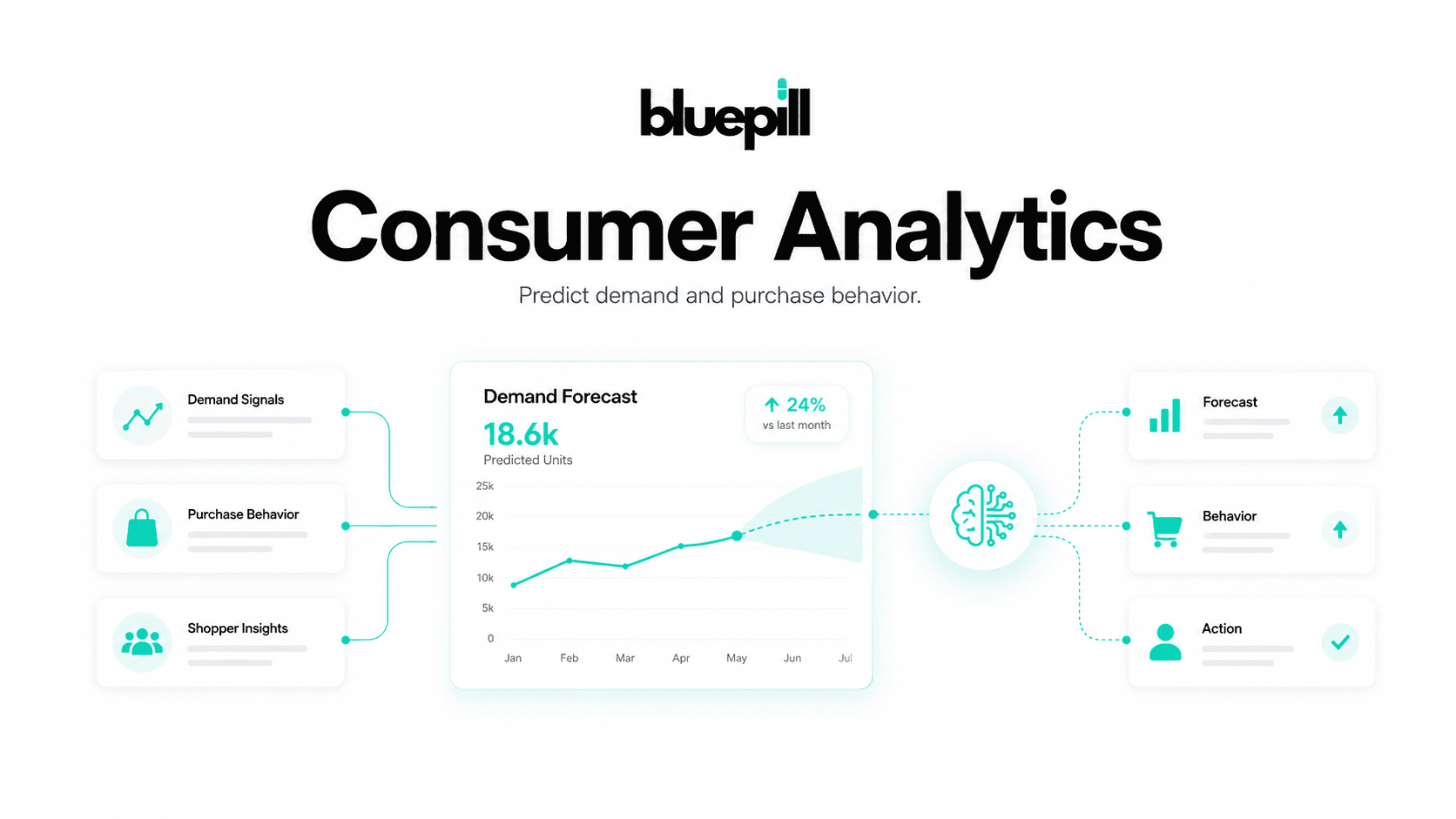
Every brand wants to know what consumers will do next.
Will they buy this product?
Will they choose this package?
Will they believe this claim?
Will they respond to this campaign?
Will they pay this price?
Will they buy again?
Will they switch from a competitor?
These questions sit behind almost every product, marketing, and growth decision.
Consumer analytics helps brands answer them by studying consumer behavior, purchase signals, customer data, and market patterns.
For consumer brands, this is valuable because demand is not created by opinions alone. Demand shows up in behavior.
What people search for.
What they click.
What they add to cart.
What they compare.
What they buy.
What they repeat.
What they abandon.
What they review.
What they recommend.
Consumer analytics helps brands turn these signals into a better understanding of demand and purchase behavior.
But analytics alone is not always enough.
Data can show what happened, but it may not always explain why it happened. It may show that consumers are not buying, but not whether the issue is price, trust, packaging, message clarity, claim believability, or weak product relevance.
That is where consumer insights and AI-powered testing become important.
In the AI era, brands can combine analytics with AI consumer panels, synthetic personas, and behavioral simulations to understand not only what consumers are doing, but why they may act a certain way before launch.
That is where BluePill helps.
BluePill lets brands ask AI consumers what they think about product concepts, packaging, claims, messages, campaigns, pricing, and purchase decisions. It helps teams use consumer analytics more intelligently by turning behavioral signals into testable hypotheses and better decisions.
What Is Consumer Analytics?
Consumer analytics is the process of collecting and analyzing consumer data to understand behavior, predict demand, and improve business decisions.
It can include data from:
Website visits
Search behavior
Product page views
Add-to-cart actions
Purchases
Repeat purchases
Subscription activity
Customer reviews
Campaign performance
Email engagement
Social engagement
Retail sales
Loyalty programs
Customer support
Surveys
Market research
CRM data
For consumer brands, consumer analytics helps answer:
Who is buying?
Why might they be buying?
Which products are gaining demand?
Which audiences convert better?
Which channels drive valuable customers?
Which messages create action?
Which products repeat?
Where do consumers drop off?
Which signals predict purchase?
The goal is not only to look at dashboards.
The goal is to understand consumer behavior well enough to make better decisions.
Consumer Analytics vs Consumer Insights
Consumer analytics and consumer insights are connected, but they are not the same.
Consumer analytics looks at behavioral data.
It tells you what consumers are doing.
Consumer insights explain the meaning behind that behavior.
They help you understand why consumers may be doing it.
For example, analytics may show that a product page has high traffic but low conversion.
Consumer insights may reveal that the product benefit is unclear, the claim is not believable, the price feels high, or the page does not answer key objections.
Analytics may show that one product has high repeat purchase.
Insights may reveal that the product fits a recurring routine and solves a specific problem better than alternatives.
The strongest brands use both.
Analytics finds the signal.
Insights explain the signal.
AI-powered research helps test what to do next.
Why Consumer Analytics Matters for Demand Prediction
Demand prediction is not only about forecasting sales.
It is about understanding the signals that show whether consumers are likely to buy.
Consumer analytics helps brands identify these signals earlier.
For example:
Search volume may show growing interest in a category.
Product page visits may show curiosity.
Add-to-cart behavior may show intent.
Repeat purchase may show product-market fit.
Reviews may show satisfaction or disappointment.
Campaign clicks may show message relevance.
Conversion rates may show whether demand is turning into sales.
When these signals are studied together, brands can better understand whether demand is real, where it is strongest, and what may be blocking it.
This is especially useful before scaling a launch, increasing media spend, entering a new channel, or expanding a product line.
Demand Is More Than Awareness
Many brands mistake awareness for demand.
People may know the brand but not buy.
They may recognize the product but not trust it.
They may click an ad but not convert.
They may say they like the idea but reject the price.
They may add to cart but abandon before checkout.
True demand is stronger than attention.
Demand means the consumer has a real reason to act.
A brand should look for signals like:
Clear product understanding
Strong use case
High purchase intent
Willingness to pay
Trust in the claim
Low purchase barriers
Competitive preference
Repeat purchase potential
Positive reviews
Strong conversion from relevant audiences
Consumer analytics helps identify which signals are present and which are missing.
Key Consumer Analytics Signals Brands Should Track
Consumer analytics can become overwhelming if teams track everything.
The most useful approach is to focus on signals that connect to buying behavior.
Search Demand
Search demand shows what consumers are actively looking for.
This can include searches around categories, problems, products, ingredients, claims, competitors, and use cases.
For example:
Best protein snacks
Low sugar cereal
Barrier repair cream
Clean energy drink
Healthy lunchbox snacks
Sensitive skin moisturizer
Functional beverage for focus
Search demand is useful because it often reflects active intent.
But search demand does not prove that a specific product will win.
It tells the brand there may be interest. The brand still needs to test whether its concept, claim, package, and price are strong enough.
BluePill can help teams test product ideas and messages that are inspired by search demand before launch.
Website Behavior
Website behavior shows how consumers interact with a brand online.
Important signals include:
Page views
Time on page
Scroll depth
Product page visits
Add-to-cart rate
Checkout start rate
Cart abandonment
Conversion rate
Repeat visits
Landing page performance
These signals help brands understand where consumer interest turns into action or friction.
For example, if many visitors reach a product page but few add to cart, the issue may be product clarity, weak claims, price, missing reviews, or low trust.
Analytics shows the drop-off.
Consumer research helps explain why.
BluePill can help test the page messaging with AI consumers to identify what feels unclear or unconvincing.
Campaign Engagement
Campaign data shows how consumers respond to marketing messages.
Important signals include:
Click-through rate
Engagement rate
Video completion
Cost per click
Conversion rate
Cost per acquisition
Landing page conversion
Audience-level performance
Message-level performance
Campaign analytics helps teams see which messages get attention and which audiences respond.
But attention is not always the same as demand.
An ad may get clicks because it is interesting, but fail to convert because the product is unclear or the claim lacks proof.
BluePill helps teams test campaign messages before media spend, so teams can improve clarity, relevance, and believability before launch.
Add-to-Cart and Checkout Behavior
Add-to-cart behavior is a strong purchase signal.
It shows that the consumer moved beyond browsing.
But cart abandonment shows that something still created friction.
Possible reasons include:
Price shock
Shipping cost
Lack of trust
Missing reviews
Weak urgency
Confusing offer
Concerns about quality
Complicated checkout
Need to compare alternatives
Consumer analytics can show where abandonment happens.
AI-powered consumer testing can help explore why.
BluePill can help teams ask AI consumers what would stop them from completing purchase and what would make them more confident.
Purchase Frequency
Purchase frequency helps brands understand how often consumers buy a product or category.
For CPG, ecommerce, and DTC brands, this is critical.
A product that fits a recurring routine usually has stronger growth potential than a product bought only once.
Track:
First purchase
Repeat purchase
Time between purchases
Subscription behavior
Replenishment cycles
Seasonality
Category usage frequency
Product-level repeat rate
If a product has high trial but low repeat, the brand needs to understand why.
Was the product experience weak?
Was the use case not recurring?
Was the first purchase discount-led?
Was the value not strong enough?
Did expectations not match reality?
BluePill can help teams test repeat potential before launch by exploring whether consumers see a clear routine or recurring use case.
Customer Reviews
Reviews are a powerful consumer analytics source because they combine behavior and explanation.
A review usually comes after purchase, which makes it valuable.
Reviews can reveal:
What customers love
What disappointed them
What they expected
What claims they believed or rejected
What language they use
What made them repeat
What made them return or complain
What they compare the product with
For example, reviews may show that consumers love the product benefit but dislike the packaging. Or they may show that the product performs well but the claim created the wrong expectation.
Review analysis helps brands improve product, packaging, messaging, and support.
Repeat Purchase and Retention
Repeat purchase is one of the strongest demand signals.
It shows that consumers did not only try the product. They found enough value to buy again.
Track:
Repeat purchase rate
Customer lifetime value
Subscription retention
Churn
Cohort performance
Time to second purchase
Product-level retention
Discount vs non-discount repeat
This helps brands understand quality of demand.
A product that sells once because of heavy discounting may not have strong demand. A product that creates repeat purchase at full price has a stronger signal.
Consumer analytics helps identify which customers are most valuable and which acquisition channels bring better long-term buyers.
How Brands Predict Demand Using Consumer Analytics
Consumer analytics helps predict demand by connecting multiple signals.
A single metric is rarely enough.
A better approach is to combine:
Category interest
Audience behavior
Message engagement
Product clarity
Purchase intent
Add-to-cart behavior
Conversion rate
Repeat purchase
Reviews
Customer segment performance
Price sensitivity
Competitive comparison
When these signals align, confidence increases.
For example, a product may show strong demand if:
Search interest is growing.
Target consumers understand the product quickly.
Campaign messages drive qualified traffic.
Product pages convert well.
Add-to-cart rate is strong.
Cart abandonment is manageable.
Repeat purchase is healthy.
Reviews confirm the core benefit.
The product performs strongly with a specific segment.
This creates a stronger demand picture than any single data point.
Predicting Purchase Behavior by Segment
Consumers do not behave the same way.
One audience may buy quickly.
Another may need proof.
Another may compare prices.
Another may wait for discounts.
Another may buy once but not repeat.
Consumer analytics should be segmented.
Useful segments include:
First-time buyers
Repeat buyers
Heavy category users
Light category users
Premium buyers
Price-sensitive buyers
Cart abandoners
Subscription buyers
High lifetime value customers
Lapsed customers
Competitor switchers
Review-led buyers
Discount-driven buyers
Segment-level analysis helps brands understand where demand is strongest.
BluePill can help teams simulate how different buyer groups may respond to product concepts, pricing, claims, and messages before launch.
Predicting Purchase Behavior Before Launch
One challenge for new products is that historical customer data may not exist yet.
Before launch, teams may not have sales, repeat purchase, or conversion data.
This is where AI consumer testing can help.
BluePill lets teams test likely consumer response before launch by asking AI consumers:
Would you understand this product?
Would this solve a real problem?
When would you use it?
What would you compare it with?
Would you believe this claim?
Would you pay this price?
What would stop you from buying?
What would make you more likely to try it?
Would you buy it again?
This helps teams predict likely purchase behavior directionally before the product goes live.
It does not replace in-market data, but it helps teams reduce guesswork.
Using Analytics to Improve Product Decisions
Consumer analytics can reveal which products have stronger demand signals.
For example:
Which product gets more page views?
Which product has higher add-to-cart rate?
Which product has stronger conversion?
Which product gets better reviews?
Which product repeats more often?
Which product attracts higher-value customers?
These signals can guide product strategy.
A brand may decide to expand a winning SKU, improve a weak product, change pack size, adjust pricing, or reposition a product based on analytics.
BluePill can support this by testing why certain products may be stronger and what changes could improve weaker ones.
Using Analytics to Improve Messaging
Consumer analytics can show which messages create action.
For example:
Which ad headline gets higher click-through?
Which landing page message converts better?
Which email subject line drives more purchases?
Which claim improves add-to-cart?
Which audience responds to which benefit?
But analytics alone may not explain why.
BluePill can help teams test message options with AI consumers and understand which ones feel clearer, more believable, more relevant, or more motivating.
This helps teams build stronger message hypotheses before A/B testing.
Using Analytics to Improve Packaging
For CPG and retail brands, packaging performance may show up in sales, reviews, retail feedback, and shopper behavior.
For ecommerce brands, packaging can influence product image performance, perceived quality, and conversion.
Analytics may reveal:
A product has strong traffic but weak conversion.
A package redesign improved sales.
A product image gets more engagement.
Reviews mention confusion about size or usage.
Customers complain that the product looked different than expected.
BluePill can help test packaging concepts and product images with AI consumers before launch or redesign.
Using Analytics to Improve Pricing
Consumer analytics can show how pricing affects behavior.
Track:
Conversion rate by price
Discount sensitivity
Average order value
Bundle performance
Subscription uptake
Cart abandonment after shipping or tax
Repeat purchase after discount
Premium product conversion
Price-related review comments
This helps brands understand whether price is blocking demand.
But price problems are not always solved by lowering price.
Sometimes the real issue is weak value communication.
BluePill can help test whether consumers understand the value behind the price and what proof or messaging may justify it.
Using Analytics to Improve Retention
Retention is where demand becomes durable.
A brand may acquire many customers, but if they do not repeat, growth becomes expensive.
Consumer analytics can show:
Which customers repeat
Which product drives repeat
Which channel brings better retention
Which cohort churns fastest
Which subscription plan performs best
Which offer attracts poor-quality buyers
Consumer insights can explain why.
BluePill can help test whether the product has a clear recurring use case, what would make consumers repeat, and what may cause them to stop buying.
The Limits of Consumer Analytics
Consumer analytics is powerful, but it has limits.
It can show patterns, but not always motivations.
It can show what happened, but not always what would happen with a new product.
It can show drop-offs, but not always the reason.
It can show that one message performed better, but not always why it worked.
It can show repeat purchase, but not always what emotional or functional need created loyalty.
This is why analytics should be combined with research and consumer insight.
The best teams do not only look at the dashboard.
They ask what the dashboard means.
How BluePill Complements Consumer Analytics
BluePill helps teams connect consumer analytics with consumer understanding.
When analytics reveals a behavior pattern, BluePill can help explore possible reasons and test what to do next.
Teams can use BluePill to test:
Product concepts
Packaging designs
Claims
Campaign messages
Ad hooks
Landing page copy
Audience segments
Purchase barriers
Competitive alternatives
Price-value perception
Repeat purchase drivers
Cart abandonment objections
For example:
If analytics shows low conversion, BluePill can test whether the message is unclear.
If analytics shows high cart abandonment, BluePill can explore likely objections.
If analytics shows weak repeat purchase, BluePill can test whether the product has a recurring use case.
If analytics shows strong interest in one segment, BluePill can explore what that segment finds motivating.
This helps teams move from observation to decision.
A Practical Consumer Analytics Workflow
A strong workflow can look like this:
Start with the business question.
Are you trying to predict demand, improve conversion, increase repeat, or choose a launch audience?
Identify the key signals.
Look at search demand, traffic, add-to-cart, conversion, repeat, reviews, and segment performance.
Find the pattern.
Identify what is working, what is weak, and where consumers drop off.
Build hypotheses.
Ask what may explain the behavior.
Test with AI consumers.
Use BluePill to explore likely objections, motivations, and message opportunities.
Improve the product or message.
Refine packaging, claims, pricing, landing pages, or campaigns.
Validate in market.
Use A/B testing, sales, conversion, repeat purchase, and customer feedback to measure impact.
Keep learning.
Use analytics and insights together as an ongoing loop.
Common Consumer Analytics Mistakes
One common mistake is treating clicks as demand.
Clicks show interest, but not necessarily purchase intent.
Another mistake is treating conversion rate as a complete answer.
Conversion rate shows what happened, not always why.
Another mistake is ignoring repeat purchase.
A product with strong first purchase but weak repeat may not have durable demand.
Another mistake is looking only at averages.
Segment-level behavior often reveals the real opportunity.
Another mistake is optimizing tactics before understanding the consumer problem.
A landing page may not need a new button. It may need a clearer value proposition.
Another mistake is separating analytics from research.
The strongest growth decisions come when behavior data and consumer insight work together.
How BluePill Helps Brands Predict Demand
BluePill helps brands predict demand directionally before decisions become expensive.
Teams can ask AI consumers how they may respond to:
A new product concept
A packaging design
A brand claim
A campaign message
A price point
A landing page
A competitive comparison
A new SKU
A flavor or variant
A subscription offer
This helps teams identify:
Which ideas are clearest
Which audiences show stronger intent
Which claims feel believable
Which messages create interest
Which objections may block purchase
Which use cases feel natural
Which options deserve human validation
Which decisions need refinement before launch
For insights teams, BluePill reduces research bottlenecks.
For brand teams, it improves positioning and claims.
For marketing teams, it improves campaign decisions.
For ecommerce and DTC teams, it helps explain conversion and retention signals.
For innovation teams, it helps prioritize product ideas.
Final Takeaway
Consumer analytics helps brands predict demand and understand purchase behavior by studying real signals like search, traffic, engagement, add-to-cart, conversion, repeat purchase, reviews, retention, and segment performance.
But analytics alone is not enough.
It can show what consumers are doing, but not always why they are doing it.
That is why consumer analytics works best when combined with consumer insights, market research, and AI-powered testing.
BluePill helps brands bridge this gap by letting teams ask AI consumers what they think about products, packaging, claims, messages, campaigns, and purchase decisions before launch.
The strongest brands do not only track consumer behavior.
They understand what drives it, what blocks it, and what to test next.
Related Blogs
May 29, 2026
Message Testing: How to Find the Best Claim, Hook, or Value Proposition
May 29, 2026
AI Personas: How Brands Use Synthetic Consumers for Faster Research

May 29, 2026
Advertising Market Research: How to Validate Ads Before Launch
May 29, 2026