Learn how consumer behavior research helps brands predict what buyers will do, understand purchase drivers, identify barriers, and test product, packaging, claims, and messages before launch.
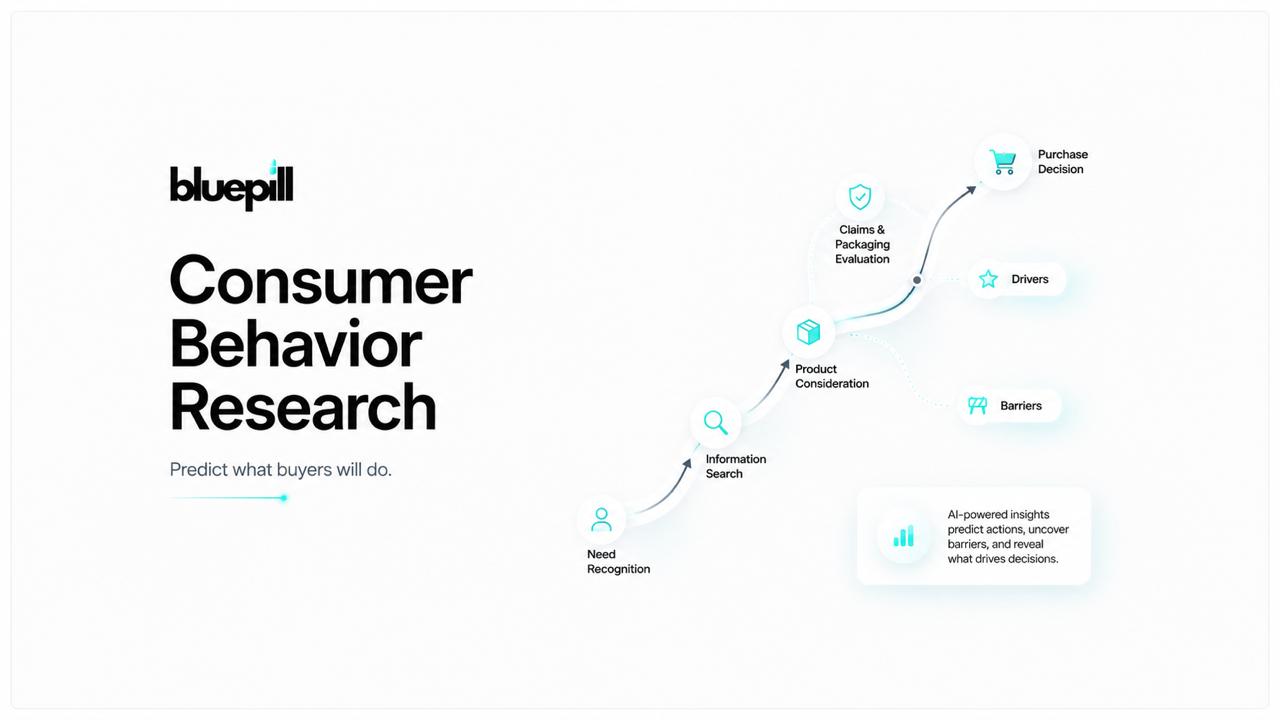
Consumers do not always buy what they say they like.
They may say a product sounds interesting, but never purchase it.
They may say price matters most, but still choose a trusted premium brand.
They may say they want healthier food, but repeat the product that tastes better.
They may say they are open to switching, but stay with the familiar option.
They may click an ad, but abandon before checkout.
This is why consumer behavior research matters.
Consumer behavior research helps brands understand how people actually make buying decisions. It studies what buyers notice, trust, compare, question, reject, and finally choose.
For consumer brands, this is important because growth depends on behavior, not only opinions.
A strong product idea still needs a clear use case.
A strong claim still needs to feel believable.
A strong package still needs to communicate quickly.
A strong campaign still needs to move the right audience.
A strong price still needs to feel worth it.
Consumer behavior research helps brands predict what buyers may do before launch, so teams can reduce risk and make better decisions.
In the AI era, brands can now study likely consumer behavior much earlier. AI consumer panels, synthetic personas, and behavioral simulations can help teams test how different buyers may react to product concepts, packaging, claims, messages, pricing, and purchase situations before investing in full human research or market launch.
That is where BluePill helps.
BluePill lets brands ask AI consumers what they think about products, packaging, claims, messages, campaigns, pricing, and buying decisions. It helps teams understand not only what consumers say, but what may influence whether they buy, hesitate, switch, or repeat.
What Is Consumer Behavior Research?
Consumer behavior research is the study of how people make buying decisions.
It looks at the full path from awareness to purchase and repeat.
It helps answer questions like:
What makes consumers notice a product?
What problem are they trying to solve?
What do they currently buy?
What would make them switch?
Which claim do they believe?
Which package creates trust?
What price feels acceptable?
What would stop them from buying?
Would they buy once or repeatedly?
Which audience is most likely to act?
For consumer brands, consumer behavior research is useful before product launches, packaging changes, pricing decisions, campaign launches, repositioning, and ecommerce optimization.
The goal is not only to understand what buyers think.
The goal is to understand what they are likely to do.
Why Consumer Behavior Is Hard to Predict
Buying behavior is not always logical.
Consumers are influenced by habit, trust, price, timing, packaging, reviews, social proof, product familiarity, claims, emotions, and competing priorities.
For example:
A shopper may choose a familiar brand because it feels safer.
A parent may reject a healthy snack if they doubt their child will eat it.
A beauty buyer may hesitate if a claim sounds too broad.
A DTC shopper may abandon cart because reviews are missing.
A premium buyer may accept a higher price if the packaging and proof feel strong.
This is why asking “Do you like this?” is not enough.
Brands need to understand the decision environment.
What is the consumer comparing?
What risk do they feel?
What proof do they need?
What habit must be changed?
What moment triggers the purchase?
What makes the product feel worth choosing?
Consumer behavior research helps answer these questions.
Start With the Buying Situation
To predict what buyers will do, start with the buying situation.
A consumer does not make decisions in a vacuum.
They are usually shopping in a specific context.
They may be in a retail aisle.
They may be scrolling social media.
They may be comparing products on Amazon.
They may be reading reviews on a DTC site.
They may be buying groceries for family.
They may be restocking a daily routine.
They may be looking for a quick solution to a problem.
The situation changes the behavior.
In retail, packaging and shelf clarity matter more.
In ecommerce, reviews, images, and product detail matter more.
In DTC, trust and brand credibility matter more.
In paid social, the hook and message matter more.
In subscription, repeat value and convenience matter more.
BluePill helps teams test consumer reactions in different buying contexts before launch.
Understand the Trigger
Most purchases begin with a trigger.
A trigger is the moment that makes a consumer consider buying.
For example:
A parent needs snacks for school lunchboxes.
An office worker wants afternoon energy.
A skincare buyer has a sensitivity flare-up.
A shopper runs out of a routine product.
A consumer sees a new claim that solves a problem.
A buyer feels dissatisfied with their current brand.
A social ad creates curiosity.
Consumer behavior research should identify these triggers.
Ask:
What would make someone think of buying this?
When does the need appear?
How often does it happen?
What does the consumer currently do in that moment?
Is the trigger strong enough to create action?
If the trigger is weak, purchase behavior may be weak.
If the trigger is frequent and urgent, the product has a stronger chance of becoming part of a routine.
Understand Current Alternatives
Consumers usually already have a solution.
They may already buy a competitor.
They may use a different category.
They may ignore the problem.
They may solve it with a habit.
They may choose the cheapest option.
They may choose the most familiar brand.
To predict behavior, brands need to understand these alternatives.
Ask:
What does the buyer currently use?
How satisfied are they with it?
What do they like about it?
What frustrates them?
What would make them switch?
What feels risky about trying something new?
A new product does not only need to be good.
It needs to be better enough to change behavior.
BluePill helps teams test whether AI consumers see a strong enough reason to switch from existing options.
Understand Product Clarity
Consumers are unlikely to buy what they do not understand.
This sounds obvious, but many products fail because the explanation is unclear.
A product may be innovative, but confusing.
A claim may be attractive, but vague.
A package may look premium, but not explain the product.
A campaign may get attention, but not communicate the benefit.
Consumer behavior research should test clarity first.
Ask:
What do consumers think this product is?
Who do they think it is for?
What problem do they think it solves?
When would they use it?
What benefit do they remember?
If consumers cannot answer these questions clearly, purchase behavior may suffer.
BluePill helps teams test clarity by asking AI consumers to explain product concepts, packaging, claims, and messages in their own words.
Understand Motivation
A buyer needs a reason to act.
That reason may be functional, emotional, social, practical, or financial.
Common buying motivations include:
Convenience
Taste
Health
Trust
Performance
Savings
Quality
Family needs
Status
Safety
Routine
Problem solving
Curiosity
Self-improvement
For example:
A snack buyer may be motivated by taste and convenience.
A parent may be motivated by trust and child acceptance.
A skincare buyer may be motivated by confidence and reduced irritation.
A wellness buyer may be motivated by proof and habit formation.
A premium buyer may be motivated by quality and identity.
Consumer behavior research should identify the strongest motivation by segment.
BluePill helps teams test which benefit or message creates the strongest motivation for each AI consumer group.
Understand Trust
Trust is one of the biggest predictors of buying behavior.
Consumers may like an idea but still not buy if they do not trust it.
Trust can come from:
Brand familiarity
Clear claims
Proof points
Reviews
Certifications
Ingredient transparency
Expert endorsement
Packaging quality
Retail presence
Guarantees
Past experience
Social proof
This is especially important for new brands and categories involving health, beauty, wellness, food, healthcare, personal care, or performance claims.
Ask:
What makes this product feel trustworthy?
What makes consumers skeptical?
What proof do they need?
Does the brand have permission to make this claim?
Does the packaging support trust?
Would reviews or expert proof change the decision?
BluePill helps teams test trust signals and proof points before launch.
Understand Claim Believability
Claims influence behavior when they are clear and believable.
A claim can make a product easier to choose.
But if the claim feels exaggerated or vague, it can create doubt.
Ask:
What does this claim mean to consumers?
Do they believe it?
Does it feel specific or generic?
What proof would they need?
Does it increase purchase interest?
Does it make the product feel different?
Could it create skepticism?
For example:
“High protein” may need a clear amount.
“Supports gut health” may need explanation.
“Clean energy” may need a use case.
“Clinically inspired” may need proof.
“Better-for-you” may need specificity.
BluePill helps teams test claim believability with AI consumers before claims appear on packaging, ads, product pages, or landing pages.
Understand Price-Value Perception
Consumers do not judge price alone.
They judge value.
A product may feel expensive if the benefit is unclear.
The same product may feel worth it if the value, proof, and packaging are strong.
Consumer behavior research should ask:
What price would buyers expect?
What price feels reasonable?
What price feels too high?
What would justify a premium?
What would they compare the price with?
Would they buy once or repeatedly at this price?
Price-value perception is critical because many consumers say they are interested until the price appears.
If price resistance is high, the solution is not always discounting.
The brand may need stronger proof, clearer messaging, better packaging, a sharper audience, or a more obvious use case.
Understand Purchase Barriers
To predict buying behavior, brands must understand what could stop purchase.
Common barriers include:
The product is unclear.
The use case is weak.
The claim is not believable.
The price feels too high.
The brand lacks trust.
The package does not communicate value.
The consumer prefers a familiar competitor.
The product feels too similar to alternatives.
Reviews or proof are missing.
The benefit does not feel urgent.
Purchase barriers are highly useful because they show what needs to change.
If consumers are confused, simplify the message.
If they doubt the claim, add proof.
If they reject the price, improve perceived value.
If they compare with a competitor, sharpen differentiation.
If they do not see the use case, make the occasion clearer.
BluePill helps teams identify these likely barriers before the product, packaging, or campaign is locked.
Understand Switching Behavior
Many launches depend on switching behavior.
A buyer must stop buying one thing and start buying another.
That is not easy.
Consumers often stay with familiar options because they reduce risk.
Consumer behavior research should ask:
What would make buyers switch?
What do they like about their current brand?
What frustration could open the door?
What proof would reduce switching risk?
What offer would encourage trial?
What would make them repeat after trial?
A product has stronger chances when it solves a dissatisfaction with current alternatives.
For example:
A healthier snack may win if current healthy snacks do not taste good.
A skincare brand may win if current products irritate sensitive skin.
A beverage may win if current energy drinks feel too sugary or jittery.
A DTC product may win if existing options feel inconvenient or overpriced.
BluePill helps teams simulate switching decisions across different buyer personas.
Understand Repeat Potential
A purchase is useful. A repeat purchase is stronger.
Consumer behavior research should not only predict trial. It should predict whether the product can become part of a habit or routine.
Ask:
Would buyers use this regularly?
How often would they need it?
Does it fit an existing routine?
Would it replace something they already buy?
What would make them buy again?
What would cause them to stop buying?
Repeat potential is especially important for CPG, ecommerce, DTC, food, beverage, beauty, wellness, and personal care brands.
A product that creates curiosity but no repeat may not be a strong long-term growth opportunity.
BluePill helps teams test whether AI consumers see a recurring use case before launch.
Understand Segment Differences
Different buyers behave differently.
One group may buy for convenience.
Another may buy for trust.
Another may buy for price.
Another may buy for proof.
Another may buy for taste.
Another may buy for status.
Another may not buy at all.
Consumer behavior research should identify the segment with the strongest buying signal.
Ask:
Which segment understands the product fastest?
Which segment has the strongest need?
Which segment believes the claim?
Which segment accepts the price?
Which segment has the fewest barriers?
Which segment is most likely to repeat?
Which segment should the brand prioritize first?
A product may perform moderately overall but very strongly with one high-intent group.
That group may be the best launch audience.
BluePill helps teams test product, packaging, claims, and message reactions across AI consumer segments.
Behavioral Signals Brands Should Watch
To predict what buyers will do, brands should look at behavioral signals, not only opinions.
Useful signals include:
Search behavior
Product page visits
Add-to-cart rate
Cart abandonment
Repeat visits
Purchase frequency
Review sentiment
Repeat purchase
Subscription interest
Price sensitivity
Competitor comparison
Claim response
Message engagement
Use case clarity
Willingness to switch
These signals help brands understand whether demand is moving from interest to action.
For new launches, some of these signals may not exist yet. That is where AI consumer simulation and pre-launch research can help.
How AI Helps Predict Buyer Behavior Before Launch
Before launch, brands may not have enough real behavioral data.
They may not yet know how shoppers will react to the concept, package, claim, price, or campaign.
AI consumer panels can help teams predict likely behavior directionally.
With BluePill, teams can ask:
Would you understand this product?
Would you consider buying it?
What would you compare it with?
What claim do you believe?
What would stop you from buying?
What price feels reasonable?
Would you switch from your current option?
Would you buy this repeatedly?
Which message makes you more likely to act?
This helps teams identify likely purchase drivers and blockers before investing heavily in launch.
AI does not replace real market data, but it helps teams reduce blind spots earlier.
When Human Research Still Matters
AI consumer behavior research is useful for early prediction and decision support, but human validation still matters when the decision is high-stakes.
Use human research when you need:
Final launch validation
Statistical confidence
Real product usage feedback
Taste, texture, or fragrance testing
Retailer-ready evidence
Regulatory or legal support
In-market behavior measurement
Post-launch performance analysis
The best workflow is often AI first, then human validation.
Use BluePill to test likely behavior, refine ideas, and identify barriers. Then validate the strongest decisions with human research or real market testing.
A Practical Consumer Behavior Research Workflow
A strong workflow can look like this:
Start with the buying decision.
Define whether you are testing product launch, packaging, claims, pricing, message, or audience.
Map the buying context.
Understand where and how the consumer will decide.
Identify the trigger.
Find what would make the buyer consider the product.
Test product clarity.
Make sure consumers understand what the product is.
Test motivation.
Find the benefit or need that drives interest.
Test trust and claim believability.
Understand what consumers believe and what proof they need.
Test price-value fit.
Check whether the product feels worth the cost.
Identify barriers.
Find what would stop purchase.
Test switching behavior.
Understand what would make consumers choose you over current options.
Test repeat potential.
See whether the product can fit a routine.
Analyze by segment.
Find the buyer group most likely to act.
Validate where needed.
Use human research or in-market testing for final confidence.
Common Consumer Behavior Research Mistakes
One common mistake is relying only on stated purchase intent.
People may say they would buy, but behavior may differ.
Another mistake is ignoring current habits.
Consumers often stay with familiar products unless there is a strong reason to switch.
Another mistake is not testing price.
Purchase intent without price can overstate demand.
Another mistake is not testing claims.
A claim may create interest but also skepticism.
Another mistake is treating all consumers the same.
Different segments have different motivations and barriers.
Another mistake is testing too late.
Behavior research is most useful before product, packaging, and campaign decisions are locked.
How BluePill Helps With Consumer Behavior Research
BluePill helps brands understand likely buyer behavior before launch.
Teams can use BluePill to test:
Product concepts
Packaging designs
Brand claims
Campaign messages
Ad hooks
Landing page copy
Price-value perception
Purchase barriers
Customer segments
Competitive alternatives
Switching behavior
Repeat potential
Use cases
For innovation teams, BluePill helps prioritize ideas.
For brand teams, it sharpens positioning, claims, and packaging.
For marketing teams, it improves campaign messages before media spend.
For ecommerce and DTC teams, it helps identify conversion and repeat purchase barriers.
For insights teams, it reduces research bottlenecks and helps decide what needs deeper validation.
Final Takeaway
Consumer behavior research helps brands predict what buyers will do by understanding how people notice, evaluate, trust, compare, hesitate, buy, switch, and repeat.
It goes beyond asking whether consumers like an idea.
It studies the real drivers of action: need strength, buying trigger, product clarity, claim believability, price-value fit, trust, competitive comparison, purchase barriers, switching behavior, and repeat potential.
In the AI era, brands can test these behaviors earlier.
BluePill helps teams ask AI consumers how they may respond to product concepts, packaging, claims, messages, pricing, and purchase decisions before launch.
The strongest brands do not only listen to what buyers say.
They study what buyers are likely to do, why they may do it, and what could stop them before the decision happens.
Related Blogs
May 29, 2026
Message Testing: How to Find the Best Claim, Hook, or Value Proposition
May 29, 2026
AI Personas: How Brands Use Synthetic Consumers for Faster Research

May 29, 2026
Advertising Market Research: How to Validate Ads Before Launch
May 29, 2026