Consumer insights aren't reports - they're growth inputs. They turn customer understanding into better products, claims, packaging, and campaigns.Learn how consumer insights help brands understand customers, improve products, sharpen messaging, test ideas, and turn customer understanding into growth.

Most brands don't fail because they lack ideas. They fail because they don't understand consumers deeply enough. A product may be useful but the message may not connect. A package may look beautiful but shoppers may not understand it. A claim may sound strong internally but consumers may not believe it. A campaign may get attention but fail to create purchase intent. A new SKU may feel exciting to the team but not solve a real customer problem.
This is why consumer insights matter. They help brands understand what people need, value, trust, reject, and act on. For consumer brands, insights aren't research outputs; they're growth inputs. They help teams make better decisions about product, packaging, claims, pricing, positioning, messaging, campaigns, audience selection, and launch strategy.
In the AI era, consumer insights are becoming faster and more continuous. AI consumer panels, synthetic personas, and behavioral simulations let teams test ideas earlier and understand likely consumer reactions before investing heavily in development, production, or media. That's where BluePill helps; brands can ask AI consumers what they think about products, packaging, claims, messages, campaigns, and buying decisions, so consumer insights, brand, marketing, and innovation teams turn customer understanding into faster, better decisions.
What Are Consumer Insights?
Consumer insights are meaningful learnings about customers that help a brand make better decisions. They're not just facts or data points.
A data point might say 62 percent of consumers prefer one claim over another. An insight explains why: "consumers prefer the claim because it feels more specific, easier to believe, and closer to the problem they're trying to solve."
That difference matters. Data tells you what happened; insights explain why it happened and what to do next. A strong consumer insight usually reveals something useful about:
• A customer need
• A buying motivation
• A purchase barrier
• A category behavior
• A decision trigger
• A trust gap
• A message opportunity
• A product improvement
• A segment difference
• A reason to switch
The best insights make action clearer. They don't just describe the consumer — they guide what the brand should do.
Why Consumer Insights Matter for Growth
Growth depends on understanding demand. A brand needs to know who's most likely to buy, why they care, what problem the product solves, what makes the product different, and what may stop the purchase.
Without consumer insights, teams rely on internal opinions: the founder believes one thing, the brand team prefers one message, the product team focuses on features, the agency pushes a creative idea, the sales team wants a stronger claim, leadership chooses what feels safe. All useful, but none equal to consumer understanding.
Consumer insights bring the customer into the decision. They help brands stop building only for internal preference and start building around real consumer needs, which improves products, messaging, packaging, claims, targeting, conversion, launch risk, media efficiency, and repeat purchase. In simple terms: consumer insights help brands stop guessing.
Consumer Insights Start With Better Questions
Good insights rarely come from vague questions. "Do consumers like this?" gives weak answers. "What would make consumers buy this instead of what they already use?" forces the team to think about behavior.
Strong consumer insights come from questions like:
• What problem are consumers trying to solve?
• What do they currently buy?
• What frustrates them about current options?
• What benefit matters most?
• What do they trust or distrust?
• What would make them switch?
• What does the product need to prove?
• What would stop them from buying?
• Which audience cares most?
• Which message makes the idea easier to understand?
These move teams beyond surface-level feedback. AI consumer panels make it possible to ask these questions earlier — simulating how different consumers may respond to product concepts, packaging, claims, and campaigns before formal research.
Consumer Insights for Product Decisions
A product should reflect what consumers actually need and value, not only what the brand can make.
A food brand may believe its strongest feature is clean ingredients, but consumer insight may reveal the real growth driver is taste without guilt. A skincare brand may believe consumers want more advanced ingredients — but the target audience may really be looking for trust, simplicity, and reduced irritation. A beverage brand may focus on functional benefits, but consumers may care more about when the product fits into their day.
These insights change product decisions - format, flavor or variant choices, ingredient emphasis, feature prioritization, SKU strategy, use-case positioning, price-value perception, and the innovation pipeline.
Consumer Insights for Messaging
Messaging is where many brands lose the consumer. The product may be strong, but the message may not explain why it matters.
A brand may want to say "Made with advanced nutritional science." Consumers may respond better to "Helps you stay full through busy mornings." The first focuses on the brand's feature. The second connects to the consumer's life.
Good messaging is built from customer understanding; what consumers care about, the problem they're trying to solve, the words they naturally use, the proof they need, what feels too vague or exaggerated, and which benefit creates action. AI consumer panels let teams test claims, headlines, ad hooks, landing-page copy, and value props before launch.
Consumer Insights for Packaging Decisions
Packaging is a major part of many consumer-brand buying decisions, and it has to communicate quickly. A shopper may give it a few seconds.
In that moment, the package needs to answer: What is this product? Who is it for? What benefit does it offer? Why should I trust it? Is it worth the price? Does it feel right for me?
A package may look premium to the internal team but feel confusing to shoppers. A claim may be visible but not meaningful. A design may stand out but fail to communicate the product. A package may look clean but not create appetite or desire. Consumer insights and AI consumer panels for early testing reveal what consumers notice first, what they understand, what feels unclear, and which design route may create stronger purchase interest.
Consumer Insights for Stronger Claims
Claims are small pieces of copy with large impact. A claim can create trust, differentiation, and purchase intent — or confusion and skepticism.
Consumer insights help teams understand which claims are clear, relevant, believable, specific, different, motivating, and supported by enough proof. "Supports wellness" may sound too broad. "20g protein to help you stay full" may feel more specific. "Clinically inspired skincare" may need explanation or proof.
The right claim depends on the consumer, the category, and the buying context. Testing claims with AI consumers before they hit packaging, ads, websites, or retail surfaces is one of the highest-leverage uses of insights work.
Consumer Insights for Audience Strategy
Not every consumer is equally valuable. Some may like the product but never buy. Some may try once but not repeat. Some may buy only on discount. Some may be hard to acquire. Some become loyal customers.
Consumer insights identify which audience deserves focus:
• Who has the strongest need?
• Who understands the product fastest?
• Who is most willing to pay?
• Who is most likely to switch?
• Who is most likely to repeat?
• Who needs too much education?
• Who should not be prioritized?
This is where segmentation becomes useful; but only if it informs decisions, not if it lives in a static deck. Testing concepts, messages, claims, and packaging across different AI consumer segments shows which audience may be most likely to buy, and why.
Consumer Insights for Campaign Growth
Campaigns perform better when built on real consumer understanding. A strong campaign isn't just creative, it's relevant. It speaks to a need consumers recognize, uses language they understand, makes a claim they believe, addresses objections, and gives a reason to act.
Consumer insights improve campaign growth by testing creative hooks, ad messages, benefit hierarchy, claims, offers, landing-page copy, audience segments, purchase barriers, and reasons to believe, before media spend. AI consumer panels don't replace A/B testing; they improve what goes into the A/B test.
The Difference Between Data and Insight
Many teams have more data than ever: website analytics, sales dashboards, customer reviews, survey results, CRM data, social listening, ad performance, retail data, search trends. But data alone doesn't create insight.
• Data may show one message performs better than another. Insight explains why that message works.
• Data may show consumers dropping off on a landing page. Insight explains what's confusing or unconvincing.
• Data may show one segment buys more often. Insight explains what motivates that segment.
Data is useful, but insight turns data into action. The goal isn't to collect more information. It's to make better product, marketing, and growth decisions.
How AI Changes Consumer Insights
Traditional consumer insights can be slow; recruit respondents, run interviews, field a survey, analyze, report. Still valuable, especially for validation. But many brand decisions need feedback earlier.
AI consumer panels make insights more continuous:
• Instead of waiting until a concept is final, teams test rough ideas.
• Instead of testing two claims, teams compare ten.
• Instead of relying on internal opinion, teams simulate consumer response.
• Instead of discovering confusion late, teams fix it early.
The shift is from research as an event to insights as an ongoing input.
What AI Consumer Insights Are Best For
AI consumer insights are especially useful for early exploration and rapid iteration. Use AI consumer panels to:
• Test product concepts
• Compare messaging routes
• Evaluate claims
• Explore packaging reactions
• Identify likely objections
• Understand segment differences
• Improve survey questions
• Test campaign ideas
• Prepare for human research
• Screen multiple ideas before validation
This is where AI moves fast, pressure-testing ideas while they're still flexible.
What AI Should Not Replace
AI shouldn't replace every form of consumer research. Human research still matters when teams need:
• Final validation
• Statistical confidence
• Real product usage feedback
• Taste, texture, or fragrance testing
• Sensitive topic exploration
• Regulatory or legal support
• Long-term brand tracking
• In-market behavior measurement
The strongest approach is AI-assisted, not AI-only. Use AI to explore and refine. Use human research to validate and confirm. Use market behavior to measure what actually happens. That combination gives teams both speed and confidence.
A Practical Consumer Insights Workflow
A modern consumer insights workflow:
• Start with the business decision : know what the insight needs to help decide.
• Define the target consumer : who the brand is trying to learn from.
• Explore the problem : what the consumer needs, wants, rejects, or struggles with.
• Test the idea : AI consumers, surveys, interviews, or other methods to understand response.
• Identify barriers : what would stop purchase or reduce trust.
• Refine the product, message, claim, or package : use the insight to improve the decision.
• Validate where needed : human research when the decision requires confidence.
• Measure in market : use sales, conversion, retention, and campaign data to keep learning.
AI consumer panels accelerate the early and middle stages, testing reactions quickly and repeatedly.
Common Mistakes With Consumer Insights
• Treating insights as a report instead of a decision tool. A report is only useful if it helps the team decide what to do.
• Relying only on averages. The average consumer may not be the most important consumer. The best opportunity may come from a specific high-intent segment.
• Confusing positive feedback with purchase intent. Consumers may like an idea but still not buy it.
• Testing too late. If the product, packaging, and message are locked, insights arrive after the team can act on them.
• Asking only what consumers think. Brands also need to understand what consumers may do.
How BluePill Helps Brands Turn Insights Into Growth
BluePill moves brands from slow, occasional research to faster consumer understanding. Teams test product concepts, new SKUs, packaging designs, claims, campaign messages, ad hooks, landing-page copy, customer segments, purchase barriers, competitive alternatives, and flavor and variant ideas — learning before decisions become expensive.
For consumer insights teams, it reduces bottlenecks and supports more business questions. For brand teams, it improves positioning and claims. For innovation teams, it prioritizes product ideas. For marketing teams, it improves campaigns before media spend. Most importantly, it turns customer understanding into action.
Final Takeaway
Consumer insights help brands understand what customers need, value, trust, reject, and act on. They turn customer understanding into better products, sharper messaging, stronger claims, clearer packaging, smarter audience strategy, and more effective campaigns.
In the AI era, consumer insights can happen earlier and more often. AI consumer panels and behavioral simulations make it possible to test ideas before launch, identify objections faster, and improve decisions before they become expensive to change.
Growth doesn't come from knowing more about consumers in theory. It comes from using that understanding to make better decisions.
Frequently Asked Questions
What are consumer insights?
Consumer insights are meaningful learnings about customers that help a brand make better decisions; about product, packaging, claims, pricing, positioning, messaging, campaigns, audience, and launch. They're not just data points; they explain why consumers behave the way they do and what the brand should do next.
What's the difference between data and consumer insights?
Data tells you what happened. Insight explains why it happened and what to do about it. Data may show one message performs better than another; the insight is which underlying consumer motivation made the message work. Data is useful, but only insight turns it into action.
How do consumer insights drive growth?
By bringing the customer into product, messaging, packaging, claims, audience, and campaign decisions; replacing internal opinion with real consumer understanding. The result is better products, sharper messaging, more believable claims, clearer packaging, smarter targeting, higher conversion, and lower launch risk.
How can AI consumer panels help with consumer insights?
AI consumer panels make insights faster and more continuous. Instead of recruiting humans for every early question, brands can simulate how different consumer segments may respond to concepts, claims, packaging, and messages; testing ten ideas where they used to test two, surfacing objections early, and refining decisions while they're still flexible.
When should brands use AI consumer research vs human research?
Use AI for early exploration, screening, and iteration; when ideas are still being shaped and speed matters. Use human research for final validation, statistical confidence, sensory testing (taste, texture, fragrance), regulatory-sensitive topics, and in-market behavior measurement. The strongest workflow is AI first, human research for the survivors.
Related Blogs
May 29, 2026
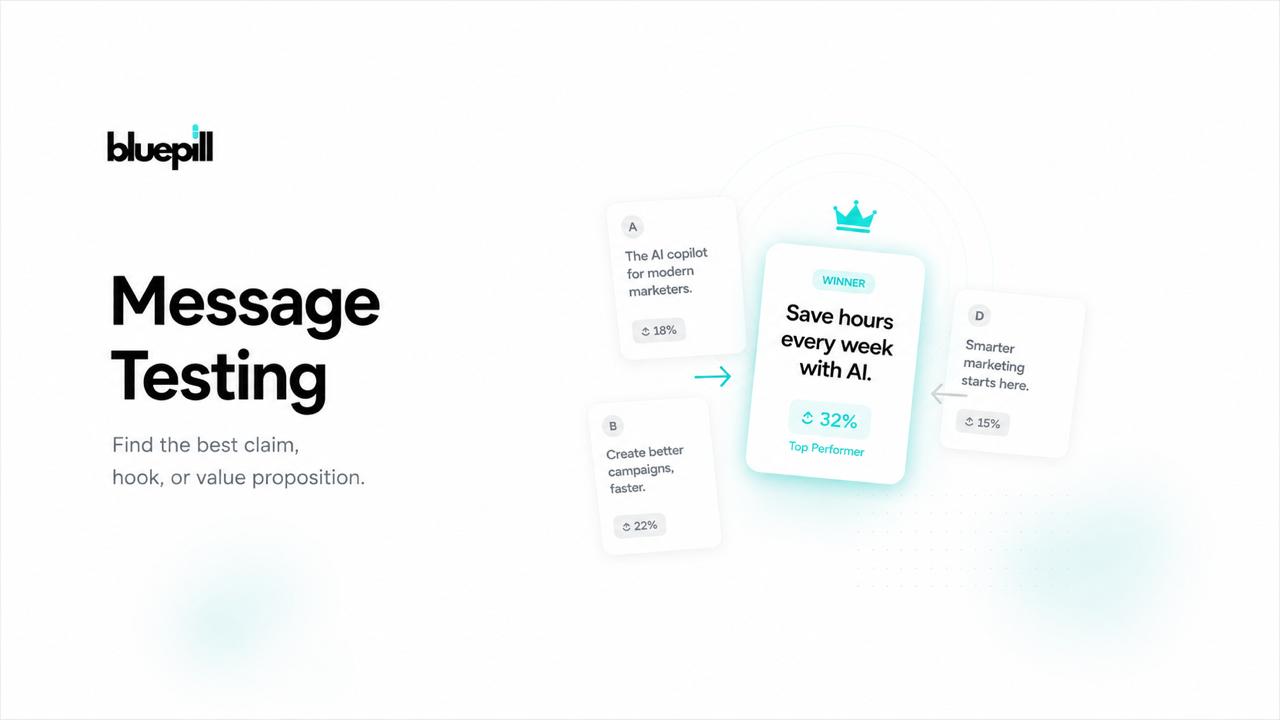
Message Testing: How to Find the Best Claim, Hook, or Value Proposition
May 29, 2026
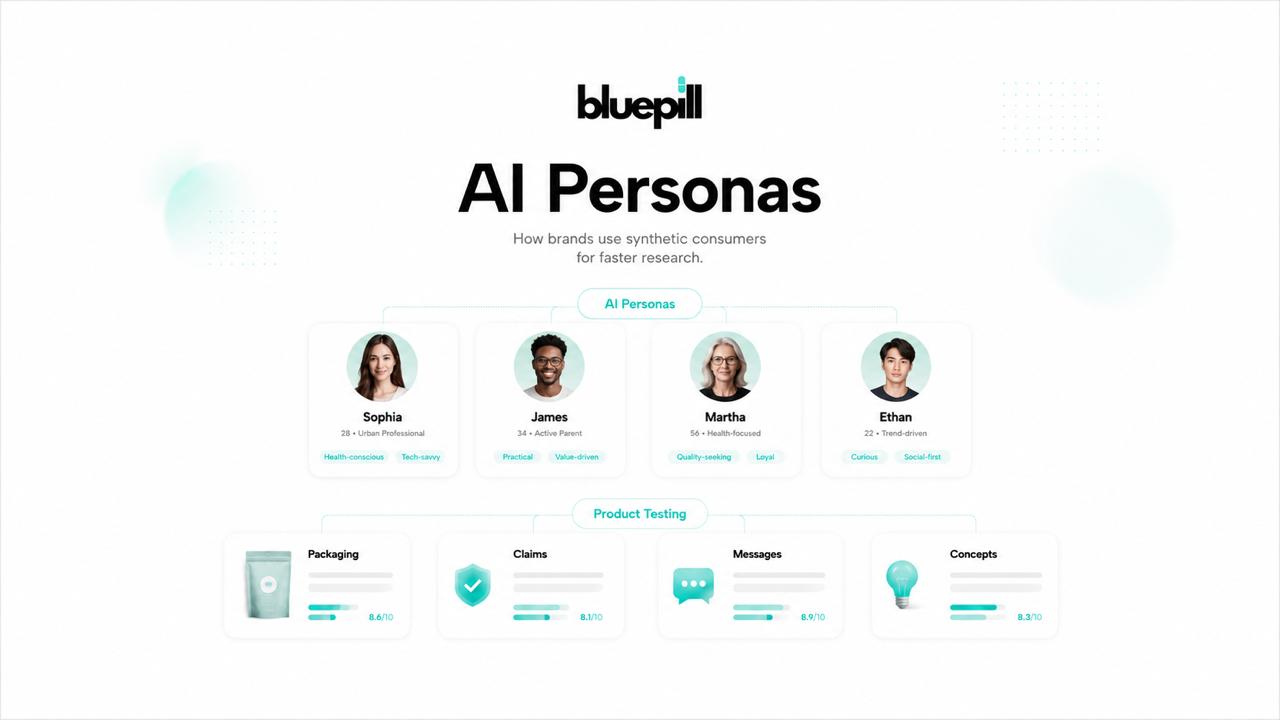
AI Personas: How Brands Use Synthetic Consumers for Faster Research

May 29, 2026
Advertising Market Research: How to Validate Ads Before Launch
May 29, 2026