Learn how food market research helps CPG brands test new products, flavors, claims, packaging, pricing, and consumer demand before launch.
Food products are emotional, practical, and highly personal.
People buy food because it tastes good.
They buy because it fits a routine.
They buy because it feels healthy.
They buy because their family likes it.
They buy because it is convenient.
They buy because the package catches their attention.
They buy because they trust the claim.
But food launches are also risky.
A flavor may sound exciting but not create repeat purchase.
A healthy claim may attract interest but fail if the product does not taste good.
A package may look premium but not explain the product clearly.
A price may feel acceptable in theory but too high on shelf.
A concept may test well internally but feel confusing to shoppers.
This is why food market research matters.
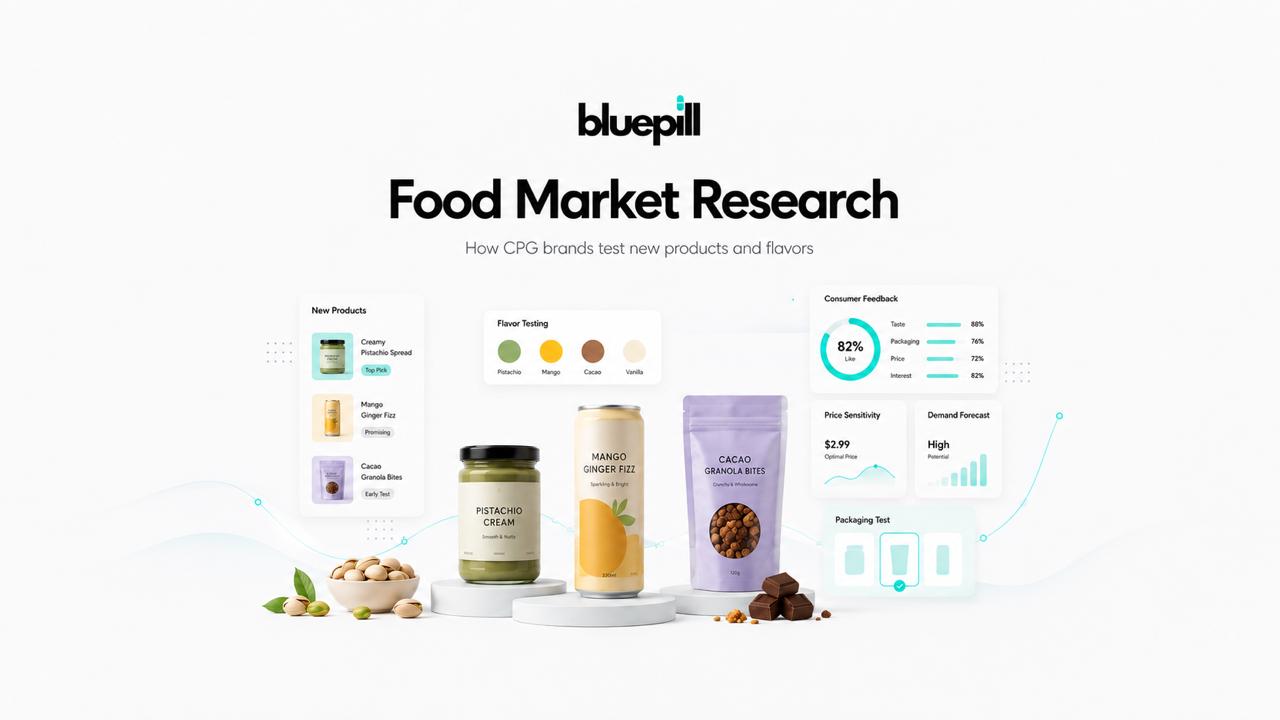
For CPG brands, food market research helps test new product ideas, flavors, claims, packaging, pricing, and launch messages before the product reaches retail or ecommerce.
It helps teams understand whether consumers actually want the product, whether they believe the claim, whether the flavor sounds appealing, and whether the product has a real buying occasion.
In the AI era, food research can also start earlier. Teams can use AI consumer panels, synthetic personas, and behavioral simulations to test concepts, flavors, packaging, claims, and purchase barriers before running full human sensory testing or larger validation studies.
That is where BluePill helps.
BluePill lets CPG teams ask AI consumers what they think about food product concepts, flavors, claims, packaging, messages, pricing, and buying decisions. It helps brands screen ideas earlier, identify stronger concepts, and decide what deserves human validation.
What Is Food Market Research?
Food market research is the process of understanding consumer demand, preferences, behavior, and purchase drivers in food categories.
It helps CPG brands answer questions like:
Will consumers understand this product?
Does the flavor sound appealing?
Which audience is most likely to buy?
Which claim feels believable?
Does the packaging communicate the product clearly?
What price feels reasonable?
What would stop purchase?
Would consumers buy once or repeatedly?
Which product idea should move forward?
Food market research can include concept testing, flavor testing, packaging research, claims testing, pricing research, consumer interviews, surveys, focus groups, product sampling, sensory testing, and AI consumer panels.
The goal is not only to know whether people like an idea.
The goal is to understand whether the idea can become a product people buy, enjoy, trust, and buy again.
Why Food Product Launches Need Research
Food products compete in crowded categories.
Snacks, beverages, cereals, sauces, frozen foods, ready meals, protein products, health foods, and functional foods all compete for limited attention.
Consumers have many choices.
They also have habits.
They already know what they like.
They already trust certain brands.
They already have routines.
They already compare taste, price, ingredients, convenience, and family acceptance.
A new food product needs a clear reason to be chosen.
Food market research helps brands find that reason before launch.
It can show whether the product solves a real need, whether the flavor has appeal, whether the packaging communicates quickly, and whether the claim makes the product more desirable or more doubtful.
Start With the Food Occasion
Food buying is often occasion-led.
Before testing a product, understand when the consumer would use it.
A product without a clear occasion can struggle, even if people like the idea.
Ask:
Is this for breakfast?
Is this for lunchbox packing?
Is this for office snacking?
Is this for post-workout use?
Is this for evening indulgence?
Is this for family meals?
Is this for travel?
Is this for gifting or hosting?
Is this for daily use or occasional use?
The occasion shapes the product, flavor, pack size, message, and price.
For example, a protein snack for gym users may need a different claim than a snack for parents packing school lunchboxes.
A beverage for morning energy may need a different message than a beverage for afternoon focus.
BluePill helps teams test which eating or drinking occasion feels most natural for a product concept before launch.
Test the Product Concept First
Before testing final flavor or packaging, test the product concept.
A food product concept should clearly explain:
What the product is
Who it is for
When it is used
What benefit it delivers
What makes it different
Why consumers should believe it
What it may taste like
What it may cost
A concept test should answer:
Do consumers understand the product?
Does the use case feel real?
Does the benefit matter?
Does the flavor sound appealing?
Does the claim feel believable?
Would they buy it?
What would stop them?
For example, “a high-protein breakfast cereal” is a product idea.
But a stronger concept might explain that it is a low-sugar, high-protein cereal for busy mornings when consumers want something convenient but more filling than regular cereal.
That gives consumers a clearer reason to evaluate it.
BluePill helps CPG teams test multiple food concepts quickly with AI consumers before investing in product development or human studies.
Test Flavor Appeal
Flavor is one of the most important parts of food market research.
A flavor can drive curiosity, trial, repeat purchase, and brand differentiation.
But flavor ideas should be tested carefully.
Ask:
Does this flavor sound appealing?
Does it fit the product category?
Does it feel familiar or new?
Does it sound too risky?
Does it feel premium, indulgent, healthy, or everyday?
Who would like this flavor most?
Would this flavor drive trial?
Would it drive repeat?
Some flavors are good for trial but weak for repeat.
A bold flavor may get attention once but not become a daily habit. A familiar flavor may feel safer and drive repeat but may not stand out enough. A seasonal flavor may create urgency but not long-term demand.
Food brands need to understand the role of each flavor.
Is it meant to be a hero SKU, a limited edition, a seasonal launch, a premium variant, or a test-and-learn innovation?
BluePill can help teams screen flavor concepts before physical product testing.
Test Flavor Fit With the Brand
Not every flavor fits every brand.
A flavor may sound attractive, but it may not match the brand’s positioning.
For example:
A health-focused snack brand may need flavors that feel indulgent but still credible.
A premium food brand may need flavors that feel elevated.
A kids’ snack brand may need flavors that feel fun and familiar.
A functional beverage brand may need flavors that support the benefit and occasion.
A clean-label brand may need flavors that do not sound artificial.
Ask:
Does this flavor fit the brand?
Does it support the product benefit?
Does it match the target audience?
Does it feel believable from this brand?
Does it make the product more or less premium?
Does it create confusion?
BluePill helps brands test whether a flavor direction fits the product story and audience expectation.
Test Taste Expectations
Before consumers taste a product, they already form expectations.
The name, package, claim, color, ingredient list, and category all shape what they expect.
Ask:
What do you expect this product to taste like?
Does the flavor name create appetite appeal?
Does it sound sweet, savory, rich, light, fresh, spicy, or mild?
Does the expected taste match the product benefit?
Does anything sound artificial or unpleasant?
Would the flavor make you want to try it?
Taste expectations matter because disappointment happens when the experience does not match the promise.
If packaging suggests indulgence but the product tastes too functional, consumers may not repeat. If a product promises health but the flavor sounds too indulgent, consumers may question the claim.
Food research should align expectation and experience.
Test Claims and Benefits
Food products often rely on claims.
Common food and beverage claims include:
High protein
Low sugar
No artificial flavors
Plant-based
Gluten-free
Gut health support
Clean ingredients
Organic
No preservatives
Keto-friendly
Dairy-free
Non-GMO
Made with real fruit
Functional energy
Rich in fiber
Claims can help drive purchase, but only if consumers understand and believe them.
Ask:
Is the claim clear?
Is it relevant?
Is it believable?
Does it make the product more appealing?
Does it need proof?
Does it make the product feel healthier, tastier, or more premium?
Does it create any skepticism?
For example, “high protein” may be clear, but consumers may still ask how much protein. “Gut health support” may sound appealing, but may need more explanation. “Clean energy” may feel vague unless connected to a clear benefit.
BluePill helps teams test food claims with AI consumers before they appear on packaging, ads, or product pages.
Balance Taste and Health
One of the biggest tensions in food research is taste versus health.
Consumers may say they want healthy food, but taste often drives actual purchase and repeat.
A better-for-you product cannot rely only on health claims if the food does not sound enjoyable.
Ask:
Does this product sound tasty?
Does the health claim make it more appealing or less indulgent?
Does the product feel like a compromise?
Does it balance taste and nutrition?
Which matters more for this occasion?
What would make the product feel both healthy and enjoyable?
For many CPG launches, the winning message is not health alone.
It is often health without compromise.
For example:
A healthier snack your kids will actually eat.
A protein cereal that still tastes like breakfast, not a supplement.
A low-sugar drink that still feels refreshing.
A better-for-you dessert that still feels indulgent.
BluePill helps teams test this balance before launch.
Test Packaging Before Retail
Packaging is critical in food categories.
It has to communicate the product quickly and create appetite appeal.
Ask:
What do consumers notice first?
Do they understand what the product is?
Does the package make the product look tasty?
Which claim stands out?
Does the packaging feel healthy, indulgent, premium, family-friendly, or functional?
Does it support the price?
Would it stand out on shelf or online?
Would shoppers pick it up or click on it?
A food package can fail if it looks too healthy and not tasty enough. It can also fail if it looks tasty but not credible for the health claim.
The package needs to communicate the right balance.
BluePill helps teams test packaging routes, front-of-pack claims, visual hierarchy, and purchase barriers before production.
Test Price-Value Fit
Food pricing is highly sensitive because consumers often compare products quickly.
They compare pack size, servings, ingredients, brand trust, taste expectation, and category norms.
Ask:
What price would consumers expect?
What price feels reasonable?
What price feels too expensive?
Does the package support the price?
Does the claim justify a premium?
Would consumers buy once or repeatedly at this price?
Would they need a trial offer, bundle, or promotion?
Price-value fit can vary by segment.
Premium buyers may pay more for quality, ingredients, and trust. Parents may pay more if the product solves a real lunchbox problem. Fitness buyers may pay more for protein and performance. Price-sensitive shoppers may need value packs or promotions.
BluePill can help teams explore early price-value reactions before deeper pricing studies.
Test Purchase Barriers
Food product research should always ask what would stop purchase.
Common barriers include:
The flavor sounds risky.
The product is unclear.
The claim is not believable.
The price feels high.
The package does not build trust.
The product does not look tasty.
The use occasion is unclear.
The product feels too similar to competitors.
The consumer already has a preferred brand.
The health benefit feels too vague.
The product sounds like it may not satisfy.
Barriers help teams improve the product before launch.
If the flavor sounds too unfamiliar, the brand may need a more familiar variant.
If the health claim feels vague, the brand may need proof.
If the product does not sound tasty, the message may need more appetite appeal.
If the price feels high, the packaging and value story may need improvement.
BluePill helps teams identify these barriers early.
Test Target Segments
Different consumer groups respond differently to food products.
A product may appeal to one segment but not another.
Useful food segments include:
Parents
Busy professionals
Fitness consumers
Office snackers
Health-focused shoppers
Premium ingredient buyers
Price-sensitive shoppers
Kids and family buyers
Meal planners
Impulse snackers
Functional food buyers
Diet-specific consumers
Flavor explorers
Routine repeat buyers
Each segment may need a different message.
Parents may need trust and child approval.
Fitness consumers may need protein and performance.
Premium buyers may need ingredient quality.
Office snackers may need convenience.
Functional food buyers may need proof.
Flavor explorers may need novelty.
BluePill helps CPG teams test food concepts, flavors, claims, and packages across different AI consumer segments.
Test Repeat Potential
For food brands, trial is important, but repeat purchase is often more important.
A flavor may get people to try once, but repeat depends on whether it fits a routine and meets expectations.
Ask:
Would consumers buy this once or regularly?
How often would they use it?
Does it fit a repeated occasion?
Would they keep it at home, work, gym, or school?
Would they buy it for themselves or family?
What would make them stop buying?
What would make it part of a routine?
Repeat potential is tied to taste, use case, price, availability, and satisfaction.
BluePill can help teams explore whether consumers see a recurring use case before launch.
Human Sensory Testing Still Matters
AI consumer panels can help test concepts, claims, flavor ideas, packaging, and likely purchase barriers.
But food products eventually need human sensory testing.
AI cannot taste, smell, chew, or experience texture.
Use human sensory testing when you need to evaluate:
Taste
Texture
Mouthfeel
Sweetness
Spice level
Aftertaste
Aroma
Freshness
Portion size
Satiety
Product experience
Preference after tasting
The best workflow is often AI first, then human sensory validation.
Use BluePill to screen ideas and identify stronger product directions. Then use human testing to validate the actual food experience.
A Practical Food Market Research Workflow
A strong workflow can look like this:
Start with category research.
Understand competitors, claims, pricing, packaging, reviews, and category trends.
Define the target consumer.
Identify who has the strongest need and buying occasion.
Test the product concept.
Check clarity, relevance, differentiation, and purchase intent.
Test flavor ideas.
Screen flavor appeal, fit, novelty, and repeat potential.
Test claims.
Evaluate clarity, believability, and proof needs.
Test packaging.
Check appetite appeal, product understanding, claim visibility, and price support.
Test price-value perception.
Understand whether consumers see the product as worth the cost.
Identify purchase barriers.
Find what would stop trial or repeat.
Test with human consumers.
Use sensory testing, surveys, or product sampling for validation.
Launch and measure.
Track sales, repeat purchase, reviews, retailer feedback, and campaign performance.
Example: Testing a New Protein Snack
Imagine a CPG brand wants to launch a high-protein snack.
The team may test:
Whether consumers understand the concept
Whether protein is the strongest claim
Whether the product sounds tasty
Which flavors are most appealing
Whether the package feels healthy but still indulgent
Which audience responds best
Whether the price feels acceptable
What would make consumers repeat
BluePill can help screen concepts, flavor names, claims, and packaging before the brand invests in physical sampling or production.
Example: Testing a New Beverage Flavor
A functional beverage brand may want to launch a new flavor.
The team may test:
Whether the flavor sounds refreshing
Whether it fits the functional benefit
Whether it feels familiar or differentiated
Which audience would try it
Whether it sounds too sweet or artificial
Whether it supports the brand’s positioning
Whether it could become a repeat SKU
AI testing can help narrow flavor ideas before human taste testing.
Example: Testing a Kids’ Food Product
A brand launching a kids’ food product needs to consider both parent and child needs.
Parents may care about health, trust, ingredients, convenience, and safety.
Children may care about taste, fun, familiarity, and texture.
Research should test:
Does the parent trust the product?
Does the flavor sound child-friendly?
Does the package communicate safety and fun?
Does the claim feel believable?
Would parents pack it regularly?
What would stop them from buying?
BluePill can help test parent decision-making before human product testing with families.
Common Food Market Research Mistakes
One common mistake is testing only health claims and not appetite appeal.
Food must still sound enjoyable.
Another mistake is ignoring repeat purchase.
Trial is not enough if the product does not fit a routine.
Another mistake is testing flavor names without testing taste expectations.
A flavor name creates expectations that the product must meet.
Another mistake is relying only on internal tasting.
The team may not represent the target consumer.
Another mistake is testing packaging too late.
Packaging affects understanding, trust, appetite, and price perception.
Another mistake is treating AI as a replacement for sensory testing.
AI can help screen ideas, but humans still need to taste the product.
How BluePill Helps With Food Market Research
BluePill helps CPG teams test food product decisions earlier.
Teams can use BluePill to test:
Product concepts
Flavor ideas
Flavor names
Packaging routes
Front-of-pack claims
Health and nutrition claims
Target segments
Purchase barriers
Price-value perception
Usage occasions
Campaign messages
Competitive comparisons
Repeat potential
For innovation teams, BluePill helps prioritize new product ideas.
For brand teams, it improves positioning, packaging, and claims.
For insights teams, it reduces research bottlenecks.
For marketing teams, it improves launch messaging before media spend.
BluePill is especially useful before human sensory testing because it helps teams decide which ideas are worth tasting, sampling, and validating.
Final Takeaway
Food market research helps CPG brands test new products and flavors before launch.
It helps teams understand whether consumers understand the product, find the flavor appealing, believe the claims, trust the packaging, accept the price, and see a real use occasion.
For food brands, research should balance taste, health, convenience, trust, price, and repeat potential.
In the AI era, teams can start this process earlier.
BluePill helps brands ask AI consumers what they think about food concepts, flavors, packaging, claims, and purchase decisions before investing in product development, sensory testing, production, or launch.
The best food launches do not rely only on internal taste panels or trend reports.
They test the product story, flavor expectation, claim, package, and buying reason before the product reaches the shelf.
Related Blogs
May 29, 2026
Message Testing: How to Find the Best Claim, Hook, or Value Proposition
May 29, 2026
AI Personas: How Brands Use Synthetic Consumers for Faster Research

May 29, 2026
Advertising Market Research: How to Validate Ads Before Launch
May 29, 2026