Learn how market research analysis helps brands turn consumer responses into clear product, packaging, claims, messaging, and launch decisions.

Collecting consumer responses is only the first step.
The real value comes from what the team does with those responses.
A survey result by itself is not a decision.
A focus group quote by itself is not a strategy.
A high purchase intent score by itself is not proof of demand.
A packaging preference by itself is not enough to approve a retail launch.
Market research analysis is the process of turning consumer feedback into clear decisions.
For consumer brands, this matters because research is usually connected to expensive choices.
Which product should we launch?
Which package should we choose?
Which claim should go on the front of pack?
Which audience should we target first?
Which campaign message should we use?
Which concept should we stop, improve, or validate further?
Good research analysis helps teams answer these questions with confidence.
Poor analysis creates the opposite problem. Teams end up with charts, transcripts, scores, and comments, but still do not know what to do next.
In the AI era, research analysis is also changing. Teams can now use AI consumer panels, synthetic personas, and behavioral simulations to test ideas earlier, analyze reactions faster, and identify stronger decision paths before running larger human validation.
That is where BluePill helps.
BluePill lets brands ask AI consumers what they think about product concepts, packaging, claims, messages, campaigns, and buying decisions. It helps teams understand consumer reactions, identify patterns, and move from feedback to action faster.
What Is Market Research Analysis?
Market research analysis is the process of interpreting consumer, market, and competitive data to make better business decisions.
It is not only about summarizing responses.
It is about finding meaning.
A consumer may say a product is interesting.
Analysis asks whether that interest is strong enough to drive purchase.
A claim may score well.
Analysis asks whether consumers believe it and whether it changes preference.
A package may be liked.
Analysis asks whether it communicates the product clearly and supports the price.
A campaign message may be memorable.
Analysis asks whether it creates the right takeaway and moves the right audience.
Good analysis connects consumer responses to the decision the brand needs to make.
Start With the Decision, Not the Data
The biggest mistake in market research analysis is starting with all the data and trying to find something interesting.
A better approach is to return to the decision.
What were we trying to decide?
Were we trying to choose a product concept?
Were we trying to identify the right audience?
Were we testing claims?
Were we choosing packaging?
Were we trying to understand purchase barriers?
Were we preparing for launch?
Were we deciding what needs human validation?
The analysis should be organized around the decision.
For example, if the research was designed to choose between three packaging routes, the analysis should not only report which package people liked most. It should explain which package best communicates the product, which claim consumers notice first, which pack creates trust, which one supports the price, and which one is most likely to drive purchase.
The goal is not to report everything.
The goal is to decide what matters.
Separate Feedback From Insight
Not every consumer response is an insight.
A response is what someone said.
An insight explains what that response means for the business.
For example:
Consumer response: “This looks expensive.”
Possible insight: The packaging creates premium cues, but the value story may need to be clearer before launch.
Consumer response: “I like the idea, but I do not know when I would use it.”
Possible insight: The product has appeal, but the use case is not clear enough to drive repeat purchase.
Consumer response: “I would need proof for this claim.”
Possible insight: The claim may be motivating, but believability is a risk unless supported by evidence.
Consumer response: “This reminds me of another brand.”
Possible insight: Differentiation may be weak and the brand needs a clearer reason to switch.
Good analysis turns raw feedback into business meaning.
Look for Patterns, Not Isolated Comments
One comment can be interesting, but a pattern is more useful.
In market research analysis, teams should look for repeated themes across responses.
For example:
Are many consumers confused by the same claim?
Do several segments reject the price?
Do many people compare the product to the same competitor?
Do consumers repeatedly mention trust as a concern?
Does one audience consistently show stronger purchase intent?
Do multiple respondents misunderstand the product category?
Patterns help separate signal from noise.
A single negative comment may not matter. But if many consumers raise the same issue, the team should pay attention.
BluePill helps teams identify these patterns faster by allowing teams to test reactions across AI consumer personas and compare how different audiences respond.
Analyze Clarity First
Before analyzing whether consumers like an idea, check whether they understand it.
Clarity is one of the most important parts of market research analysis.
Ask:
Did consumers understand what the product is?
Did they understand who it is for?
Did they understand the main benefit?
Did they understand the claim?
Did they understand when they would use it?
Did they describe it the way the brand intended?
If the answer is no, other scores may be less reliable.
A product may score low because the idea is weak, or because the explanation is unclear.
Those are very different problems.
If clarity is weak, the next decision may not be “stop the concept.” It may be “rewrite the concept and test again.”
This is where AI consumer panels can help early. BluePill can show how AI consumers interpret a product concept, package, or message in their own words before a team spends on larger validation.
Analyze Relevance
After clarity, analyze relevance.
A consumer may understand the idea but still not feel it is for them.
Ask:
Does the product solve a real problem?
Does the audience see a clear use case?
Does the benefit matter?
Is the problem frequent enough?
Is the product connected to a real buying moment?
Which segment finds it most relevant?
Relevance is often more important than general appeal.
A product that feels highly relevant to a specific group may be stronger than a product that feels mildly appealing to everyone.
For example, a snack may not appeal to all consumers, but it may be highly relevant to parents looking for healthier lunchbox options. That could be a strong launch audience.
Good analysis should identify where relevance is strongest.
Analyze Believability
Claims often drive interest, but only if consumers believe them.
In market research analysis, believability should be treated as a major decision factor.
Ask:
Do consumers believe the claim?
What makes it believable?
What creates doubt?
What proof do they need?
Does the brand have permission to make the claim?
Does the claim feel specific or vague?
Does the claim increase purchase intent?
A claim that scores high on appeal but low on believability is risky.
It may attract attention but create skepticism.
For example, claims like “supports gut health,” “clean energy,” “clinically inspired,” “better-for-you,” or “premium quality” may need proof, explanation, or more specific language.
BluePill helps teams test claim believability early, before claims are used in packaging, campaigns, landing pages, or retail materials.
Analyze Differentiation
Consumers already have alternatives.
A product must give them a reason to notice, consider, and possibly switch.
Analyze whether consumers understand what makes the product different.
Ask:
What did consumers compare it with?
Did they see it as different from competitors?
Did the difference matter?
Could they explain why they would choose it?
Did it feel new, better, or simply familiar?
Was the differentiation meaningful or superficial?
Differentiation matters because many products can be liked but still not chosen.
A concept may sound good, but if it feels too similar to existing options, the brand may struggle to win attention or justify price.
Good analysis should identify whether the brand has a clear reason to win.
Analyze Purchase Intent Carefully
Purchase intent is useful, but it should not be treated as the full answer.
People often overstate what they would buy in research.
A strong analysis looks at purchase intent together with other signals.
Ask:
Is purchase intent supported by strong relevance?
Is it supported by believability?
Is the price acceptable?
Is there a clear use case?
Are barriers low enough?
Is there willingness to switch?
Is repeat potential clear?
Which segment shows the strongest intent?
Purchase intent without context can mislead.
For example:
High purchase intent plus low believability means the claim needs proof.
High purchase intent plus weak price acceptance means the value story needs work.
High purchase intent plus unclear use case may mean trial is possible, but repeat is uncertain.
Moderate purchase intent overall plus high intent in one segment may suggest a focused launch opportunity.
The analysis should explain the quality of intent, not just the score.
Analyze Barriers to Purchase
Barriers are often the most useful part of market research analysis.
They tell the team what needs to change.
Common barriers include:
The product is unclear.
The claim is not believable.
The price feels too high.
The package does not build trust.
The product feels too similar to competitors.
The use case is weak.
The brand lacks credibility.
The audience is too broad.
The message does not create urgency.
The consumer is loyal to another brand.
A good analysis should separate barriers into two types.
Fixable barriers and structural barriers.
A fixable barrier may be unclear messaging, weak proof, confusing packaging, or poor benefit hierarchy.
A structural barrier may be weak category need, low willingness to pay, strong competitor loyalty, or no clear use case.
This distinction matters.
Fixable barriers suggest improvement.
Structural barriers may suggest stopping or repositioning the idea.
Analyze Segment Differences
Averages can hide the most important insight.
A concept may look average overall but perform strongly with a specific buyer group.
For example:
Parents may love the product, while general snackers do not care.
Sensitive-skin consumers may trust the skincare claim, while casual beauty buyers ignore it.
Premium buyers may accept the price, while value buyers reject it.
Heavy category users may understand the benefit faster than light users.
Market research analysis should always ask:
Which segment responded strongest?
Which segment had the clearest need?
Which segment believed the claim?
Which segment accepted the price?
Which segment had the fewest barriers?
Which segment should the brand prioritize?
This is especially important for launch strategy.
The best audience is not always the largest audience. It is often the audience with the strongest reason to buy first.
BluePill helps teams explore these segment differences early using AI consumer personas.
Analyze Open-Ended Responses
Open-ended responses are where many of the best insights live.
Scores tell you what happened.
Open-ended responses explain why.
When analyzing open-ended responses, look for:
Repeated words
Common objections
Confusing phrases
Emotional reactions
Trust concerns
Use case descriptions
Competitor mentions
Reasons to buy
Reasons not to buy
Suggestions for improvement
Do not only collect quotes that support the preferred idea.
Look for tension.
If consumers like the product but question the price, that is important.
If they understand the claim but need proof, that is important.
If they find the package attractive but cannot explain the product, that is important.
Good analysis uses open-ended responses to explain the numbers.
Compare Against the Original Hypothesis
Every research project usually begins with a hypothesis.
For example:
We believe this product solves a strong consumer need.
We believe this claim will build trust.
We believe this package will feel premium.
We believe this audience is the best launch segment.
We believe this message will create purchase intent.
Market research analysis should compare the results against the hypothesis.
Was the hypothesis supported?
Was it partially supported?
Was it rejected?
Did the research reveal a better direction?
What did the team assume incorrectly?
This helps keep analysis honest.
The goal is not to prove the team right. The goal is to learn what the market is telling you.
Turn Findings Into Clear Decisions
The best market research analysis ends with clear actions.
It should not only say what consumers said.
It should say what the team should do.
For example:
Move forward with Concept B because it has the strongest clarity, relevance, and purchase intent among high-frequency category users.
Refine Claim A before launch because it is appealing but needs stronger proof.
Do not prioritize Segment C because interest is high but willingness to pay is low.
Choose Package 2 because consumers understand the product faster and perceive higher quality.
Delay launch until the use case is clearer because many consumers like the idea but do not know when they would use it.
Good analysis should lead to one of a few decisions:
Launch
Stop
Refine
Retest
Validate
Reposition
Change audience
Change message
Change claim
Change packaging
Change price-value story
If the analysis does not help the team choose, it is incomplete.
Use a Decision Matrix
A decision matrix can help teams compare options more clearly.
For example, product concepts can be scored across:
Clarity
Relevance
Differentiation
Believability
Purchase intent
Price-value fit
Barriers
Segment strength
Repeat potential
Strategic fit
Packaging options can be scored across:
Product understanding
Claim visibility
Trust
Visual appeal
Shelf standout
Perceived quality
Purchase intent
Competitive strength
Messages can be scored across:
Clarity
Relevance
Believability
Emotional pull
Distinctiveness
Action intent
Segment fit
The point is not to reduce everything to a single number.
The point is to make tradeoffs visible.
An option with the highest appeal may not be the best if it has weak believability. An option with slightly lower overall score may be stronger if it performs extremely well with the right segment.
Use AI to Analyze Early Responses Faster
AI consumer panels can make early analysis faster and more iterative.
With BluePill, teams can test concepts, packaging, claims, and messages with AI consumers and quickly identify:
What is clear
What is confusing
What feels believable
What creates doubt
Which segment responds best
What barriers appear
What needs to be improved
Which ideas deserve human validation
This helps teams analyze consumer response before investing in larger research.
It also helps teams test more variations.
Instead of analyzing only one final concept, teams can analyze multiple early versions and improve them before a human study.
When Human Validation Is Still Needed
AI can help with early analysis, but human research still matters when the decision is high-stakes.
Use human validation when you need:
Final launch confidence
Statistical reliability
Retailer-ready evidence
Real product usage feedback
Taste, texture, or fragrance testing
Regulatory or legal support
Precise pricing validation
In-market behavior measurement
The best workflow is often AI first, then human validation.
Use BluePill to test and analyze early ideas. Then validate the strongest options with human research where needed.
Common Market Research Analysis Mistakes
One common mistake is reporting data without interpretation.
A chart is not enough. The team needs to know what it means.
Another mistake is overvaluing the highest score.
The highest-scoring option is not always the best strategic choice.
Another mistake is ignoring negative feedback.
Objections often reveal what needs to be fixed before launch.
Another mistake is relying only on averages.
Segment-level insight may be more useful than the overall result.
Another mistake is treating purchase intent as proof of demand.
Intent should be analyzed with relevance, price, believability, and barriers.
Another mistake is not connecting findings to action.
Research analysis should end with decisions, not only observations.
How BluePill Helps Turn Responses Into Decisions
BluePill helps teams move faster from consumer response to decision.
Teams can use BluePill to test and analyze:
Product concepts
New SKUs
Packaging designs
Claims
Campaign messages
Ad hooks
Landing page copy
Audience segments
Purchase barriers
Competitive alternatives
Price-value perception
Flavor and variant ideas
For insights teams, BluePill reduces research bottlenecks.
For brand teams, it sharpens positioning and claims.
For innovation teams, it helps prioritize product ideas.
For marketing teams, it improves campaign messages before media spend.
BluePill is especially useful when teams need to compare options quickly and decide what deserves deeper validation.
A Practical Research Analysis Workflow
A clear workflow can look like this:
Start with the decision.
Know what the research needs to help decide.
Review clarity first.
Check whether consumers understood the idea correctly.
Analyze relevance.
Identify who cares and why.
Analyze believability.
Understand whether claims and proof are strong enough.
Analyze differentiation.
Check whether consumers see a reason to choose.
Analyze purchase intent with context.
Look at intent alongside price, barriers, and competitive alternatives.
Analyze barriers.
Separate fixable issues from structural problems.
Analyze by segment.
Find the audience with the strongest demand signal.
Review open-ended responses.
Use consumer language to explain the scores.
Create decision recommendations.
Decide whether to launch, stop, refine, retest, or validate.
Final Takeaway
Market research analysis is where consumer responses become business decisions.
It is not enough to collect survey scores, focus group quotes, or open-ended feedback.
Teams need to interpret what the responses mean for product, packaging, claims, messaging, audience, pricing, and launch strategy.
Good analysis looks at clarity, relevance, believability, differentiation, purchase intent, barriers, segment differences, and consumer language.
In the AI era, teams can make this process faster by using AI consumer panels to test and analyze ideas earlier.
BluePill helps brands ask AI consumers what they think, identify patterns, and decide what to improve, stop, or validate before launch.
The best market research analysis does not only answer, “What did consumers say?”
It answers, “What should we do next?”
Related Blogs
May 29, 2026
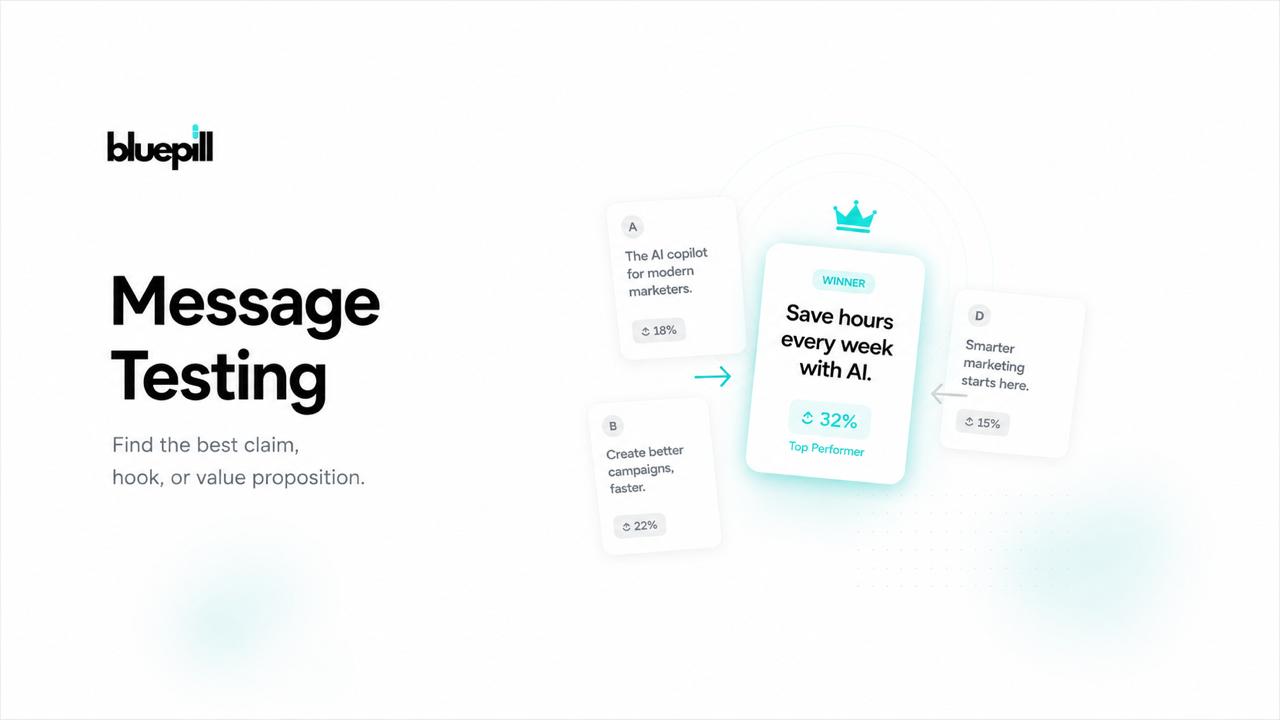
Message Testing: How to Find the Best Claim, Hook, or Value Proposition
May 29, 2026
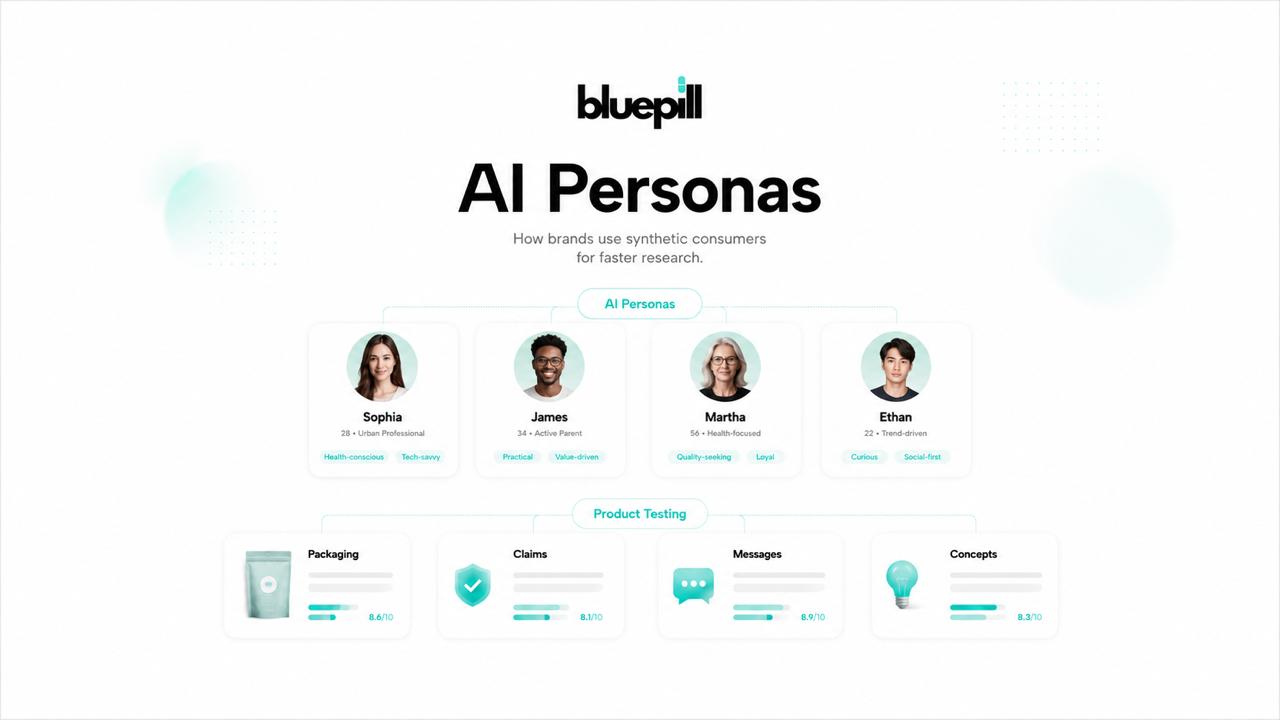
AI Personas: How Brands Use Synthetic Consumers for Faster Research

May 29, 2026
Advertising Market Research: How to Validate Ads Before Launch
May 29, 2026