Learn what consumer brands should look for before choosing a market research company, and how AI consumer panels can help teams test products, packaging, claims, and messages faster.
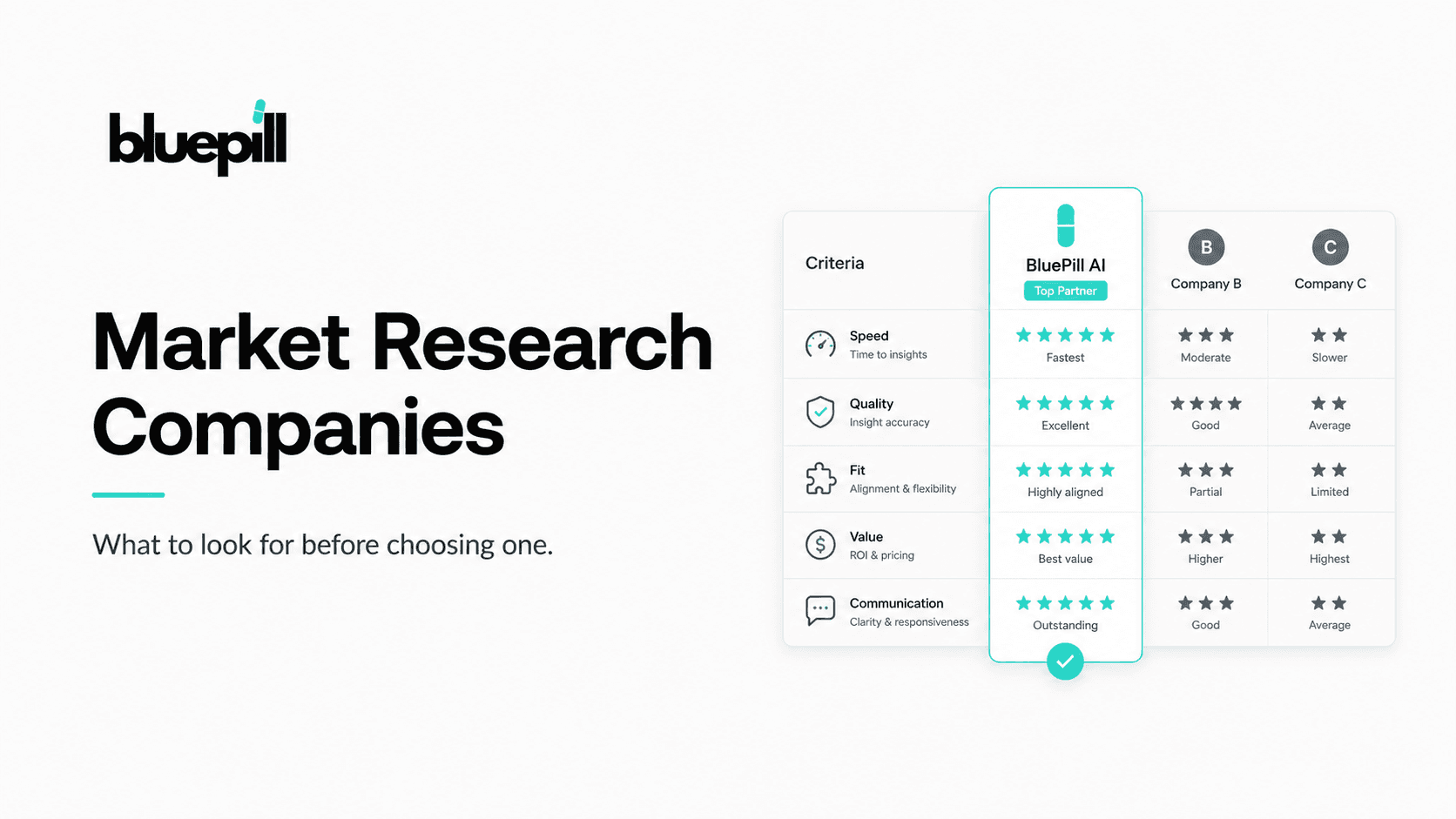
Choosing a market research company is not just a vendor decision.
It is a business decision.
The right research partner can help a brand understand consumers, reduce launch risk, improve product ideas, sharpen messaging, and make better decisions before spending heavily on production, retail, or media.
The wrong partner can create the opposite problem.
Slow timelines.
Generic reports.
Poor sample quality.
Unclear recommendations.
Research that confirms what the team already believed.
Insights that arrive too late to influence the decision.
For consumer brands, this matters because most big decisions are expensive to reverse.
A product launch can require months of work.
A packaging change can affect retail performance.
A weak claim can reduce trust.
A campaign message can waste media spend.
A poorly chosen audience can increase acquisition costs.
Market research companies help reduce these risks. But not every company is right for every brand, category, or decision.
In the AI era, the choice has become even more important. Brand teams no longer need to depend only on slow traditional studies for every early-stage question. AI consumer panels, synthetic personas, and behavioral simulations now make it possible to test concepts, packaging, claims, and messages much earlier.
That is where BluePill helps.
BluePill gives consumer insights, brand, marketing, and innovation teams a faster way to ask AI consumers what they think before moving into full human research. It helps teams screen ideas, understand likely reactions, and improve decisions before launch.
Start With the Decision You Need to Make
Before choosing a market research company, start with the decision.
Do not start with the methodology.
Do not start with the vendor list.
Do not start with the sample size.
Do not start with the report format.
Start with the business question.
Are you trying to decide whether to launch a product?
Are you choosing between packaging designs?
Are you testing a new claim?
Are you trying to understand why sales are slowing?
Are you entering a new category?
Are you deciding which customer segment to target?
Are you testing campaign messages before media spend?
The clearer the decision, the easier it becomes to choose the right research partner.
A company that is excellent at large brand tracking may not be the best fit for rapid concept testing.
A company that is strong in qualitative interviews may not be the best fit for pricing research.
A company that is good at survey programming may not be strong at strategic interpretation.
The first question should always be:
What decision must this research help us make?
Look for Category Understanding
Consumer behavior changes by category.
A skincare buyer does not evaluate products the same way as a snack buyer.
A beverage shopper does not behave the same way as a healthcare consumer.
A parent buying for a child does not decide the same way as a premium beauty shopper.
A sports fan does not respond to messaging the same way as an ecommerce buyer.
This is why category understanding matters.
A good market research company should understand the category context behind the consumer response.
For CPG, this may include shelf behavior, packaging hierarchy, claims, price-value perception, trial, repeat, and retailer dynamics.
For beauty, it may include trust, ingredient literacy, before-after expectations, skin concerns, brand credibility, and social proof.
For healthcare, it may include sensitivity, credibility, compliance, risk perception, and emotional reassurance.
For ecommerce, it may include reviews, product detail pages, price comparison, delivery expectations, and conversion friction.
If a research company does not understand the category, it may ask the wrong questions or misread the answers.
BluePill helps here by allowing teams to test category-specific concepts, claims, packaging, and messages with AI consumers that reflect different audience types. This gives teams early directional insight before committing to a larger study.
Check Whether They Understand Consumer Decisions
Good market research is not just about collecting opinions.
It should help predict decisions.
A consumer may say they like a product but never buy it.
They may say a claim sounds interesting but not believe it.
They may say packaging looks nice but fail to understand the product.
They may say price is acceptable but choose a competitor at the shelf.
That is why a strong market research company should understand decision behavior.
They should know how to measure:
Purchase intent
Relevance
Believability
Clarity
Differentiation
Perceived value
Switching likelihood
Barriers to purchase
Usage occasions
Competitive alternatives
Segment-level differences
If the research only asks, “Do you like this?” it may not be enough.
A better research partner asks:
Will this change behavior?
Who is most likely to act?
What will stop them?
What must be improved?
What should the brand do next?
This is also where AI-powered research can help. BluePill allows teams to simulate likely consumer decisions across different personas and scenarios, helping brands understand not only what people may say, but why they may or may not act.
Evaluate Sample Quality
For traditional research, sample quality is one of the most important factors.
If the wrong people are included, the results become weak.
A good market research company should be able to explain:
Who will be recruited
How respondents will be verified
Whether they match the target audience
How they prevent poor-quality responses
How they manage professional respondents
How they ensure category relevance
How they handle segmentation
For example, if a brand is testing a premium functional beverage, the audience should not simply be “adults aged 18 to 55.” The sample should reflect people who actually buy or consider the category, understand the price range, and fit the intended consumer profile.
Poor sampling can make a weak concept look strong or a strong concept look weak.
In early-stage research, AI consumer panels can help teams explore audience response before recruiting a full human sample. BluePill is useful for this stage because teams can quickly simulate how different audience segments may react and decide which segments deserve deeper validation.
Look for Strong Research Design
The quality of market research depends heavily on the quality of the questions.
Poorly designed research creates misleading answers.
A strong market research company should know how to avoid:
Leading questions
Confusing answer choices
Overly broad surveys
Unrealistic purchase scenarios
Vague concept descriptions
Biased stimulus material
Poor sequencing
Overreliance on averages
Weak open-ended questions
For example, a bad question might ask:
“How appealing is this innovative and healthy snack?”
That already leads the respondent.
A better question would ask:
“How appealing is this snack?”
“What words would you use to describe it?”
“What makes it appealing or unappealing?”
“How healthy does it seem?”
“How believable are the claims?”
Good research design helps teams understand the truth more clearly.
BluePill can support this process by helping teams test questions, concepts, and messages before they go into human research. If AI consumers consistently misunderstand a concept or react negatively to a claim, the team can improve it before spending on fieldwork.
Ask How They Handle Speed
Speed matters more than ever.
Consumer brands often need insight while the decision is still flexible. If research takes too long, the team may move forward without it.
A market research company should be clear about timelines.
How long does recruitment take?
How long does fieldwork take?
How long does analysis take?
When will the team get usable insight?
Can they support quick-turn decisions?
Can they separate early directional learning from final validation?
Traditional research has its place, but not every decision can wait weeks.
This is one reason AI-powered research is becoming valuable. BluePill helps teams get early directional feedback quickly, especially when they need to compare concepts, packaging, claims, or messages before deciding what to validate formally.
The goal is not to replace every research company. The goal is to make the research process faster and more efficient.
Look for Clear Recommendations, Not Just Data
A research report should not only present charts.
It should help the team decide what to do.
Many market research companies provide data, but the best ones provide interpretation.
They explain:
What the findings mean
Which audience matters most
What the biggest risk is
Which idea should move forward
What should be changed
What should be tested next
What the team should avoid
For brand teams, this is critical.
A chart showing that Concept A scored 7.2 and Concept B scored 7.0 may not be enough. The team needs to know whether the difference matters, why consumers responded differently, and what action should follow.
Good research should create confidence, not confusion.
BluePill is designed to support decision-making by helping teams understand consumer reactions, motivations, objections, and segment-level differences. This helps teams move from raw feedback to clearer next steps.
Check Whether They Can Handle Qualitative and Quantitative Needs
Most brand decisions need both numbers and human explanation.
Quantitative research helps answer how many.
Qualitative research helps answer why.
For example, a survey may show that purchase intent is low. But qualitative responses may reveal that the product benefit is unclear, the claim feels exaggerated, or the price feels too high.
A strong market research company should know when to use quantitative methods, when to use qualitative methods, and when to combine both.
For many consumer brands, the best workflow is:
Use qualitative exploration to understand language and objections.
Use quantitative research to measure strength and scale.
Use AI simulation to test more ideas earlier.
Use human validation for final confidence.
BluePill fits especially well in the early and middle stages of this workflow. Teams can use AI consumers to explore reactions, screen ideas, and improve concepts before investing in larger quantitative or qualitative studies.
Make Sure They Understand Segmentation
Average results can be misleading.
A concept may look average overall but perform very strongly with one audience.
A claim may not work broadly but may be highly persuasive for a specific segment.
A package may appeal to premium buyers but confuse value buyers.
A price may feel acceptable to loyal users but too high for trial buyers.
This is why segmentation matters.
A good research company should help the brand understand differences across consumer groups.
They should be able to answer:
Who is most likely to buy?
Which segment has the strongest need?
Which segment has the highest barriers?
Which message works best for each group?
Which audience should the brand target first?
Which segment is not worth prioritizing?
BluePill helps teams make segmentation more actionable by allowing them to simulate responses across different AI consumer personas. This helps brands test how different segments may respond before running deeper research.
Understand Their Technology Approach
Modern market research companies use different types of technology.
Some use survey platforms.
Some use online panels.
Some use social listening.
Some use analytics dashboards.
Some use AI for analysis.
Some use synthetic consumers and simulations.
Technology alone does not make research good. But the right technology can make research faster, more scalable, and more useful.
Before choosing a research company, ask:
How do they use technology?
Does it improve quality or only speed?
Can it help test more ideas?
Can it support faster iteration?
Can it explain consumer reasoning?
Can it integrate with existing workflows?
Does it help the team make decisions earlier?
AI is becoming especially important for early-stage research.
BluePill helps teams use AI consumer panels to test product concepts, packaging, claims, messages, and campaigns before launch. This gives brands a modern way to reduce early uncertainty while still using human research where it matters most.
Compare Traditional Research Companies and AI Research Platforms
Traditional market research companies and AI research platforms serve different but connected roles.
Traditional research companies are useful for:
Human validation
Large-scale surveys
Brand tracking
Usage and attitude studies
Deep interviews
Regulatory-sensitive research
In-market measurement
Statistical confidence
AI research platforms like BluePill are useful for:
Early concept screening
Message testing
Packaging feedback
Claims testing
Segment-level simulation
Rapid iteration
Research preparation
Testing more ideas before human validation
The best choice depends on the stage of the decision.
If a team needs final validation before a major launch, traditional human research may be necessary.
If a team needs to compare ten early product ideas, test five claims, or understand which packaging route deserves deeper validation, AI research can be faster and more cost-effective.
In many cases, the strongest approach is not choosing one or the other.
It is using both.
Ask About Deliverables
Before choosing a market research company, understand what you will actually receive.
Some companies provide raw data.
Some provide dashboards.
Some provide slide decks.
Some provide strategic recommendations.
Some provide recordings and transcripts.
Some provide executive summaries.
Some provide detailed segmentation analysis.
The right deliverable depends on your team.
A founder may need a clear decision summary.
A brand manager may need messaging implications.
An insights team may need methodology and data tables.
A marketing team may need campaign recommendations.
A product team may need concept improvement guidance.
The best research deliverable should be easy to act on.
It should clearly explain:
What was tested
Who was tested
What was learned
What matters most
What should change
What should happen next
A beautiful report is not useful if the team still does not know what to do.
Check Flexibility
Consumer brand decisions often change quickly.
A team may test a concept and realize the claim needs to change.
A packaging route may create confusion.
A price point may need to be adjusted.
A new competitor may enter the market.
A leadership question may come up late in the process.
A strong research partner should be flexible enough to support iteration.
This is where traditional research can sometimes be difficult. Once a study is fielded, it may be hard to change the questions or test new variants.
AI consumer research gives teams more flexibility. With BluePill, teams can quickly test new versions, compare alternatives, and refine ideas before locking the final research direction.
This helps teams avoid the common problem of learning too late.
Red Flags to Watch For
Not every market research company will be the right fit.
Some warning signs include:
They recommend a methodology before understanding the business decision.
They use generic samples that do not match your target audience.
They focus only on data collection and not decision-making.
They cannot explain how they ensure response quality.
They rely too heavily on averages.
They provide slow timelines for fast-moving decisions.
They do not understand your category.
They do not explain what action should follow from the findings.
They make the research process feel more complex than necessary.
A good research partner should make the decision clearer, not more confusing.
How BluePill Helps Before Choosing a Research Company
One practical way to use BluePill is before commissioning a larger market research study.
Teams can use BluePill to:
Test early product concepts
Identify confusing language
Compare claims
Explore packaging reactions
Understand segment differences
Find likely objections
Improve survey questions
Prioritize what deserves human validation
This helps teams go to a traditional research company with stronger inputs.
Instead of testing rough ideas, they can validate more refined concepts.
Instead of asking broad questions, they can ask sharper ones.
Instead of spending budget on weak directions, they can focus on the strongest options.
This makes the overall research process more efficient.
How to Choose the Right Market Research Company
The right choice depends on the decision you need to make.
If you need final validation, choose a company with strong human panel quality, statistical rigor, and category experience.
If you need deep emotional understanding, choose a company strong in qualitative research and moderation.
If you need brand tracking, choose a company with longitudinal measurement experience.
If you need fast early feedback, use an AI research platform like BluePill to screen and improve ideas before formal research.
If you need both speed and confidence, combine AI-powered research with human validation.
The key is to avoid using one method for every problem.
Final Takeaway
Market research companies can help consumer brands make better decisions, but choosing the right partner requires clarity.
Start with the decision you need to make. Then evaluate category expertise, sample quality, research design, speed, segmentation, recommendations, technology, and ability to support action.
In the AI era, brand teams also have more options.
They no longer need to wait weeks for every early-stage question. AI consumer panels can help teams test concepts, packaging, claims, messages, and consumer reactions much earlier.
BluePill helps brands do exactly that.
It gives teams a faster way to learn from AI consumers, improve ideas, and decide what deserves deeper validation.
The best market research partner is not just the one that collects the most data.
It is the one that helps your team make better decisions before those decisions become expensive to change.
Related Blogs
May 29, 2026
Message Testing: How to Find the Best Claim, Hook, or Value Proposition
May 29, 2026
AI Personas: How Brands Use Synthetic Consumers for Faster Research

May 29, 2026
Advertising Market Research: How to Validate Ads Before Launch
May 29, 2026