Market research firms vs AI research platforms - use AI for fast exploration and screening, firms for human validation when the stakes are high.
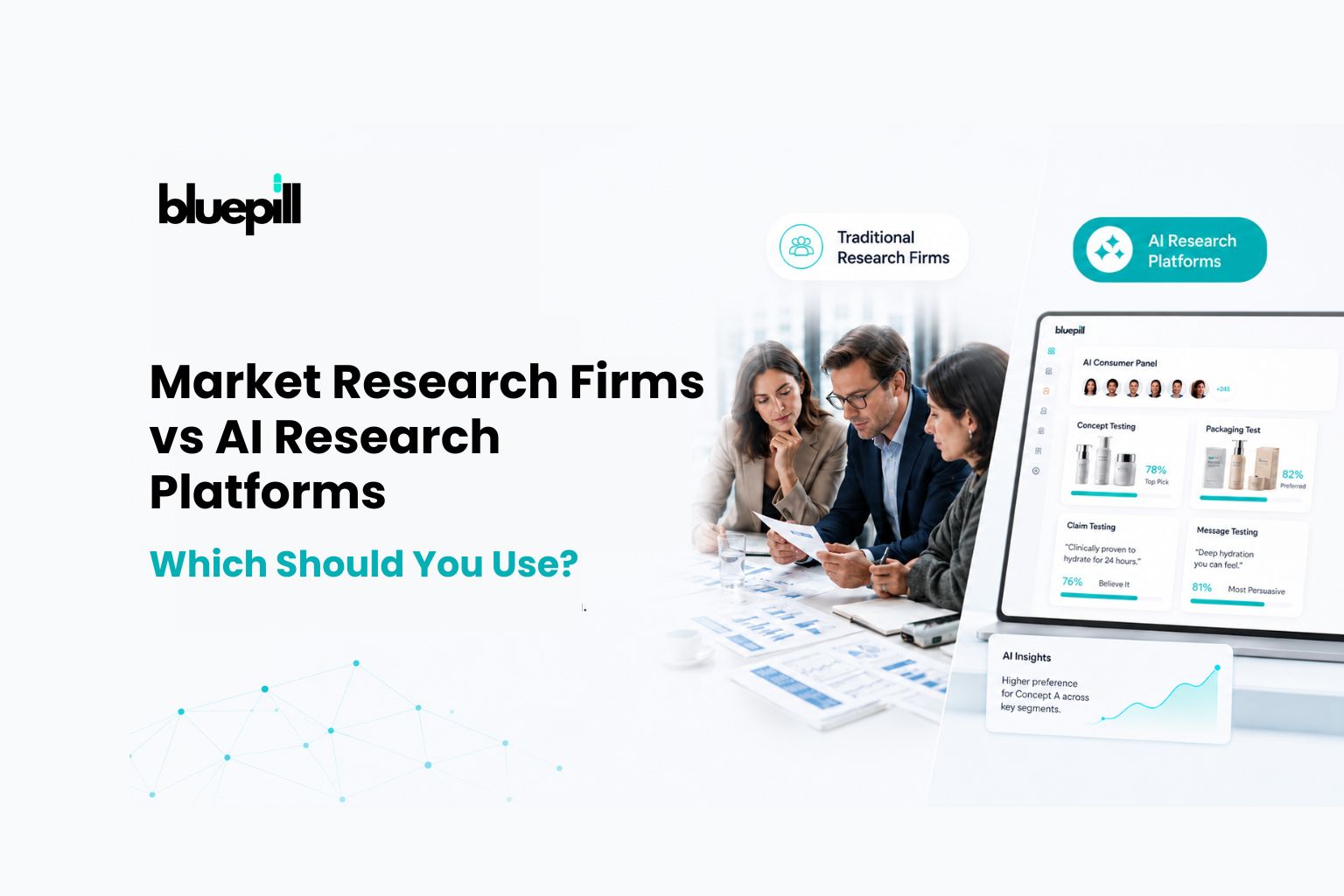
Consumer brands have more research options than ever. For a long time, the default for consumer insight was to hire a market research firm; surveys, focus groups, interviews, brand tracking, segmentation, product testing, usage and attitude studies, validation projects. That still makes sense for many decisions.
But now there's another option. AI research platforms let teams test product concepts, packaging, claims, messages, campaigns, and consumer reactions using AI consumer panels and synthetic personas.
So which should you use? It depends on the decision. If you need final validation with real consumers, a traditional firm is the right choice. If you need fast early feedback, want to test many ideas, or need to improve a concept before validation, an AI research platform is the better starting point. In many cases, the strongest workflow uses both, at the right stage.
That's where BluePill fits. BluePill gives teams a faster way to ask AI consumers what they think about products, packaging, claims, ads, and concepts before those ideas reach larger human research. It helps brands reduce guesswork, test more options, and move stronger ideas into validation.
What Market Research Firms Do Well
Market research firms are built for structured human research; collecting feedback from real people, designing studies, managing samples, analyzing results, and turning findings into reports or recommendations. They're especially valuable when the decision is important, expensive, and needs confidence from human data: validating a new product before national launch, measuring brand awareness, running a large segmentation study, understanding category behavior through interviews and surveys.
Firms are the right call when teams need human respondent data, statistical confidence, large-scale surveys, representative samples, expert moderation, deep qualitative interviews, brand tracking, usage and attitude studies, pricing studies, final concept validation, or regulatory-sensitive research.
AI can simulate likely responses, but it can't fully replace live consumer validation when a brand needs high confidence before making a major investment.
Where Market Research Firms Can Struggle
The biggest limitation is speed. A full research project can take weeks; brief, design, recruitment, fielding, analysis, output. That's acceptable for final validation but too slow for early decisions.
The second is cost. Human recruitment, moderation, programming, fieldwork, and analysis take time and people, so research becomes expensive. Teams test fewer ideas. A brand with ten product concepts, five packaging routes, and six claims may only have budget to test two or three; so the team narrows ideas internally before consumers ever see them. Good ideas die early.
Firms can also be less flexible once the study is live. If a claim is misunderstood, a concept needs revision, or a new stakeholder question comes up, you can't easily change the study mid-flight.
None of this means firms are outdated. It means they're best used when the question deserves formal human validation.
What AI Research Platforms Do Well
AI research platforms are built for speed, scale, and iteration. Instead of recruiting a human panel for every early question, teams use AI consumer panels or synthetic personas to simulate how target audiences may react.
An AI platform can test product concepts, packaging designs, brand claims, campaign messages, ad copy, landing-page copy, new SKUs, flavor and variant ideas, customer segments, purchase barriers, competitive comparisons, and usage scenarios.
The biggest payoff is in early and middle-stage decisions. A brand team may not yet know which product concept is worth testing with real consumers; AI screens multiple options and surfaces which deserve deeper validation. A marketing team may have several campaign hooks; AI consumers identify which messages feel clear, relevant, believable, or confusing before media spend. An innovation team comparing flavors, variants, or packaging claims can narrow the field faster than human recruitment allows.
Where AI Research Platforms Have Limits
AI platforms shouldn't be treated as a full replacement for every type of research. AI is best for exploration, screening, simulation, and iteration; not for statistically representative human data, regulatory-grade evidence, or final validation before a major launch.
Be careful using AI alone for:
• Final national launch validation
• Regulatory or legal claims support
• Highly sensitive or medical consumer topics
• Precise demand forecasting
• In-market sales measurement
• Long-term brand tracking
• Retailer-facing evidence that requires human data
The best teams don't ask AI to do everything. They use AI where it adds the most value, then use human research where confidence and proof matter most.
The Simple Difference
Market research firms help you validate with real consumers. AI research platforms help you explore and improve ideas faster before validation.
Firms are strongest when the question is "are we confident enough to make this decision?" AI platforms are strongest when the question is "which ideas are worth taking forward?" Both questions matter. A brand that only uses AI may move fast but miss the confidence of real-world validation. A brand that only uses traditional research may get strong validation but move too slowly or test too few ideas. The smartest workflow combines speed and confidence.
How They Compare on Cost, Speed, and Quality
The differences map cleanly across three dimensions. Cost: firms cost more because human recruitment, design, fieldwork, moderation, analysis, and reporting all involve people - justified for final validation, impractical for every early-stage idea. AI platforms are more cost-effective for rapid exploration because teams can test more ideas without recruiting a new human sample each time. Speed: firms typically take days to weeks depending on methodology, sample, and analysis; AI delivers early feedback in hours, which matters when packaging deadlines, media flights, or production windows are moving. Quality: firms get their quality from real respondents, strong sampling, rigorous design, and expert interpretation; AI gets its quality from the strength of the simulation, the clarity of the personas, the quality of the inputs, and how well the team interprets the output. The mistake is comparing the two as if they solve the same problem. A human survey is stronger for final measurement. An AI simulation is stronger for fast exploration and iteration.
The practical rule: use AI when the cost of learning needs to be low; use human research when the cost of being wrong is high.
When to Use a Market Research Firm
Use a firm when the decision needs formal human evidence, especially when the research will influence a large investment, board-level decision, retailer pitch, product launch, or long-term strategy:
• Validating a final product concept
• Measuring market demand with real respondents
• Running a statistically significant survey
• Conducting in-depth human interviews
• Moderating live focus groups
• Building a formal customer segmentation study
• Tracking brand health over time
• Testing pricing with real consumers
• Supporting retailer or investor decisions
• Measuring post-launch performance
A CPG brand preparing for national retail expansion, for example, needs a robust human study to validate consumer demand, pricing, packaging, and purchase intent. That's a firm's home turf.
When to Use an AI Research Platform
Use AI when the team needs speed, iteration, and early directional feedback; especially before a formal human study:
• Screening many product concepts
• Comparing early packaging routes
• Testing claims before finalizing copy
• Identifying confusing messages
• Exploring purchase barriers
• Understanding segment-level reactions
• Improving survey questions
• Simulating consumer decision scenarios
• Testing ad hooks before media spend
• Prioritizing what deserves human validation
If a brand has ten new snack concepts but only wants to take three into human testing, screen all ten with AI consumers first. The team refines the strongest concepts and invests human research budget more wisely.
When to Use Both Together
In most cases, the strongest approach uses both. The workflow is simple:
• AI exploration first. Test rough product concepts, packaging ideas, claims, and messages with AI consumers. Look for clarity issues, weak claims, segment differences, and purchase barriers.
• Refine the strongest options. Improve concepts based on what AI consumers reveal. Remove weak ideas. Sharpen messaging. Fix confusing claims. Adjust packaging hierarchy.
• Human validation last. Take the strongest options into a traditional survey, focus group, or validation study with real respondents.
This avoids wasting human research budget on weak ideas, and helps research firms work with better inputs. Instead of validating rough thinking, they validate refined concepts that have already been pressure-tested.
Example: A New Product Launch
A food brand wants to launch a better-for-you breakfast product. The team has five ideas: a high-protein cereal, a low-sugar granola, a ready-to-eat breakfast bowl, a functional oatmeal cup, and a kids-focused healthier breakfast snack.
Hiring a research firm immediately is expensive and slow, and may force the team to pick only two or three to test. AI consumer panels react to all five concepts first, explain what's clear or confusing, identify which feel most relevant, and show which segments are most likely to buy. The team may learn that one concept feels too similar to existing options, another has strong appeal but weak believability, and another works well for busy parents but not fitness consumers.
The team refines the strongest ideas, then a research firm validates the survivors with humans. The study is more focused and more useful.
Example: Packaging and Claims Testing
A beauty brand has three packaging routes and five possible claims. The internal team is split; one group prefers a clinical look, another a premium lifestyle design, another wants stronger ingredient claims, another worries the claims feel too technical.
AI consumer panels can pressure-test different packaging-and-claim combinations before the team commits to a final research stimulus: what do you notice first? What does this product seem to do? Which claim feels most believable? What feels confusing? Does this feel premium, clinical, natural, or trustworthy? Would this make you more likely to buy? Once the team narrows down, a research firm validates the strongest route with real shoppers.
Example: Campaign Message Testing
A marketing team is preparing a campaign and debating several messages; the agency likes an emotional hook, the product team prefers a feature-led message, the founder wants a bold claim, the performance team wants direct response copy.
AI consumer panels simulate how different consumer segments may respond to each route: which message is clearest? Which feels most believable? Which creates curiosity? Which feels generic? Which creates purchase interest? Which audience responds best? The strongest direction then goes into paid testing or human research for validation, reducing wasted media spend and improving campaign quality.
Questions to Ask Before Choosing
Before deciding between a research firm and an AI platform, ask:
• What decision are we trying to make?
• How final is the idea?
• How quickly do we need feedback?
• How many options do we need to test?
• Do we need human validation or directional learning?
• How expensive would the wrong decision be?
• Is the topic sensitive or regulated?
• Do we need statistical confidence?
• Can we improve the idea before formal research?
• Who will use the output and what action will they take?
These questions make the choice much clearer.
How BluePill Fits Into the Research Stack
BluePill isn't another survey tool. It's an AI consumer research platform that simulates consumer reactions before launch; for product concepts, new SKUs, packaging designs, brand claims, campaign messages, ad copy, landing-page copy, customer segments, purchase barriers, competitive alternatives, and flavor or variant ideas.
It's especially useful before traditional research because it helps teams decide what's worth validating. For consumer insights teams, it reduces research bottlenecks. For brand teams, it improves messaging and positioning. For innovation teams, it screens product ideas earlier. For marketing teams, it tests campaign ideas before media spend.
The result: a modern research workflow where AI helps teams learn faster and human research confirms the strongest decisions.
Final Takeaway
Market research firms and AI research platforms aren't enemies; they solve different parts of the research problem. Firms are best for human validation, statistical confidence, deep qualitative work, and high-stakes decisions. AI platforms are best for fast exploration, concept screening, packaging feedback, claims testing, message testing, and early consumer reaction simulation.
For modern consumer brands, the strongest approach is often both. Use AI first to test more ideas, improve weak concepts, and understand likely reactions. Then use traditional research when you need human validation and confidence.
The future of market research isn't traditional versus AI. It's faster learning first, stronger validation next.
Frequently Asked Questions
What is the difference between market research firms and AI research platforms?
Market research firms validate ideas with real human respondents; surveys, focus groups, interviews, segmentation studies, brand tracking. AI research platforms simulate consumer reactions using AI consumer panels and synthetic personas, letting teams test more ideas, faster, before human validation. Firms deliver confidence; AI platforms deliver speed and iteration.
When should brands use a market research firm vs an AI research platform?
Use a firm when the decision is high-stakes and needs human evidence; final product validation, retailer pitches, pricing studies, brand tracking, regulatory-sensitive research. Use an AI platform when the team needs fast, directional feedback; screening concepts, testing claims, comparing packaging routes, identifying confusing messages, or prioritizing what's worth human validation.
Can AI research replace traditional market research?
No. AI research accelerates the early stages - exploration, screening, refinement - but human research still matters for statistically representative data, regulatory-grade evidence, and final validation. The strongest workflow uses AI first, then human research for the decisions that need confidence and proof.
Are AI research platforms cheaper than market research firms?
Generally, yes, because there's no human recruitment, fielding, or moderation per study. But the value isn't only cost: AI platforms also let teams test more ideas, iterate faster, and improve concepts before they reach the more expensive human study. The cost saving compounds when AI prevents weak ideas from consuming research budget.
How do brands combine traditional and AI research?
The simplest workflow: use AI consumer panels first to explore concepts, claims, packaging, and messages - then refine the strongest options based on what AI consumers reveal - then validate the survivors with traditional human research. AI screens; humans confirm. This avoids wasting research budget on weak ideas and gives firms better inputs to work with.
Related Blogs
May 29, 2026
Message Testing: How to Find the Best Claim, Hook, or Value Proposition
May 29, 2026
AI Personas: How Brands Use Synthetic Consumers for Faster Research

May 29, 2026
Advertising Market Research: How to Validate Ads Before Launch
May 29, 2026