Surveys, focus groups, concept tests, segmentation; all still matter. What's changed is when you use them. AI consumer panels just test ideas earlier.
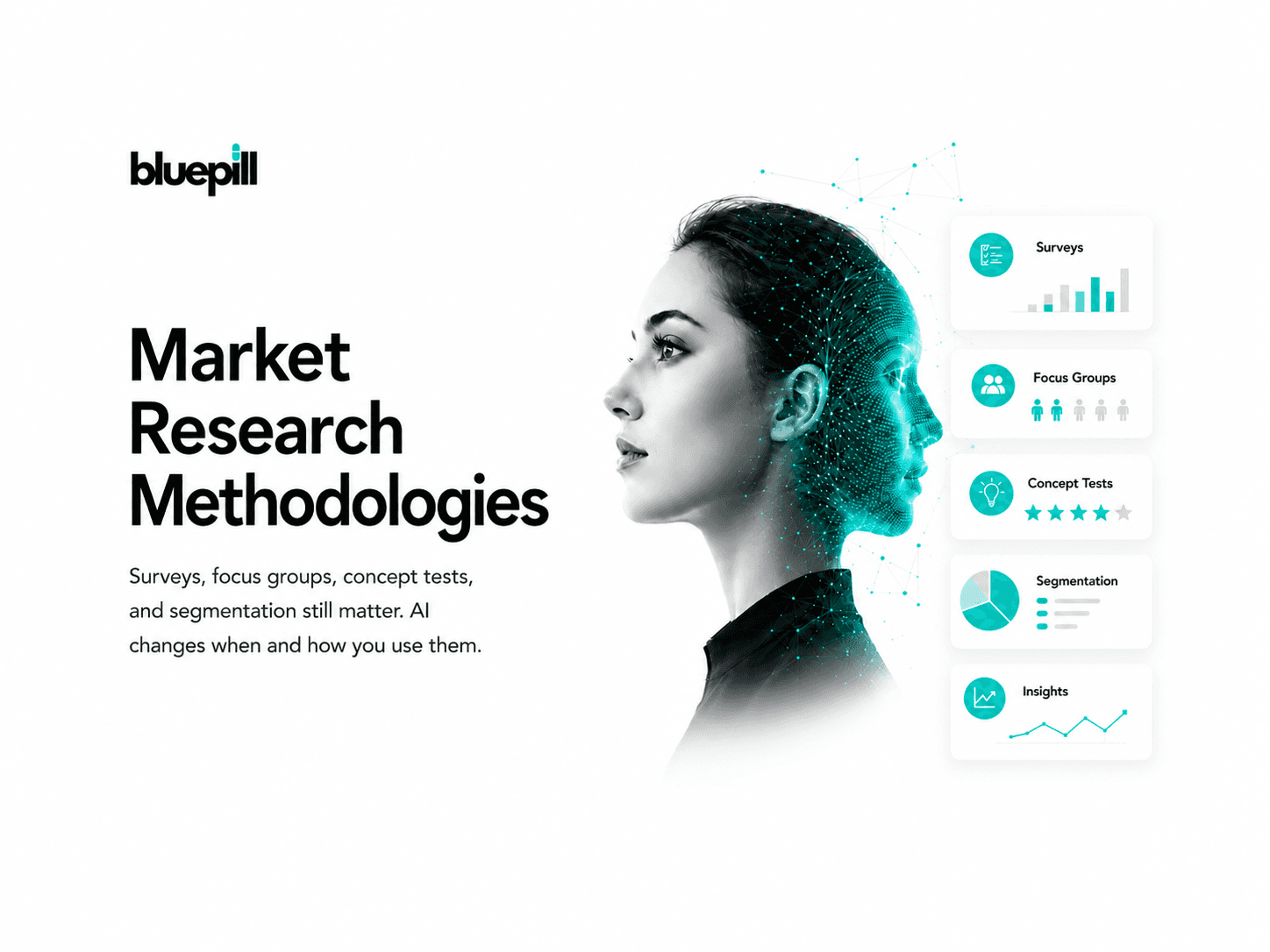
Market research has always answered one question: will people care enough to buy? For years, brands answered it with surveys, focus groups, interviews, concept tests, segmentation, and packaging tests. Those methods still work, but the way teams use them is changing.
AI has added a new layer. Teams can now use AI consumer panels, synthetic personas, and behavioral simulations to pressure-test ideas before recruiting respondents or spending on a launch. This doesn't replace traditional research; it lets research start much earlier on rough ideas and competing routes, before they harden into expensive decisions.
That's where BluePill comes in. BluePill lets brands ask AI consumers what they think about products, packaging, claims, messages, and campaigns; so, insights, brand, marketing, and innovation teams can learn faster and cut guesswork before launch.
Why Market Research Is Changing
Traditional research was built for a slow decision cycle: create a concept, recruit respondents, field a survey, analyze, report, decide. It works, but it often takes weeks. Because of that cost, teams test only a handful of ideas, which means most decisions get made before enough consumer feedback comes in:
• A brand decides the product benefit.
• Marketing chooses the campaign message.
• Design finalizes the packaging route.
• Leadership approves a new SKU.
Research often happens only after, when the team is already too committed to change course. AI fixes the sequence by making early feedback cheap. The best use of AI isn't to replace research; it's to make research continuous.
Surveys Still Matter
Surveys remain one of the most useful methodologies for measuring preference, purchase intent, awareness, brand perception, and message clarity. A good survey answers:
• Which product idea is more appealing?
• Which benefit matters most?
• Which claim feels believable?
• How strong is purchase intent?
• How do responses differ by segment?
Their weakness is cost and speed when used too early. With 12 product ideas, you can't realistically survey all of them, so teams cut the list internally, and good ideas get filtered out before a single consumer sees them. BluePill closes that gap: screen all 12 with AI consumers first, then put real survey budget behind the few that earn it.
Focus Groups Still Matter
Focus groups get at the why behind reactions; emotions, objections, confusion, language, decision-making:
• Why does this claim feel unclear?
• Why does this package look premium or cheap?
• Why does this ad feel memorable?
• What would make someone more likely to buy?
But they're hard to scale: recruitment, scheduling, moderation, and a handful of participants. Running an AI focus-group-style conversation first helps you sharpen your questions and the ideas worth testing, so the human session goes deeper instead of warming up.
Interviews Still Matter
One-on-one interviews are still essential for deep human context: personal motivations, category habits, unmet needs, emotional triggers. AI can't replace them, especially on sensitive or complex topics. What it can do is prepare them, simulating how different consumers might respond surfaces better questions, likely objections, and themes worth exploring before you sit down with real people.
Concept Testing Matters More Than Ever
Concept testing tells you whether an idea is worth pursuing. It answers:
• Is the idea clear, relevant, and different?
• Does it solve a real problem and create purchase interest?
• Which audience responds, and what should change before launch?
Most launches fail because the core idea isn't strong enough: the product is useful but the message is unclear, or the benefit is real but the audience doesn't get it. Traditional concept testing runs too late, once the team is attached to the idea. Testing concepts, claims, and positioning routes with AI consumers earlier lets you fix weak ideas and prioritize strong ones before a full study.
Packaging Testing Is Critical for Consumer Brands
Packaging is usually the first thing a shopper sees; it has to grab attention, explain the product, signal the benefit, and build trust. Packaging testing checks that before production or rollout:
• Is the product easy to understand?
• Does the design stand out?
• Does the pack feel premium, healthy, affordable, or trustworthy?
• Which design drives stronger purchase interest, and what confuses people?
This matters most for CPG, FMCG, beauty, food, beverage, wellness, and healthcare brands. Comparing packaging routes, claims, and layouts with AI consumers first makes the research faster and moves it earlier, before final-design costs lock in.
Message Testing Should Happen Before Media Spend
Plenty of campaigns fail on the message alone; right product, right audience, strong creative, but the message doesn't connect. Message testing finds the headlines, claims, and hooks most likely to land:
• Which message is easiest to understand?
• Which claim feels most believable?
• Which hook creates interest, and what sounds exaggerated?
• Which message works best per segment?
Testing ad copy, product descriptions, and landing-page messages with AI consumers before media spend replaces internal opinion with directional feedback while changes are still free.
Customer Segmentation Still Matters
Segmentation captures the obvious truth that people buy for different reasons - price, quality, convenience, health, status, sustainability, taste, trust. The problem is that traditional segmentation goes static: profiles land in a deck and never reach daily decisions. AI makes it operational, test how each segment reacts to the same product, claim, message, or pack, so you move from describing the audience to testing decisions against it.
Behavioral Studies Are Becoming More Important
What people say and what they do rarely match:
• They say they want healthy food, then buy indulgent snacks.
• They say price matters most, then choose premium packaging.
• They say sustainability matters, then decide on convenience.
Behavioral research explores those gaps, and behavioral simulation is becoming a core part of consumer insights. Simulating reactions to products, claims, packaging, and campaigns gives teams a faster read on likely objections, motivations, and purchase drivers before launch.
Secondary Research Is Useful, but Not Enough
Market reports, category trends, competitor analysis, reviews, and social listening set the context; but they mostly tell you what's already happened. They show a category is growing or a competitor's claim; they can't tell you whether your idea, pack, or message will work. The strong pattern is to use secondary research to understand the market, then test the specific decisions with AI consumers:
• Which claim should we use?
• Which packaging route should we choose?
• Which audience should we target first?
• Which idea moves forward?
That's how teams get from information to action.
The New Market Research Workflow
The old workflow was linear:
Create the idea → run the research → wait for the report → decide → launch.
The new one is continuous:
Create multiple ideas → test with AI consumers → improve the strongest → validate with human research where needed → launch with confidence.
That's the real value of AI in market research: more questions asked earlier, more ideas tested, a lower cost of learning, and fewer weak concepts taken too far.
How BluePill Fits Into This Workflow
BluePill is the AI consumer simulation layer for modern research teams. Use it to test product concepts, new SKUs, packaging, brand claims, ad messages, campaign ideas, landing-page copy, flavor and variant ideas, segments, purchase drivers, and consumer objections.
• Insights teams clear bottlenecks.
• Brand teams sharpen messaging.
• Innovation teams screen ideas earlier.
• Marketing teams test campaigns before media spend.
It's most valuable for fast, directional feedback; deciding what's worth taking into deeper validation.
AI Should Support Research, Not Replace All of It
AI shouldn't replace every methodology. Human research still matters for final validation, statistically representative results, sensitive topics, regulatory confidence, and real-world behavior. The best approach is AI-assisted research: use AI to explore, screen, and refine; use human research to validate, measure, and confirm. That combination gives you both speed and confidence.
Final Takeaway
Market research methodologies still matter in the AI era. Surveys, focus groups, interviews, concept testing, packaging testing, message testing, segmentation, behavioral studies, and secondary research all keep their roles. What's changed is when and how you use them.
AI consumer panels and synthetic personas make it possible to test ideas earlier, compare more options, and learn faster; before research, production, or launch get expensive. In the AI era, the strongest teams won't ask fewer questions. They'll ask better ones, earlier.
Frequently Asked Questions
Which market research methodologies still matter in the AI era?
All the core ones still matter: surveys, focus groups, interviews, concept testing, packaging testing, message testing, segmentation, behavioral studies, and secondary research. What's changed is the sequence; AI consumer panels now handle early exploration and screening, so human methods are reserved for validating the ideas that have already proven directionally strong.
Can AI replace focus groups and surveys?
No. AI doesn't replace focus groups or surveys; it runs before them. AI consumer panels are best for fast, early, low-cost feedback that sharpens your questions and narrows your options. Human focus groups and surveys still deliver final validation, statistically representative results, and confidence on sensitive or regulated topics.
What is an AI consumer panel?
An AI consumer panel is a set of synthetic personas that simulate how different consumer segments react to a product, package, claim, message, or campaign. It lets brands gather directional feedback in hours instead of weeks, before recruiting real respondents or committing to a full study.
When should brands use AI research versus traditional research?
Use AI research to explore, screen, and refine early, when you have many ideas and need to know which ones deserve deeper investment. Use traditional human research to validate, measure, and confirm, when you need representative data, regulatory confidence, or real-world behavioral proof before launch.
What can BluePill test?
BluePill tests product concepts, new SKUs, packaging designs, brand claims, ad messages, campaign ideas, landing-page copy, flavor and variant ideas, customer segments, purchase drivers, and consumer objections; giving insights, brand, marketing, and innovation teams fast directional feedback before decisions get expensive to change.
Related Blogs
May 29, 2026
Message Testing: How to Find the Best Claim, Hook, or Value Proposition
May 29, 2026
AI Personas: How Brands Use Synthetic Consumers for Faster Research

May 29, 2026
Advertising Market Research: How to Validate Ads Before Launch
May 29, 2026