Market research reports explain the market, live consumer testing evaluates your idea. Use reports to spot opportunity, testing to capture it.
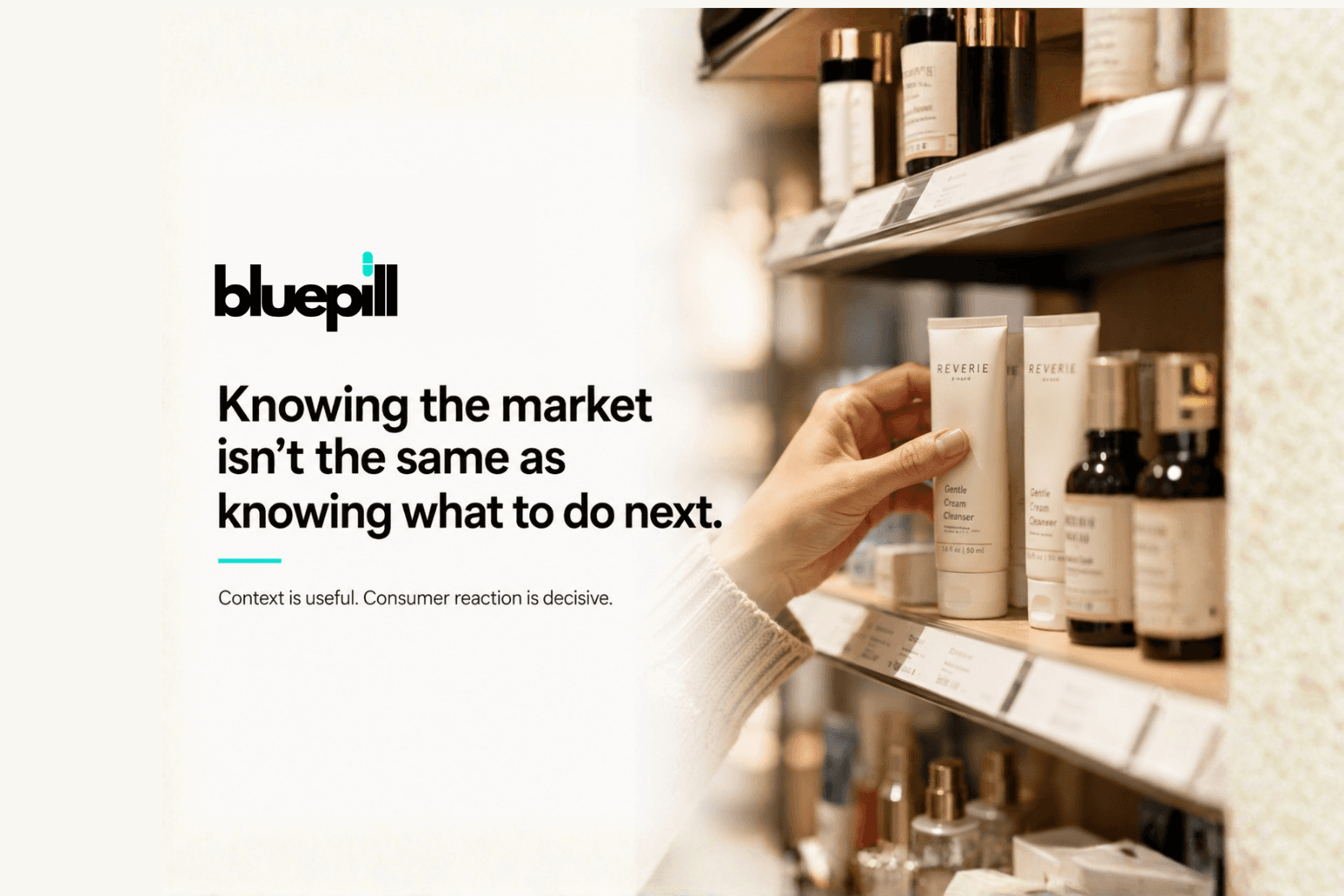
Market research reports and live consumer testing are both useful, but they don't solve the same problem.
A market research report helps you understand the market. Live consumer testing helps you understand how people respond to your specific idea.
That difference matters. A report may tell you a category is growing; consumer testing tells you whether your product concept is clear enough to win. A report may show that consumers care about health, convenience, or sustainability; testing tells you whether your claim is believable. A report may show that competitors are investing in a trend; testing tells you whether your audience would actually switch from what they buy today.
For consumer brands, that distinction is everything. You're not just asking "is this market attractive?"; you're asking, "will this product, package, claim, message, or campaign work for this audience?"
In the AI era, live testing is also getting much faster. AI consumer panels, synthetic personas, and behavioral simulations let teams test ideas before running large human studies. That's where BluePill helps; brands can ask AI consumers what they think about product concepts, packaging, claims, messages, campaigns, and purchase decisions, so teams move beyond static market information to test how consumers may react to specific decisions before launch.
What Are Market Research Reports?
Market research reports are structured documents that summarize information about a market, category, consumer trend, competitor landscape, or industry opportunity. They typically cover:
• Market size and growth trends
• Category performance
• Consumer behavior patterns
• Competitive landscape
• Pricing trends
• Channel insights
• Regional insights
• Future forecasts
• Industry risks
• Macro trends
They come from research firms, consulting companies, analyst firms, industry associations, data providers, or internal strategy teams. They give context, useful at the strategy and planning stage. Is the category growing? What trends are shaping demand? Who are the major players? Which consumer needs are emerging? Where might the opportunity be?
But reports have limits.
What Is Live Consumer Testing?
Live consumer testing gets feedback from consumers on a specific product, concept, package, claim, message, ad, or experience. Methods include surveys, focus groups, interviews, concept testing, packaging testing, claims testing, message testing, ad testing, product usage testing, landing page testing, AI consumer panels, and synthetic persona testing.
It answers actionable questions:
• Do consumers understand the product?
• Do they care about the benefit?
• Do they believe the claim?
• Would they buy it?
• Which segment responds best?
• What would stop them from buying?
• Which package is clearer?
• Which message creates more interest?
A report shows demand exists in the category. Live testing shows whether your idea can capture it.
The Simple Difference
Market research reports explain the market. Live consumer testing evaluates your decision. Reports help you know where to look. Testing helps you know what to do.
Both are useful, but they shouldn't be treated as interchangeable.
How Reports and Testing Compare
The differences map cleanly across three dimensions.
Time orientation: reports explain what already happened - past sales, trends, performance; while consumer testing explores what may happen if you make a specific decision.
Format: reports are static, written once and then read and extracted; testing is interactive, letting teams ask, test, refine, and re-test.
Best use: reports excel at strategy - category understanding, trend analysis, opportunity sizing; while testing excels at execution - concepts, packaging, claims, messaging, pricing, launch readiness.
The takeaway stays the same: strategy without execution leads to vague opportunity chasing; execution without strategy leads to testing in markets that aren't attractive. Strong brands need both, use reports to understand the opportunity, then use testing to decide how to capture it.
When Market Research Reports Are Useful
Reports are useful when a team needs broad context; entering a new category, building a strategy, sizing an opportunity, understanding the competitive landscape. Use them to understand market size, category growth, consumer trends, competitor activity, pricing norms, channel shifts, regional opportunities, macro changes, and industry forecasts.
A CPG brand considering the functional beverage category, for example, gets real value from a report covering market size, growth rate, major brands, common claims, pricing tiers, and consumer trends. That information sharpens leadership alignment around opportunity size and strategic direction before the brand creates a product concept or campaign.
Where Market Research Reports Fall Short
The biggest limitation: they're usually broad. Reports may tell you what's happening in the category, but rarely whether your specific idea will work.
• A report may say consumers are interested in gut health, but not whether your gut health claim is believable.
• A report may say premium skincare is growing, but not whether your packaging feels premium.
• A report may say shoppers want convenient meals, but not whether your meal concept feels worth the price.
• A report may say sustainability matters, but not whether your sustainability message will change purchase behavior.
Reports build confidence at the category level, not the execution level. That's where brands get into trouble: they see a trend in a report and assume demand exists for their product. Market demand and product demand are not the same.
When Live Consumer Testing Is More Useful
Testing is more useful when the team needs to make a specific decision: which concept to launch, which packaging design to choose, which claim to use, which message to lead with, which segment to target, which benefit matters most, which price point feels acceptable, which ad hook creates interest, which variant deserves investment, what objections need fixing.
A report may show that protein snacks are growing. If your brand has five protein snack concepts, you still need to know which is clearest, most relevant, most differentiated, and most likely to drive purchase. That requires testing, and AI consumer panels make it fast enough to do early, when changes are still cheap.
Example: A Beauty Brand Exploring a New Category
A beauty brand is considering a new skin-barrier-repair product. A market research report shows skin barrier care is growing, consumers want gentler products, ingredient education is rising, competitors are using claims around ceramides, hydration, and sensitivity, and premium products are performing well.
Useful context, but the brand still needs to test:
• Do consumers understand "skin barrier repair"?
• Which claim feels most believable?
• Does the packaging feel clinical, gentle, or premium?
• Which audience has the strongest need?
• Does the price feel justified?
• What would make consumers switch from current skincare products?
That's where AI consumer panels test product concepts, claims, and packaging directions before production or human validation.
Example: A Food Brand Launching a New Snack
A food brand wants to launch a healthier snack. A report shows better-for-you snacking is growing, consumers want low sugar and high protein, parents are looking for healthier kids' snacks, taste remains the biggest purchase driver, and premium snack brands are gaining shelf space.
Useful context, but the brand still needs to know:
• Is our concept clear?
• Does the product sound tasty?
• Which claim matters more - low sugar or high protein?
• Does the package create trust?
• Would parents buy it for children? Would adults buy it for themselves?
• What price feels acceptable, and what would stop purchase?
A report identifies the opportunity. Testing shows whether your idea is strong enough to capture it.
How AI Changes Live Consumer Testing
Traditional live testing is valuable but slow; recruiting respondents, running surveys, moderating focus groups, and analyzing results takes time and budget that early-stage decisions don't always have.
AI consumer testing changes the early workflow. Teams can ask AI consumers to react to concepts, claims, packaging, messages, and campaign ideas before running full human studies. This lets teams:
• Test more ideas earlier
• Identify confusing language
• Compare product concepts
• Evaluate claims
• Understand segment differences
• Find likely purchase barriers
• Improve packaging before production
• Choose stronger ideas for human validation
Most useful while the team is still exploring and improving options; it replaces internal opinion with directional consumer feedback at a stage where research budget usually doesn't reach.
When Reports and Testing Should Work Together
The best workflow isn't reports versus testing; it's reports plus testing:
Start with market research reports - understand the category, trends, competitors, pricing, and opportunity.
Build hypotheses - identify potential product ideas, segments, claims, messages, or packaging routes.
Run AI consumer testing - test early ideas, understand reactions, improve weak areas.
Validate with human research where needed - real surveys, interviews, focus groups, or product tests for final confidence.
Launch and measure - use sales, conversion, retention, and campaign data to keep learning.
This gives teams both context and action.When a Report Is Enough
Sometimes a report is sufficient, when you're exploring a category for the first time, need market size or trend context, preparing an internal strategy discussion, comparing category opportunities, studying competitor positioning, or not yet making a specific product or campaign decision.
In those moments, broad market intelligence may be all you need. But once the team is choosing a product, package, claim, price, audience, or message, reports alone usually aren't enough.When Consumer Testing Is Necessary
Testing becomes necessary when the decision is specific and expensive to reverse. Use consumer testing before:
• Launching a new product
• Finalizing packaging
• Approving brand claims
• Spending on media
• Choosing a campaign message
• Entering a new audience segment
• Committing to production
• Pitching retailers
• Changing positioning
• Scaling a new SKU
A report can inform the direction; testing should guide the choice.
Common Mistakes Brands Make
• Using a report as proof of product demand. A growing market doesn't guarantee your product succeeds.
• Skipping testing because the trend looks obvious. Even obvious trends require strong execution.
• Testing too late. If the product, package, and message are locked, research only confirms problems you can't easily fix.
• Relying only on internal opinion after reading a report. The report shows opportunity; consumers still need to test the brand's specific response to that opportunity.
• Treating AI testing and human testing as the same. AI testing is for fast exploration and refinement. Human testing is for final validation and confidence.How BluePill Helps Bridge the Gap
BluePill moves teams from market research reports to consumer decision testing. A brand reads a report, identifies an opportunity, then tests how AI consumers respond to specific ways of capturing it:
• A report says consumers want healthier snacks → BluePill tests which snack concept feels most relevant.
• A report says skincare buyers care about trust → BluePill tests which claim feels most believable.
• A report says functional drinks are growing → BluePill tests which benefit creates stronger purchase intent.
• A report says packaging matters at shelf → BluePill tests which package communicates faster.
It closes the gap between knowing the market and making the right brand decision.
Final TakeawayMarket research reports and live consumer testing are both useful, they just serve different purposes. Reports help brands understand the market. Consumer testing helps brands understand how people may respond to specific decisions.
Reports are useful for strategy, category understanding, trend analysis, and opportunity sizing. Live consumer testing is useful for concepts, packaging, claims, messaging, pricing, audience selection, and launch.In the AI era, AI consumer panels let teams move faster, testing ideas before investing in full human research. The most useful research isn't the one that describes the market. It's the one that helps your team decide what to do next.
Frequently Asked Questions
What is the difference between market research reports and live consumer testing?
Market research reports describe the market - size, trends, competitors, pricing, opportunity. Live consumer testing evaluates how consumers respond to a specific product, package, claim, message, or campaign. Reports tell you where to look; testing tells you what to do.When should brands use a market research report vs. consumer testing?
Use a report when you need broad context - entering a category, sizing opportunity, understanding trends, or aligning strategy. Use consumer testing when you need to make a specific decision - choosing a concept, finalizing packaging, picking a claim, or selecting a campaign message. The strongest workflow uses both: reports for strategy, testing for execution.Can a market research report predict whether a product will succeed?
No. Reports show category-level demand, but they can't tell you whether your specific concept, claim, or packaging will work. A growing market doesn't guarantee that any individual product succeeds - that requires consumer testing of the brand's actual response to the opportunity.How does AI consumer testing fit alongside traditional market research?
AI consumer panels accelerate the early-exploration stage of live testing. Teams can compare concepts, claims, packaging routes, and messages with AI consumers in hours instead of weeks - before committing budget to full human research. The strongest workflow is AI testing for exploration and refinement, human research for final validation.Is one type of research better than the other?
Neither is better - they answer different questions. Reports inform strategy; testing guides execution. Brands that rely only on reports tend to chase trends without validating their specific idea. Brands that rely only on testing tend to over-invest in ideas in unattractive markets. The strongest brands use both, in order.
Related Blogs
May 29, 2026
Message Testing: How to Find the Best Claim, Hook, or Value Proposition
May 29, 2026
AI Personas: How Brands Use Synthetic Consumers for Faster Research

May 29, 2026
Advertising Market Research: How to Validate Ads Before Launch
May 29, 2026