Most surveys measure what consumers say. The ones that predict consumer decisions ask about tradeoffs, barriers, behavior, and not just preference.
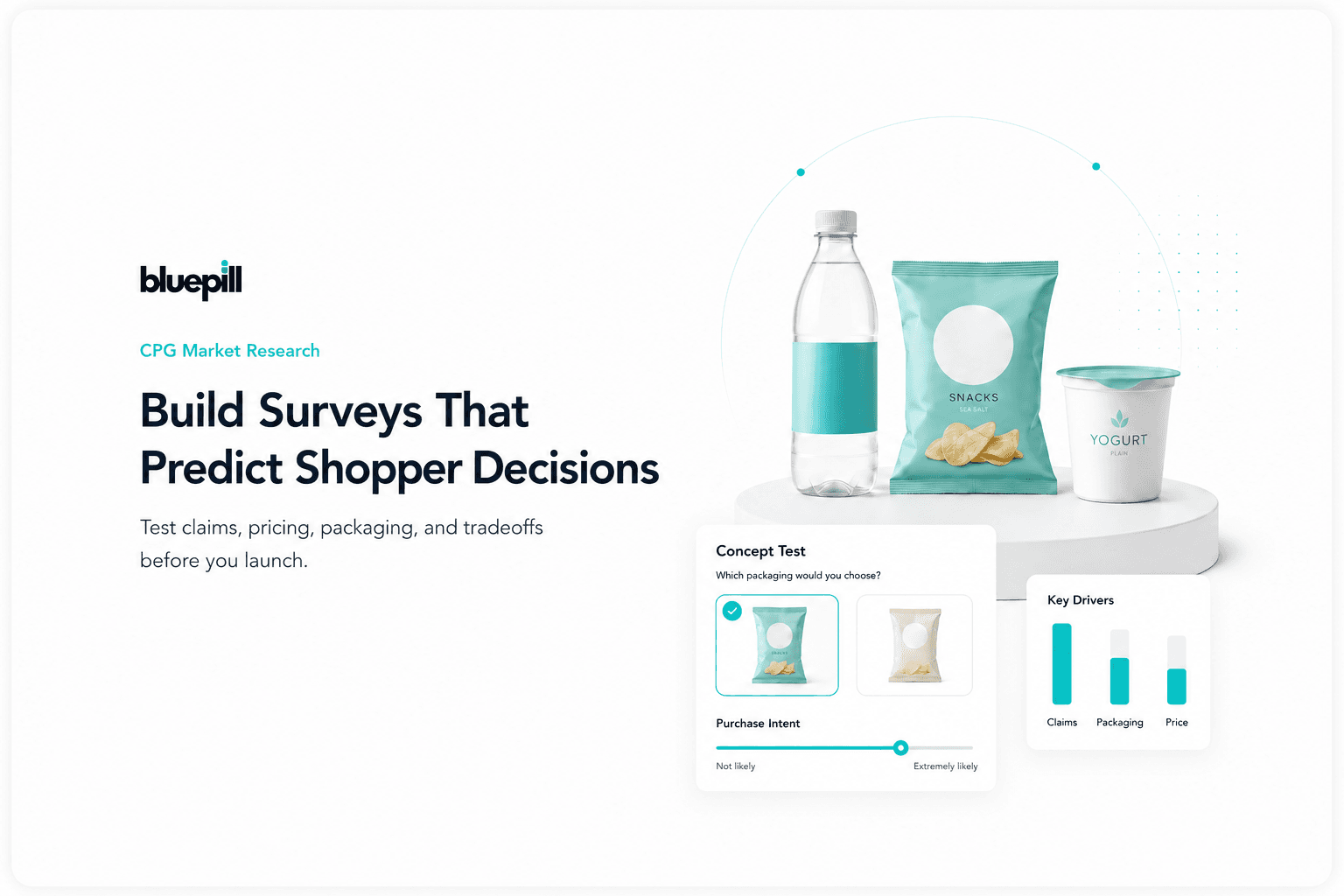
Most market research surveys ask people what they think. The better question is: what will people actually do?
That's where many surveys fail. A consumer may say they like a product idea but never buy it. They may rate a concept highly and still choose a cheaper, more familiar alternative. They may say sustainability matters, then decide on price or convenience at the moment of purchase.
Collecting opinions isn't enough. A good survey should predict consumer decisions: whether buyers will pay the price, believe the claim, notice the pack, and choose your brand over another.
In the AI era, teams can pressure-test that prediction earlier. AI consumer panels, synthetic personas, and behavioral simulations let researchers test survey questions, screen ideas, and surface likely reactions before fielding a full human study. That's where BluePill helps; teams ask AI consumers what they think about product concepts, packaging, claims, messages, campaigns, and purchase decisions, so the human survey that follows is sharper, cheaper, and more predictive.
Start With the Decision, Not the Survey
The biggest mistake in survey design is starting with questions. Start with the business decision instead. Before writing anything, ask: what are we trying to decide?
• Choosing between product concepts?
• Testing packaging designs?
• Validating a new claim?
• Deciding which segment to target?
• Comparing campaign messages?
• Evaluating whether a new SKU is worth launching?
A survey that tries to answer too many things usually answers nothing well. If the decision is whether to launch a protein snack, the survey should be built around that; not become a generic study of snacking habits, awareness, packaging, diet preferences, and media all at once.
A decision-led survey produces sharper answers. Instead of "do people like this idea?" it asks: "is this idea strong enough to move forward, and for which audience?"
Define the Consumer Behavior You Want to Predict
A survey gets useful when it's designed around a specific behavior:
• Will consumers buy this product?
• Will they switch from another brand?
• Will they pay a premium?
• Will they trust this claim?
• Will they notice this package?
• Will they click this ad?
• Will they recommend it?
Each behavior needs different questions. To predict purchase, you measure intent, perceived value, need fit, barriers, price sensitivity, and competitive alternatives. To predict message performance, you measure clarity, relevance, believability, uniqueness, emotional response, and action intent. To predict packaging performance, you measure noticeability, product understanding, claim hierarchy, perceived quality, trust, and purchase interest.
A good survey doesn't just ask if consumers like something. It studies the decision path.
Ask About Tradeoffs, Not Just Preferences
Consumers are good at expressing preferences. Real decisions involve tradeoffs.
Someone may like a product but not enough to pay more. They may like the packaging but trust a competitor more. They may like a claim but find it hard to believe. They may like a flavor but not see when they'd use it.
Preference questions alone are weak predictors. Tradeoff questions are stronger:
• Which would you choose if they were the same price?
• Which would you choose if one was 20% more expensive?
• What would stop you from buying this?
• Which benefit matters most when choosing this type of product?
• Which product would you replace with this one?
• How often would you realistically buy it?
These force respondents closer to a real buying moment. AI consumers can rehearse the same tradeoffs cheaply; useful for refining tradeoff questions and avoiding shallow preference data before the human survey goes out.
Measure Purchase Intent Carefully
Purchase intent is one of the most common survey metrics; and one of the easiest to misread. "Probably buy" doesn't always mean will buy. People overstate interest because saying yes costs them nothing.
To make purchase intent useful, never ask it in isolation. Pair it with:
• How relevant is this product to your current needs?
• How different is it from what you already buy?
• How believable are the claims?
• How much would you expect to pay?
• What would stop you from buying it?
• What would you buy instead?
• How often would this fit into your routine?
Combined with relevance, differentiation, trust, value, and barriers, intent becomes far more predictive. A concept with high interest but low believability needs a clearer proof point. High relevance but low willingness to pay needs pricing or packaging changes. Strong differentiation but low clarity needs better messaging.
The goal isn't a purchase-intent score. It's to understand what's driving or blocking it.
Test Clarity Before Appeal
Many surveys ask whether consumers like an idea before checking whether they understand it. If they don't understand it, their opinion isn't useful. Clarity comes before appeal.
For a product concept: What do you think this product is? Who is it for? What problem does it solve? What benefit stands out most? What feels unclear?
For a packaging design: What product do you think this is? What benefit do you notice first? What claim stands out? What feels confusing?
For a campaign message: What's the main idea? What is the brand trying to say? What action would you take after seeing this? What feels unclear or exaggerated?
A concept can't sell if people can't understand it. AI consumers surface confusing language, weak benefit hierarchy, and mismatched expectations fast; before real budget gets spent.
Include Competitive Context
Consumers don't make decisions in isolation. They compare. A shopper isn't asking "do I like this?"; they're asking, often without thinking, "is this better than what I already buy?"
Build that into the survey:
• What do you currently buy for this need?
• Why do you choose that product?
• What would make you switch?
• How does this concept compare with your current choice?
• What would need to be true for you to try this instead?
A product can score well in isolation and still fail in market because the existing alternative is good enough; especially in crowded categories like CPG, beauty, wellness, food, beverage, ecommerce, and healthcare.
Segment the Responses
Averages hide the most important insight. A product can look mediocre overall and yet perform strongly with one segment. A claim can fall flat broadly and still be highly persuasive for premium buyers. A pack may resonate with younger consumers and confuse older shoppers. A price may be acceptable to loyal users and too high for trial buyers.
Capture enough information to compare across meaningful groups — current users, heavy users, light users, non-users, premium buyers, price-sensitive buyers, health-focused consumers, convenience-driven consumers, loyalists, switchers, first-time buyers.
The right segments depend on the category and the decision. The goal isn't fancy segmentation; it's finding where the opportunity is strongest. Simulating responses across personas with AI consumers before the human study reveals which segments are most promising and which questions need to be customized per group.
Ask Open-Ended Questions, But Use Them Well
Open-ended questions reveal language, emotion, and objections that multiple-choice can miss. But most surveys use them poorly.
Weak: "What do you think?"
Stronger:
• What's the main reason you would buy or not buy this?
• What feels most believable or unbelievable?
• What would you tell a friend about this product?
• What part of this concept is most confusing?
• What would make this more appealing?
• What concern would you have before buying?
These give richer insight and improve copy, claims, packaging, and positioning, because they reveal how consumers naturally describe the product.
Avoid Leading Questions
A survey that leads the respondent produces weak data.
Leading: "How appealing is this innovative and healthy snack?"
The words "innovative" and "healthy" tell the respondent how to think. Better:
• How appealing is this snack?
• Which words would you use to describe it?
• What makes it appealing or unappealing?
• How healthy does it seem?
• How new or different does it seem?
Same with claims. Instead of "Does this trusted, science-backed claim make you more likely to buy?" ask "How believable is this claim?" and follow with "What makes it believable or unbelievable?"
Good survey design removes bias wherever possible. AI tools can flag leading language and check whether respondents interpret questions as intended before the survey goes out.
Make the Survey Feel Like a Real Decision
The closer a survey feels to a real buying moment, the more useful it gets. Real decisions include context; where the consumer is, what they're trying to solve, what alternatives exist, what the product costs, what it looks like, what claims they can see.
A survey doesn't need to reproduce the full shopping experience, but it should include enough context to make the response meaningful.
"Would you buy this drink?" is weaker than:
Imagine you're shopping for a healthier afternoon drink option. You see this product priced at $3.49 next to other ready-to-drink beverages. How likely would you be to buy it?
For packaging, include shelf context where possible. For message testing, show the actual ad or landing-page copy. For concept testing, include price, benefit, use case, and alternatives.
Use AI Before Human Research
One of the best ways to improve survey quality is to test the survey before sending it to real respondents. Traditionally that meant internal review or a small pilot. Now, AI consumers are the early research-design layer.
Test with AI consumers first:
• Are the questions clear?
• Is the concept understandable?
• Do the answer options make sense?
• Do the claims feel believable?
• Do segments interpret the idea differently?
• Is the survey missing important objections?
• Is the concept actually ready for human validation?
This avoids burning research budget on weak survey design, and lets teams screen more ideas before deciding what to validate.
What a Predictive Survey Includes
A market research survey that predicts consumer decisions covers more than preference. It should capture:
• Clarity: does the consumer understand the concept?
• Relevance: does it fit their needs?
• Differentiation: is it different from what they buy now?
• Believability: do they trust the claims?
• Perceived value: does the price match the benefit?
• Purchase intent: combined with all of the above, not on its own.
• Competitive comparison vs. existing alternatives.
• Barriers to purchase: what's stopping them?
• Use-case fit: when and where would they use it?
• Segment-level response: who responds strongest?
• Open-ended reasoning: why?
• Tradeoff behavior: what would they give up?
A Simple Survey Structure for Consumer Decision Prediction
A practical sequence teams can use:
Category behavior - what they currently buy, how often, where, what matters most.
Concept introduction - show the product, claim, pack, message, or campaign realistically.
Understanding - what they think it is, who it's for, what benefit they notice first.
Appeal - how appealing, relevant, different, and believable it feels.
Decision intent - how likely they'd buy, try, click, switch, recommend, or pay.
Barriers - what would stop them, what info they'd need.
Competitive context - what they'd choose instead, what would make them switch.
Open-ended reasoning - why they responded the way they did.
Segmentation - compare responses across meaningful audience groups.
This sequence gives teams a far better shot at predicting real decisions than a generic preference survey.
How BluePill Helps Teams Design Better Surveys
BluePill moves teams from opinion collection to decision simulation. Instead of using surveys only after ideas are nearly final, teams can use BluePill earlier to test questions, concepts, claims, packages, and messages with AI consumers.
The result:
• Screen more ideas before human research.
• Catch confusing concepts earlier.
• Understand purchase barriers.
• Compare reactions across segments.
• Improve claims and messaging.
• Test packaging routes faster.
• Design stronger human surveys.For insights teams, that means better inputs. For brand teams, clearer positioning. For product teams, stronger concepts. For marketing teams, better campaigns before spend. Not just faster research, better decision-making.
Final Takeaway
A good market research survey shouldn't only ask what consumers think. It should help predict what they may do.
That means designing surveys around real decisions, tradeoffs, purchase barriers, competitive context, and segment-level behavior. In the AI era, teams no longer have to wait until the end of the process to get feedback; AI consumer panels test ideas earlier, sharpen survey design, and identify stronger concepts before investing in full human research.
The best surveys don't just collect answers. They help teams make better decisions.Frequently Asked Questions
What makes a market research survey predictive of consumer decisions?
Predictive surveys go beyond preference. They start with the business decision, capture tradeoffs and barriers, include competitive context, test clarity before appeal, and segment the responses. Purchase intent only becomes predictive when it's paired with relevance, differentiation, believability, and price sensitivity.
Why do consumers say one thing in surveys but do another?
Because surveys often measure stated preference, which has no real cost. Real buying involves tradeoffs - price, trust, convenience, alternatives - that preference questions don't capture. Adding tradeoff and barrier questions narrows the gap between what consumers say and what they do.
How should purchase intent be measured in a survey?
Never in isolation. Pair purchase intent with relevance, differentiation, believability, expected price, barriers, alternatives, and use-case fit. Combined, these reveal what's driving or blocking the intent; not just the score, but the levers behind it.
What is a leading question, and how do you avoid it?
A leading question primes the respondent toward a particular answer using loaded words like "innovative," "healthy," or "trusted." Avoid them by stating the subject neutrally and letting respondents describe it in their own words.
Can AI replace human market research surveys?
No. AI consumer panels accelerate survey design and screening before fielding; testing questions, surfacing objections, comparing segments. Human surveys still deliver final, statistically representative validation. AI is the before, not the replacement.
Related Blogs
May 29, 2026
Message Testing: How to Find the Best Claim, Hook, or Value Proposition
May 29, 2026
AI Personas: How Brands Use Synthetic Consumers for Faster Research

May 29, 2026
Advertising Market Research: How to Validate Ads Before Launch
May 29, 2026