Learn how market research technology is changing consumer insights teams, from surveys and analytics to AI consumer panels, synthetic personas, and behavioral simulations.

Consumer insights teams are being asked to move faster.
Brand teams want feedback before campaigns launch.
Innovation teams want to screen more product ideas.
Packaging teams want to test claims before production.
Marketing teams want to know which message will work before media spend.
Leadership wants faster evidence before approving big decisions.
At the same time, consumer behavior is becoming harder to predict.
People compare more options.
They trust claims less easily.
They move across retail, ecommerce, social, and DTC channels.
They respond differently by segment, occasion, and buying context.
They may say one thing in research but behave differently in market.
This is why market research technology is changing.
Traditional research still matters. Surveys, interviews, focus groups, human panels, product testing, and brand tracking are still valuable. But they are no longer the only tools available to insights teams.
Modern market research technology now includes AI consumer panels, synthetic personas, behavioral simulations, automated survey analysis, social listening, review mining, customer analytics, concept testing platforms, packaging testing tools, and campaign pre-testing systems.
The goal is not only to collect more data.
The goal is to help teams make better decisions faster.
That is where BluePill helps.
BluePill lets teams ask AI consumers what they think about product concepts, packaging, claims, campaign messages, pricing, and purchase decisions. It helps consumer insights teams test more ideas earlier, identify likely objections, and decide what deserves deeper human validation.
What Is Market Research Technology?
Market research technology refers to software, platforms, and AI tools that help teams collect, analyze, simulate, and apply consumer insight.
It can help teams understand:
What consumers need
What they currently buy
Which products they may consider
Which claims they believe
Which packages communicate clearly
Which messages create interest
Which audience segments respond best
What would stop purchase
What should be tested before launch
In the past, research technology was mostly used to run surveys, recruit panels, analyze data, or produce reports.
Today, it is becoming more active in decision-making.
Modern research tools do not only ask consumers questions. They help teams test concepts, simulate reactions, analyze open-ended responses, compare segments, and generate faster recommendations.
Why Consumer Insights Teams Need Better Tools
Insights teams are often stuck between speed and rigor.
Business teams want answers quickly.
Research teams want quality and confidence.
That tension is difficult.
A full human research study can be valuable, but it may take time. A quick internal decision may be fast, but it may rely too much on opinion.
Market research technology helps bridge this gap.
It allows teams to:
Test ideas earlier
Screen more concepts
Analyze responses faster
Identify segment differences
Reduce repetitive manual work
Prepare better human studies
Support more business questions
Improve decision speed without fully losing rigor
For consumer brands, this matters because product, packaging, claims, and campaign decisions are happening continuously.
Research cannot be a once-a-quarter activity.
It needs to become part of the daily decision workflow.
1. Online Survey Platforms
Online survey platforms are one of the most common market research technologies.
They help teams collect structured feedback from consumers.
Surveys can measure:
Concept appeal
Purchase intent
Brand awareness
Claim believability
Packaging preference
Message clarity
Customer satisfaction
Price sensitivity
Audience differences
Surveys are useful when teams need measurement.
For example, a brand may use a survey to compare three packaging routes or measure purchase intent for a new product.
But surveys depend heavily on question quality.
If the concept is unclear or the questions are biased, the results can mislead.
This is why many teams now use AI tools before surveys to refine concepts, improve wording, and identify likely objections before fielding human research.
2. Human Panel Platforms
Human panel platforms give brands access to real respondents.
They are useful when teams need feedback from a specific audience.
For example:
Parents who buy kids’ snacks
Premium skincare buyers
Functional beverage users
Ecommerce shoppers
DTC wellness customers
Competitor buyers
Category heavy users
Human panels are valuable for validation.
They help teams collect real consumer responses before launch.
But human panels can be slower and more expensive when teams need to test many early ideas.
This is where AI consumer panels can help first.
A team can use AI to screen options, improve weak ideas, and then take the strongest ones into human panel validation.
3. AI Consumer Panels
AI consumer panels are one of the biggest changes in market research technology.
They allow teams to simulate how different consumer types may respond to product concepts, packaging, claims, messages, pricing, and purchase scenarios.
Instead of waiting for human respondents for every early question, teams can ask AI consumers:
What do you think this product is?
Which benefit stands out?
Does this claim feel believable?
What would stop you from buying?
Which package feels clearer?
Which message creates interest?
What price concerns appear?
Would you choose this over current alternatives?
BluePill is built for this workflow.
It helps teams get fast directional feedback while the idea is still easy to change.
AI consumer panels are especially useful for early exploration, concept screening, claims testing, packaging feedback, message testing, and identifying likely purchase barriers.
4. Synthetic Personas
Synthetic personas are AI-generated representations of consumer segments.
They help teams explore how different buyer groups may respond to decisions.
For example, a brand may want to understand how these groups respond differently:
Busy parents
Fitness consumers
Premium buyers
Price-sensitive shoppers
Skeptical buyers
Convenience-driven buyers
Review-led ecommerce shoppers
Competitor loyalists
Synthetic personas can help teams test whether the same product, claim, or message works across different audiences.
This is useful because averages often hide the real opportunity.
A concept may look average overall but perform strongly with one high-intent segment.
BluePill helps teams use AI consumer personas to understand segment-level reactions before launch.
5. Behavioral Simulation Tools
Behavioral simulation tools help teams understand how consumers may act in different decision scenarios.
They do not only ask what people like. They explore what may influence behavior.
For example:
Would a consumer switch from a current brand?
Would they pay a premium?
Would they trust this claim?
Would they buy once or repeatedly?
Would they abandon because of price?
Would they need reviews before purchase?
Would they understand the product from the package?
This is important because consumer behavior is not the same as consumer opinion.
A buyer may like an idea but still not act.
BluePill helps teams simulate buying reactions across product, packaging, claims, pricing, and campaign scenarios.
6. Concept Testing Platforms
Concept testing platforms help teams evaluate product ideas before launch.
They can test:
Product clarity
Relevance
Differentiation
Purchase intent
Claim believability
Audience fit
Price-value perception
Purchase barriers
Competitive alternatives
Concept testing is important because many product launches fail before they reach the market. The idea may not be clear, the benefit may not matter enough, or the audience may be too broad.
Modern concept testing tools help teams compare multiple ideas and decide what deserves investment.
BluePill supports AI-powered concept testing by allowing teams to test more concepts earlier before moving into human validation.
7. Packaging Testing Tools
Packaging testing technology helps teams understand whether packaging communicates clearly and supports purchase.
Packaging tools can evaluate:
First impression
Product understanding
Claim visibility
Benefit hierarchy
Shelf standout
Trust
Perceived quality
Price support
Purchase intent
Competitive comparison
For CPG, food, beverage, beauty, wellness, healthcare, and personal care brands, packaging is often one of the most important purchase drivers.
A package can look good internally but fail if consumers do not understand it.
BluePill helps teams test packaging concepts, claims, and purchase barriers before retail launch or production.
8. Claims Testing Tools
Claims testing tools help teams evaluate whether a claim is clear, believable, relevant, and motivating.
This matters because claims often appear on packaging, ads, landing pages, retail decks, ecommerce pages, and product descriptions.
A claim may sound strong internally but feel vague to consumers.
For example:
“Supports gut health” may need proof.
“Clean energy” may need a clearer use case.
“Clinically inspired” may sound premium but not specific.
“Better-for-you” may feel too generic.
“Premium quality” may need visible support.
BluePill helps teams test claim interpretation and believability with AI consumers before using claims in market.
9. Message Testing Platforms
Message testing platforms help marketing and brand teams compare campaign ideas, ad hooks, headlines, landing page copy, and value propositions.
They help answer:
Which message is clearest?
Which benefit creates interest?
Which claim feels believable?
Which audience responds best?
What would stop someone from clicking or buying?
Which message feels generic?
Which route should move into paid testing?
This is valuable because media spend is expensive.
Testing messages before launch helps teams avoid paying to learn basic problems.
BluePill helps marketers test messages with AI consumers before campaign production or media spend.
10. Social Listening Tools
Social listening tools help brands understand what consumers are saying online.
They can analyze:
Social media posts
Comments
Reddit discussions
TikTok conversations
YouTube comments
Community forums
Brand mentions
Category trends
Competitor reactions
Social listening helps identify natural consumer language, emerging trends, complaints, and cultural signals.
But social listening has limits.
Online conversations can be loud, biased, or unrepresentative.
The best use of social listening is to generate hypotheses, then test those hypotheses with consumers or AI panels.
For example, if social listening shows that consumers are frustrated with artificial-tasting healthy snacks, BluePill can help test whether a taste-led better-for-you positioning is more compelling.
11. Review Mining Tools
Review mining tools analyze customer reviews across ecommerce sites, marketplaces, retailer pages, app stores, and competitor websites.
Reviews are valuable because they come from real buyers.
They can reveal:
What customers love
What disappointed them
What claims they believed or rejected
What they expected before buying
What made them repeat
What made them return
What language they use
What competitors are failing to solve
Review mining is especially useful for product development, positioning, claims, packaging, and message strategy.
BluePill can help teams turn review patterns into testable concepts, claims, and messages.
12. Customer Analytics Platforms
Customer analytics platforms help teams understand actual behavior.
They track:
Website visits
Product page views
Add-to-cart rate
Conversion rate
Cart abandonment
Repeat purchase
Retention
Customer lifetime value
Campaign performance
Channel performance
Segment performance
Subscription behavior
Analytics tells teams what customers are doing.
But it does not always explain why.
For example, analytics may show that conversion is low. BluePill can help test whether the issue may be unclear messaging, weak trust, price resistance, missing proof, or poor audience fit.
The strongest teams connect analytics with consumer insight.
13. Research Automation Tools
Research automation tools help teams run repeatable research faster.
They can support:
Survey programming
Panel recruitment
Data cleaning
Open-ended response analysis
Report generation
Dashboard creation
Benchmarking
Template-based studies
Automated summaries
Automation is useful because insights teams often handle more requests than they can manually support.
But automation should not replace thinking.
A faster report is only useful if it helps the team make a better decision.
The best research automation tools reduce manual work while keeping the research focused on business decisions.
14. AI Text Analysis Tools
AI text analysis tools help teams analyze open-ended responses, reviews, interview transcripts, focus group notes, support tickets, and social comments.
They can identify themes, sentiment, repeated objections, and consumer language.
This is useful because open-ended feedback often contains the richest insight.
A score may tell you a concept is weak.
A written response may tell you the claim is confusing or the price feels too high.
AI analysis tools help teams process this qualitative data faster.
BluePill complements this by generating consumer-style reactions and helping teams explore why a concept, claim, or message may work or fail.
15. Decision Support Tools
The next wave of market research technology is not only about data collection.
It is about decision support.
Consumer insights teams need tools that help answer:
Should we launch this concept?
Which audience should we target?
Which claim should we use?
Which package should move forward?
What should we fix before validation?
What should we test in human research?
Which campaign message deserves media spend?
BluePill fits into this decision-support layer.
It helps teams pressure-test decisions before they become expensive.
How AI Is Changing Consumer Insights Teams
AI is changing research work in several ways.
It makes early testing faster.
It allows teams to test more ideas.
It helps identify likely objections sooner.
It makes segmentation more interactive.
It helps teams prepare better human studies.
It reduces dependence on internal opinion.
It supports continuous learning instead of occasional research.
This does not mean AI replaces insights teams.
It changes the role of insights teams.
Instead of only managing studies, insights teams can become faster strategic partners to brand, marketing, product, and innovation teams.
They can help more decisions, earlier in the process.
What AI Should Not Replace
AI-powered research is useful, but it should not replace every research method.
Human research still matters when teams need:
Final launch validation
Statistical confidence
Real product usage feedback
Taste, texture, or fragrance testing
Sensitive topic exploration
Regulatory or legal support
Brand tracking
Retailer-ready evidence
In-market measurement
The best research technology stack uses AI and human research together.
Use AI for early exploration and iteration.
Use human research for validation and depth.
Use analytics for real behavior.
Use market data to measure outcomes.
A Modern Consumer Insights Tech Stack
A practical consumer insights tech stack may include:
Survey tools for structured measurement.
Human panel platforms for real respondent validation.
AI consumer panels for fast early testing.
Social listening tools for category signals.
Review mining tools for buyer language and pain points.
Customer analytics tools for behavior data.
Concept testing tools for product ideas.
Packaging testing tools for retail readiness.
Claims testing tools for believability.
Message testing tools for campaign development.
Research automation tools for efficiency.
AI analysis tools for qualitative data.
Decision support tools for turning insight into action.
BluePill can sit inside this stack as the AI consumer testing and behavioral simulation layer.
It helps teams move faster before formal human validation.
How BluePill Helps Consumer Insights Teams
BluePill helps insights teams support more business decisions without waiting for a full research cycle every time.
Teams can use BluePill to test:
Product concepts
New SKUs
Packaging designs
Brand claims
Campaign messages
Ad hooks
Landing page copy
Customer segments
Purchase barriers
Competitive alternatives
Price-value perception
Flavor and variant ideas
Use cases
For insights teams, BluePill reduces bottlenecks.
For brand teams, it sharpens positioning and claims.
For innovation teams, it helps prioritize product ideas.
For marketing teams, it improves campaigns before media spend.
For ecommerce and DTC teams, it helps test conversion barriers and product page messaging.
Most importantly, it helps teams make better decisions while there is still time to change the outcome.
Common Mistakes With Market Research Technology
One common mistake is buying tools without defining the decision workflow.
Technology should support better decisions, not just create more dashboards.
Another mistake is treating AI as final proof.
AI is useful for early testing and simulation, but human validation still matters for high-stakes decisions.
Another mistake is using too many disconnected tools.
If research, analytics, surveys, and campaign data do not connect, teams may still struggle to make decisions.
Another mistake is automating weak research.
Bad questions still produce weak answers, even if the process is faster.
Another mistake is treating insights as a report function.
Modern insights teams should help shape product, packaging, claims, messaging, and growth decisions.
A Practical Workflow for Research Technology
A strong workflow can look like this:
Start with the business decision.
Know what the team needs to decide.
Use secondary and social data for context.
Understand the category, competitors, trends, and consumer language.
Use AI consumer testing early.
Test concepts, claims, packaging, messages, and barriers with BluePill.
Refine the idea.
Improve weak areas before larger research.
Use human research where needed.
Validate the strongest options with surveys, panels, interviews, or product testing.
Use analytics after launch.
Measure real behavior, conversion, repeat purchase, reviews, and campaign performance.
Feed learning back into the next decision.
Use each launch or campaign to improve the next one.
Final Takeaway
Market research technology is changing how consumer insights teams work.
The modern research stack now includes surveys, human panels, AI consumer panels, synthetic personas, behavioral simulations, social listening, review mining, customer analytics, concept testing, packaging testing, claims testing, message testing, automation, and AI analysis.
The biggest change is speed.
Teams can now test more ideas earlier, identify weak points faster, and prepare stronger human validation studies.
BluePill helps consumer insights teams make this shift.
It gives teams a way to ask AI consumers what they think about products, packaging, claims, messages, pricing, and purchase decisions before launch.
The future of consumer insights is not only about more data.
It is about faster learning, better judgment, and clearer decisions before the market makes the decision for you.
Related Blogs
May 29, 2026
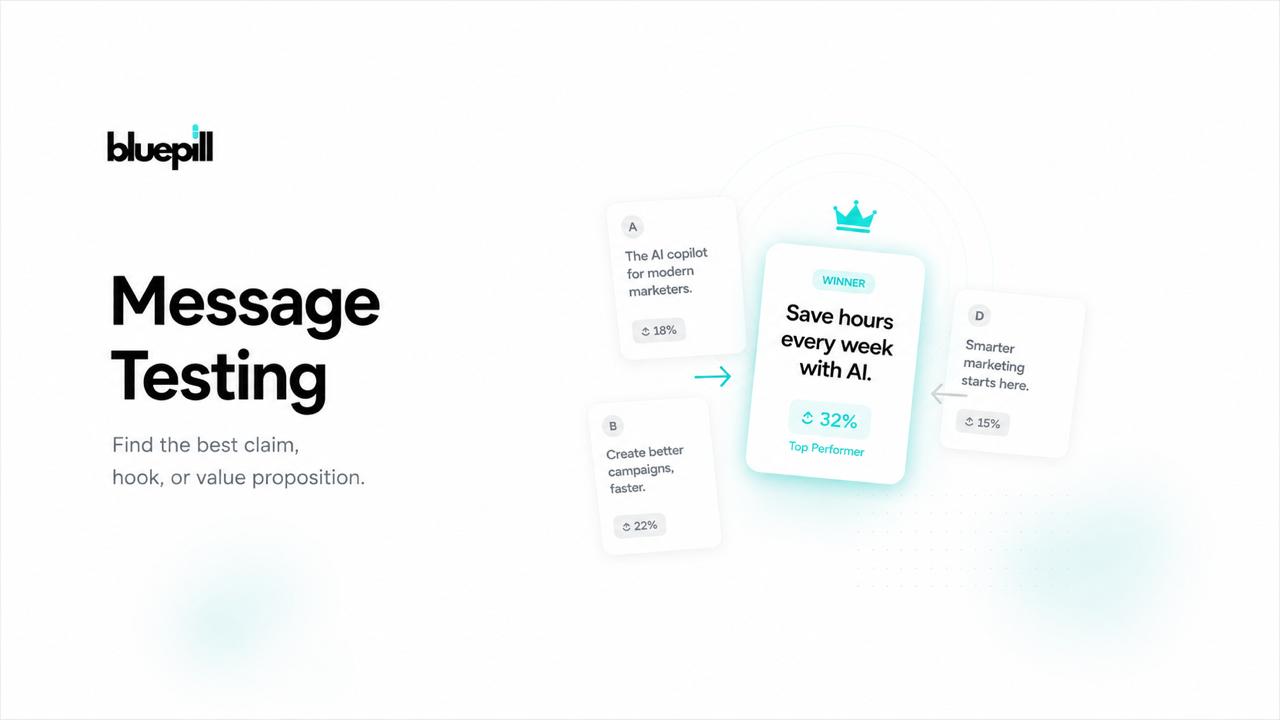
Message Testing: How to Find the Best Claim, Hook, or Value Proposition
May 29, 2026
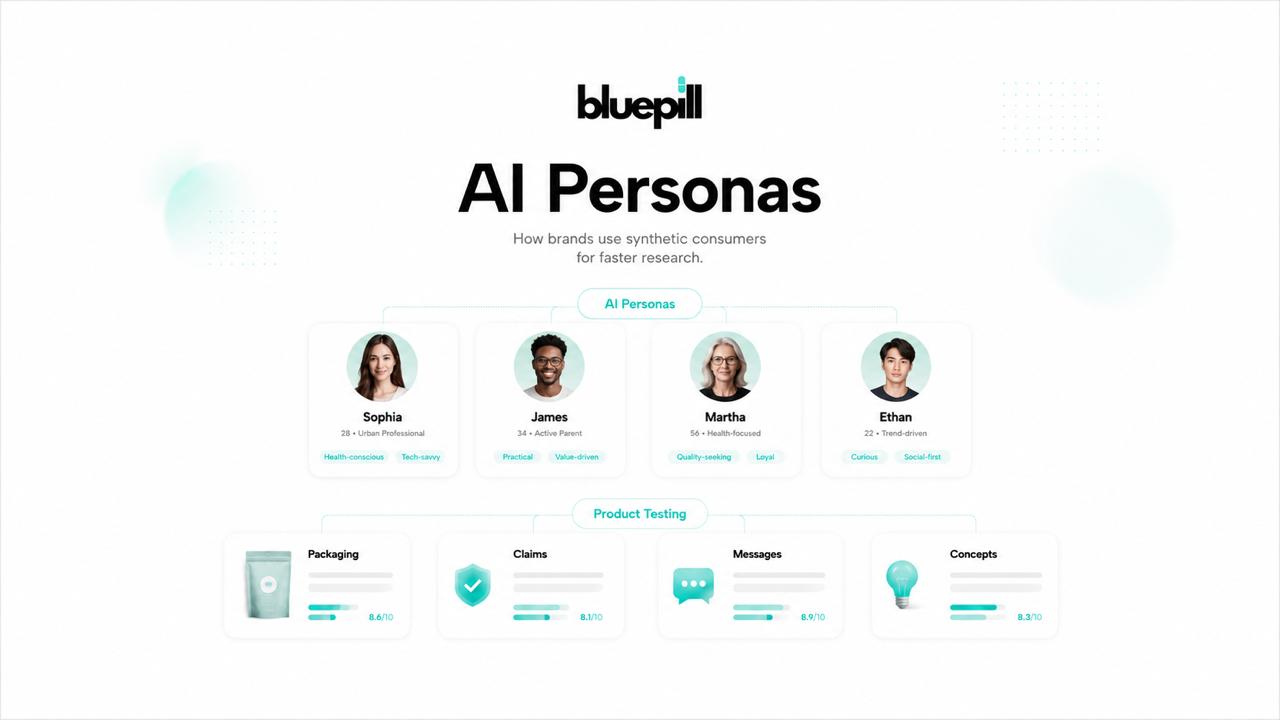
AI Personas: How Brands Use Synthetic Consumers for Faster Research

May 29, 2026
Advertising Market Research: How to Validate Ads Before Launch
May 29, 2026