Learn how market segmentation analysis helps brands find high-intent buyer groups, test demand, improve messaging, and prioritize the right audience before launch.
Not every consumer in a market is equally valuable.
Some people may like your product but never buy it.
Some may buy once but not repeat.
Some may only buy on discount.
Some may need too much education.
Some may already be loyal to a competitor.
Some may have a strong need and be ready to switch.
This is why market segmentation analysis matters.
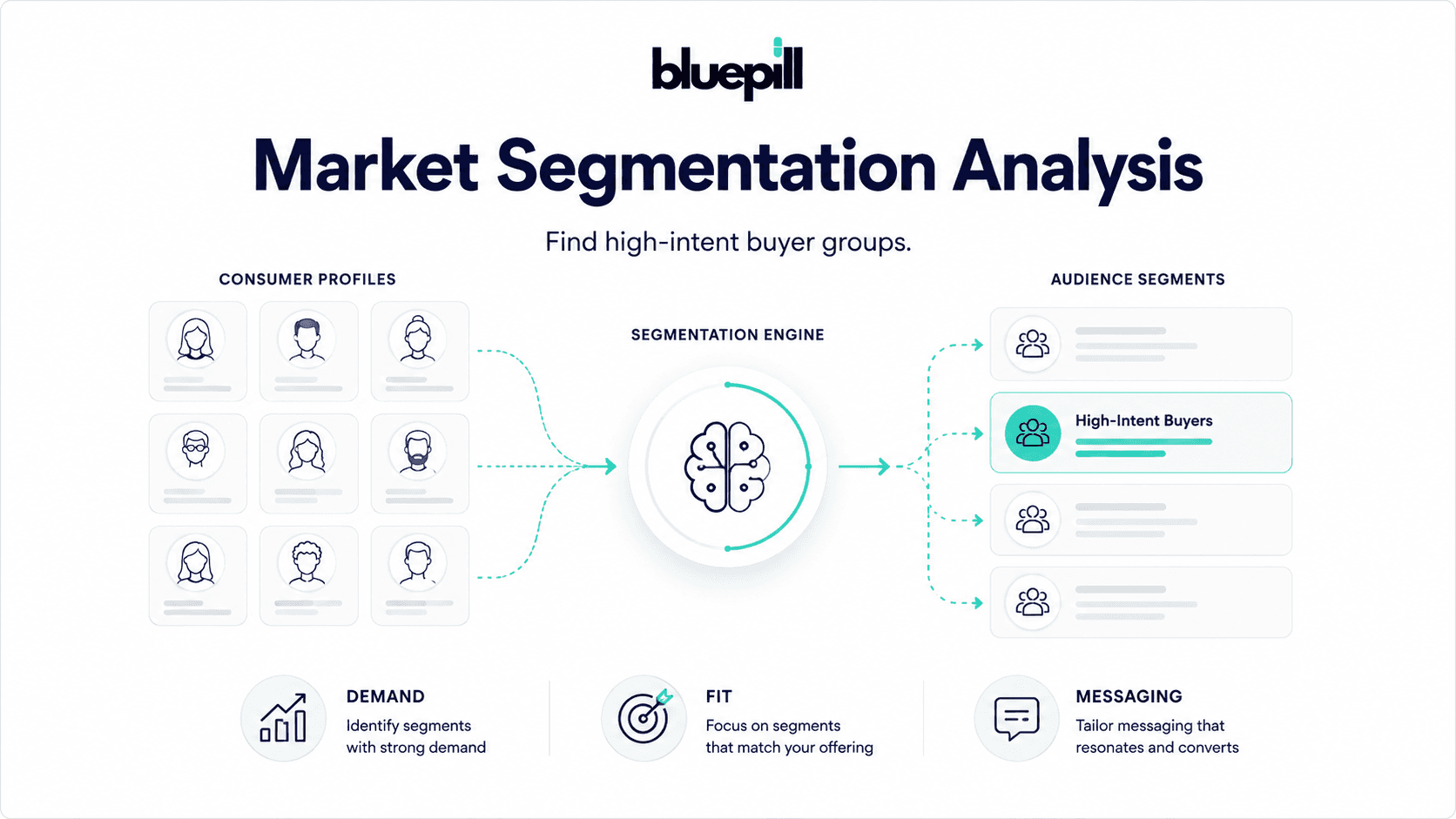
Market segmentation analysis helps brands divide a broad market into smaller buyer groups, then identify which groups show the strongest buying signals.
For consumer brands, the goal is not only to describe the audience.
The goal is to find high-intent buyer groups.
These are the consumers most likely to understand the product, care about the benefit, believe the claim, accept the price, switch from current options, and buy with less friction.
A brand that finds these groups early can make better decisions across product, packaging, claims, messaging, pricing, media, and launch strategy.
In the AI era, segmentation analysis is becoming more practical. Instead of creating static audience profiles that sit in a deck, teams can now use AI consumer panels, synthetic personas, and behavioral simulations to test how different segments may respond to specific concepts, packages, claims, and campaign messages.
That is where BluePill helps.
BluePill lets brands ask AI consumers what they think about product concepts, packaging, claims, messages, campaigns, and buying decisions. It helps teams identify which buyer groups are most likely to respond before investing heavily in launch or human validation.
What Is Market Segmentation Analysis?
Market segmentation analysis is the process of studying a market and grouping consumers based on shared characteristics, needs, behaviors, motivations, or purchase patterns.
It helps brands understand that a market is not one large group of identical buyers.
Different consumers may buy for different reasons.
One group may care about price.
Another may care about quality.
Another may care about convenience.
Another may care about taste.
Another may care about trust.
Another may care about performance.
Another may care about family safety.
Another may care about status or identity.
Market segmentation analysis helps teams decide which group matters most for the business decision in front of them.
For a new launch, that usually means finding the segment with the strongest demand signal.
What Makes a Buyer Group High-Intent?
A high-intent buyer group is not simply a group that likes the idea.
High intent is stronger than interest.
A high-intent group usually has several signals:
They understand the product quickly.
They feel the problem or need strongly.
They see a clear use case.
They believe the claim.
They accept the price or understand the value.
They are dissatisfied with current alternatives.
They are open to switching.
They show purchase intent.
They have repeat potential.
They are reachable through practical channels.
The more of these signals a segment shows, the more attractive it becomes.
For example, a snack brand may find that many consumers like the idea of a healthier snack. But the high-intent segment may be busy parents who need better lunchbox options their children will actually eat.
That segment has a clearer need, a repeated use case, and a stronger reason to buy.
Why High-Intent Segments Matter
Many brands waste time targeting audiences that are too broad.
They create campaigns for “health-conscious consumers,” “modern parents,” “busy professionals,” or “premium shoppers.”
These labels may be directionally useful, but they are often too vague to guide decisions.
High-intent segmentation goes deeper.
It asks:
Who has the strongest reason to buy?
Who understands the value fastest?
Who is most likely to switch?
Who is willing to pay?
Who is easiest to reach?
Who is most likely to repeat?
Who needs less persuasion?
This matters because launch resources are limited.
A brand cannot test every audience equally.
A marketing team cannot write messaging for everyone.
A sales team cannot pitch every use case.
A product team cannot optimize for every need.
A media team cannot efficiently target every possible buyer.
High-intent segmentation helps brands focus where growth is most likely to start.
Start With Category Behavior
The first step in market segmentation analysis is understanding how consumers currently behave in the category.
Ask:
Who currently buys this type of product?
How often do they buy it?
What brands do they choose?
Where do they buy?
What triggers purchase?
What makes them repeat?
What makes them switch?
What frustrates them about current options?
How much do they usually spend?
Category behavior is important because high intent often starts with existing behavior.
A consumer who already buys in the category may be easier to convert than someone who needs to be educated from zero.
For example, someone who already buys protein snacks every week may understand a new protein snack faster than someone who rarely buys functional food.
BluePill can help teams simulate how different category users may respond to new product concepts, claims, and packaging before launch.
Segment by Need Strength
One of the best ways to find high-intent buyers is to look at need strength.
A segment with a strong need is more likely to respond.
Ask:
Who experiences the problem most often?
Who feels the problem most strongly?
Who is actively looking for a better solution?
Who is dissatisfied with current options?
Who would notice the benefit immediately?
Who would be disappointed if this product did not exist?
Need strength is often more useful than demographic size.
A smaller group with a strong need may be more valuable than a large group with weak interest.
For example, “people who want healthier snacks” is broad. “Parents who want healthier snacks that their children will actually eat” is sharper and likely more actionable.
Segment by Use Case
Use case is a strong signal of intent.
Consumers are more likely to buy when they can clearly see when, where, and why they would use the product.
Ask:
When would this segment use the product?
How often would that moment happen?
Is the use case urgent or occasional?
Does the product fit an existing routine?
Would it replace something they already buy?
Would it create a new habit?
For example:
A beverage can be for morning energy, afternoon focus, post-workout recovery, or social occasions.
A snack can be for lunchboxes, office breaks, fitness routines, or late-night indulgence.
A skincare product can be for morning routine, post-treatment recovery, sensitivity, or anti-aging.
Each use case creates a different buyer group.
BluePill helps teams test which use cases feel most natural to different AI consumer personas.
Segment by Purchase Barriers
High-intent buyers are not only people with strong interest.
They are also people with lower barriers.
A segment may like the product but still not buy because:
The price feels too high.
The claim is not believable.
The use case is unclear.
The brand lacks trust.
The product feels too similar to competitors.
The packaging does not communicate value.
The segment is loyal to existing brands.
Market segmentation analysis should identify which groups have fewer or more fixable barriers.
Ask:
What would stop this segment from buying?
What proof would they need?
What price concerns do they have?
What competitors do they trust?
What would make them switch?
What information is missing?
BluePill helps teams identify likely barriers by segment before product, packaging, or campaign decisions are locked.
Segment by Willingness to Switch
Most consumers already have habits.
They already buy something.
They already know what they trust.
They already have a routine.
They already compare based on past experience.
A high-intent buyer group often has a reason to switch.
Ask:
What does this segment currently buy?
How satisfied are they with current options?
What feels missing?
What would make them try a new brand?
What would make them replace their current choice?
What switching risk do they feel?
A segment with strong dissatisfaction and active category participation can be very valuable.
For example, a consumer who regularly buys healthy snacks but dislikes the taste of current options may be more likely to try a new better-tasting product.
A skincare buyer who struggles with irritation may be more open to a brand that credibly owns sensitive skin.
Segment by Willingness to Pay
High intent also depends on value perception.
A segment may want the product, but not at the price the business needs.
Ask:
What price would this segment expect?
What price feels reasonable?
What would feel too expensive?
What would justify a premium?
Would they buy once or repeatedly?
Would they need a trial offer?
Willingness to pay can change by segment.
Premium buyers may accept a higher price if the product feels trusted, effective, or high quality. Price-sensitive buyers may need value messaging, bundles, or trial formats. Existing category users may better understand the price than new users.
BluePill can help teams explore price-value reactions across different buyer groups before deeper pricing research.
Segment by Message Responsiveness
Different segments respond to different messages.
A health-focused buyer may respond to ingredients.
A convenience buyer may respond to time-saving.
A parent may respond to trust and family approval.
A fitness consumer may respond to performance.
A premium buyer may respond to quality.
A skeptical buyer may respond to proof.
Market segmentation analysis should test which messages move each group.
Ask:
Which benefit matters most to this segment?
Which claim feels most believable?
Which message creates interest?
Which message feels irrelevant?
What language does this segment naturally use?
What proof does this segment need?
BluePill helps teams test messaging across AI consumer segments before campaign launch. This makes it easier to match the right message to the right buyer group.
Segment by Repeat Potential
A high-intent group is not only likely to try.
It should also have repeat potential.
Ask:
How often would this segment use the product?
Would the product fit a routine?
Is the need recurring?
Would they buy again after trial?
What would make them loyal?
What might cause them to stop buying?
Repeat potential is especially important for CPG, ecommerce, food, beverage, beauty, wellness, and personal care brands.
A group that buys once but does not repeat may not be as attractive as a group with a smaller initial audience but stronger retention.
Segment by Reachability
A segment can be high-intent but hard to reach.
That matters.
Ask:
Where can we reach this group?
Do they search for this problem?
Are they active on social platforms?
Do they follow creators or experts?
Do they buy online or in retail?
Do they rely on reviews?
Can paid media reach them efficiently?
Do they require education before buying?
The best early target usually balances intent and reach.
A highly motivated segment that can be reached clearly is often a better launch target than a larger but vague audience.
How to Score Buyer Groups
A practical way to evaluate segments is to score each group across key criteria.
Use criteria like:
Need strength
Product clarity
Use case fit
Purchase intent
Willingness to pay
Willingness to switch
Claim believability
Message responsiveness
Repeat potential
Reachability
Strategic fit
A segment does not need to score perfectly on everything.
But if it has strong need, clear use case, believable claims, and purchase intent, it may be worth prioritizing.
If it has interest but weak price acceptance, poor reachability, or high switching barriers, it may need a different approach.
Example: Finding High-Intent Buyers for a Snack Brand
Imagine a brand is launching a better-for-you snack.
Possible segments include:
Fitness consumers
Busy professionals
Parents
Premium ingredient shoppers
Students
Price-sensitive snackers
Indulgent snackers
Diet-focused consumers
A broad view may suggest that all health-conscious consumers are relevant.
But segmentation analysis may show something sharper.
Fitness consumers understand the protein claim but see many alternatives.
Busy professionals like convenience but may not see strong differentiation.
Parents show strong need because they want healthier snacks children will actually eat.
Premium ingredient shoppers like the idea but may need stronger packaging cues.
Price-sensitive snackers reject the premium price.
The high-intent segment may be parents if they show strong need, recurring use case, willingness to pay, and lower switching barriers.
BluePill can help test these reactions across AI consumer segments before launch.
Example: Finding High-Intent Buyers for a Beauty Brand
Imagine a beauty brand is launching a barrier repair cream.
Possible segments include:
Sensitive skin consumers
Premium skincare buyers
Ingredient-conscious shoppers
Clean beauty buyers
Anti-aging buyers
Minimalist routine users
Segmentation analysis may show that sensitive skin consumers have the strongest need and highest trust requirement.
Premium skincare buyers may accept the price but need proof.
Clean beauty buyers may care about ingredients but not the core barrier claim.
Minimalist users may reject adding another product unless the use case is clear.
The high-intent segment may be sensitive skin consumers who are dissatisfied with current products and actively looking for gentle, credible solutions.
BluePill can help test positioning, claims, and packaging with these segments before human validation.
Example: Finding High-Intent Buyers for a Beverage Brand
A functional beverage brand may consider several segments:
Fitness consumers
Office workers
Students
Health-focused shoppers
Energy drink users
Premium wellness buyers
The team may learn that office workers looking for afternoon focus show a strong use case and clear buying moment.
Energy drink users may be harder to switch because they already have strong brand habits.
Fitness consumers may care more about hydration or recovery.
Premium wellness buyers may need ingredient proof.
Students may like the idea but be price-sensitive.
The high-intent group may be office workers if the message connects to focus, energy, and avoiding a sugar crash.
BluePill can help test those message routes quickly.
How AI Makes Segmentation Analysis More Useful
Traditional segmentation analysis often ends in a presentation.
The segments are named, described, and visualized.
But brand teams still need to apply the segmentation to real decisions.
AI makes segmentation more interactive.
With BluePill, teams can ask:
How would this segment react to our concept?
Which segment believes this claim?
Which segment rejects the price?
Which segment understands the package fastest?
Which segment is most likely to switch?
Which segment responds best to this message?
Which segment has the strongest purchase barrier?
This turns segmentation from a static framework into a decision-making tool.
When to Use Human Validation
AI segmentation testing is useful for early learning, but human research still matters for high-stakes decisions.
Use human validation when you need:
Final audience validation
Statistical confidence
Large-scale segmentation
Retailer-ready evidence
Media planning confidence
Precise demand sizing
In-market measurement
The best workflow is often AI first, then human validation.
Use BluePill to compare segments, identify likely high-intent buyers, and refine messaging. Then validate the strongest audience with human research where needed.
Common Market Segmentation Analysis Mistakes
One common mistake is creating segments that are too broad.
A label like “health-conscious consumers” may not be specific enough to guide product or messaging decisions.
Another mistake is relying only on demographics.
Age and income can help with targeting, but they do not always explain buying behavior.
Another mistake is confusing interest with intent.
A segment may like the product but still not buy.
Another mistake is ignoring barriers.
High intent requires not only motivation, but also low enough friction.
Another mistake is choosing the biggest segment instead of the best segment.
The largest audience is not always the easiest or most profitable to win.
Another mistake is treating segmentation as fixed.
Consumer behavior changes. Segmentation should be revisited as the market, product, and category evolve.
How BluePill Helps With Market Segmentation Analysis
BluePill helps teams find high-intent buyer groups faster by simulating consumer reactions across different audience segments.
Teams can use BluePill to test:
Product concepts
New SKUs
Packaging designs
Brand claims
Campaign messages
Ad hooks
Landing page copy
Price-value perception
Purchase barriers
Competitive alternatives
Use cases
Segment-level intent
This helps teams understand which groups are most likely to buy and why.
For insights teams, BluePill makes segmentation more actionable.
For brand teams, it sharpens positioning.
For innovation teams, it helps prioritize product ideas.
For marketing teams, it improves audience and message fit before media spend.
BluePill is especially useful when teams need to compare segments before running larger human validation.
Final Takeaway
Market segmentation analysis helps brands find the buyer groups most likely to respond.
The goal is not only to divide the market into neat categories.
The goal is to identify high-intent groups with strong need, clear use case, believable claims, willingness to pay, switching potential, repeat opportunity, and reachability.
For consumer brands, this can improve product strategy, packaging, claims, messaging, pricing, media planning, and launch performance.
In the AI era, segmentation can become more practical and interactive.
BluePill helps brands test how different buyer groups may respond to real product, packaging, claims, and campaign decisions before launch.
The strongest brands do not start by asking, “Who could buy this?”
They ask, “Who has the strongest reason to buy this first?”
Related Blogs
May 29, 2026
Message Testing: How to Find the Best Claim, Hook, or Value Proposition
May 29, 2026
AI Personas: How Brands Use Synthetic Consumers for Faster Research

May 29, 2026
Advertising Market Research: How to Validate Ads Before Launch
May 29, 2026