Learn which marketing survey questions reveal real purchase intent, buyer motivation, objections, price sensitivity, and demand before launching a campaign or product.
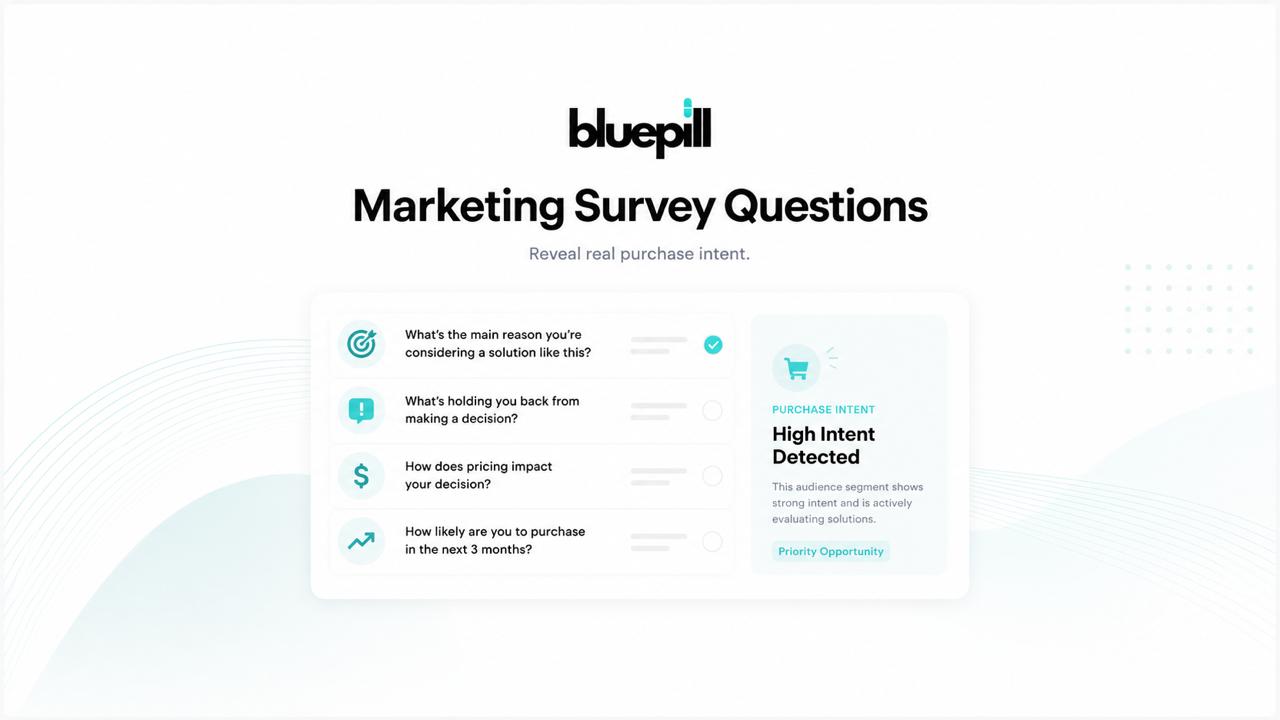
Not every positive survey response means someone will buy.
A consumer may say they like a product.
They may say a campaign is interesting.
They may say a claim sounds useful.
They may say they would consider trying it.
But when the real buying moment comes, they may still choose something else.
They may not trust the claim.
They may not see enough value for the price.
They may prefer a familiar brand.
They may not understand when they would use the product.
They may like the idea, but not enough to act.
This is why marketing survey questions need to go beyond surface-level preference.
A good marketing survey should not only ask what people like. It should reveal whether people understand the product, care about the benefit, believe the claim, accept the price, compare it favorably with alternatives, and have a real reason to buy.
That is what real purchase intent looks like.
For consumer brands, this matters before product launches, campaign launches, packaging decisions, claim testing, landing page updates, and paid media spend.
In the AI era, teams can now test marketing survey questions earlier using AI consumer panels and synthetic personas. This helps brands identify confusing questions, weak claims, missing objections, and stronger purchase drivers before running full human research.
That is where BluePill helps.
BluePill lets brands ask AI consumers what they think about product concepts, packaging, claims, campaign messages, pricing, and buying decisions. It helps teams understand not only whether consumers say they may buy, but why they may buy, hesitate, reject, or switch.
Why Purchase Intent Is Hard to Measure
Purchase intent sounds simple.
You ask someone how likely they are to buy, and they give an answer.
But real purchase behavior is more complicated.
People often overstate intent in surveys because there is no real cost to saying yes. It is easy to say, “I would probably buy this,” when they are not actually choosing between brands, prices, reviews, shipping costs, and competing needs.
This is why purchase intent should never be measured with one question alone.
A stronger marketing survey looks for supporting signals.
Does the consumer understand the product?
Does the product solve a real problem?
Does the consumer see a use case?
Is the claim believable?
Is the price acceptable?
Would the consumer switch from what they already buy?
What would stop them from buying?
The more these signals align, the more meaningful purchase intent becomes.
Start With Clarity Questions
Before asking whether someone would buy, first ask whether they understand what is being offered.
If consumers misunderstand the product, the rest of the survey becomes less reliable.
Useful questions include:
What do you think this product is?
How would you describe this product in your own words?
Who do you think this product is for?
What problem do you think it solves?
When would someone use this product?
These questions reveal whether the concept, campaign, package, or landing page is clear.
If people cannot explain the product simply, low purchase intent may be caused by confusion. If people explain it incorrectly, the message may need to change before launch.
BluePill helps teams test clarity early by asking AI consumers to interpret concepts, claims, and messages before a full survey is launched.
Ask About Problem Strength
Real purchase intent usually starts with a real need.
A consumer is more likely to buy when the problem is frequent, important, and not fully solved by current options.
Useful questions include:
Is this a problem you personally experience?
How often do you experience this problem?
How important is this problem to you?
What do you currently do to solve it?
How satisfied are you with your current solution?
What feels missing from current options?
This helps separate curiosity from demand.
A product may sound interesting, but if the problem is not strong enough, consumers may not act.
For example, a snack may sound healthy, but if consumers do not have a clear eating occasion, purchase intent may be weak. A skincare product may sound advanced, but if consumers do not feel the problem, they may not add it to their routine.
Ask About Use Case
A strong buying signal is when consumers can clearly imagine using the product.
Useful questions include:
When would you use this product?
Where would you use it?
How often would you use it?
What situation would make you think of buying it?
Would this be a daily, weekly, occasional, or one-time purchase?
Would this replace something you already use?
Use case questions are important because they reveal whether the product fits into real behavior.
A product without a clear use case may get polite interest but weak purchase action.
For CPG, ecommerce, DTC, beauty, wellness, food, beverage, and personal care brands, use case is often the bridge between appeal and buying.
Ask About Benefit Relevance
Consumers buy because a benefit matters to them.
A marketing survey should identify which benefit is actually driving interest.
Useful questions include:
Which benefit stands out most?
Which benefit matters most to you personally?
Which benefit feels least important?
What is the main reason someone would buy this?
Does this benefit feel different from what you already get today?
Would this benefit make you more likely to consider the product?
This helps teams avoid overloading the message.
A brand may want to communicate many benefits, but consumers usually respond to one or two strongest reasons.
BluePill helps teams test benefit hierarchy with AI consumers, making it easier to understand what different segments notice and value.
Ask About Claim Believability
A claim can increase purchase intent only if consumers believe it.
A bold claim may create attention, but it can also create doubt.
Useful questions include:
What does this claim mean to you?
How believable is this claim?
What makes it believable or unbelievable?
What proof would you need?
Does this claim make you more interested in buying?
Does this claim feel specific or too vague?
Does this claim feel different from competitors?
This is especially important for claims around health, wellness, performance, beauty, food, sustainability, science, or quality.
For example, “supports gut health” may need explanation. “Clean energy” may need a clearer reason to believe. “Clinically inspired” may sound premium but vague.
BluePill helps teams test claims before they appear on packaging, ads, product pages, or landing pages.
Ask About Competitive Alternatives
Consumers do not make decisions in isolation.
They compare your product with what they already buy.
Useful questions include:
What would you compare this product with?
What do you currently buy instead?
Which brand or product would you choose today?
How satisfied are you with your current option?
What would make you switch?
What does this product do better or worse than your current choice?
These questions reveal whether purchase intent is realistic.
A consumer may like a new product but still prefer a familiar competitor. That does not mean the idea is bad. It means the product needs a stronger reason to switch.
Ask Purchase Intent Carefully
You should still ask purchase intent, but do it with context.
Useful questions include:
How likely would you be to buy this product?
How likely would you be to try it once?
How likely would you be to buy it repeatedly?
How soon would you consider buying it?
Where would you expect to buy it?
Would you actively look for this product or only consider it if you saw it?
The distinction between trial and repeat matters.
Some ideas create curiosity but not habit. Others may appeal to a smaller audience but have stronger repeat potential.
A strong marketing survey should measure both.
Ask About Price and Value
Purchase intent without price can be misleading.
Consumers may say they would buy, but change their mind once price appears.
Useful questions include:
What price would you expect for this product?
What price would feel reasonable?
What price would feel expensive but still possible?
What price would feel too expensive?
Does the product feel worth the price?
What would justify a higher price?
Would you buy this once or regularly at this price?
Price questions help reveal whether the product has real value perception.
If price resistance is high, the answer is not always to discount. The brand may need clearer benefits, stronger proof, better packaging, more trust signals, or a more specific audience.
Ask About Purchase Barriers
The most useful marketing survey question is often not “Would you buy?”
It is “What would stop you from buying?”
Useful questions include:
What would stop you from buying this product?
What feels unclear?
What feels hard to believe?
What concern would you have before buying?
What information is missing?
What would make you more confident?
What would make you choose a competitor instead?
Barriers reveal what needs to be fixed before launch.
Common barriers include unclear product explanation, weak trust, high price, vague claims, low urgency, poor differentiation, missing reviews, unfamiliar brand, or unclear use case.
BluePill helps teams identify likely barriers early by simulating how AI consumers may respond before campaigns or product launches go live.
Ask About Trust
Trust is a major part of purchase intent.
A consumer may understand the product and like the idea, but still hesitate if the brand or claim does not feel credible.
Useful questions include:
How much do you trust this product or brand?
What makes it feel trustworthy?
What makes you skeptical?
What proof would increase trust?
Would reviews, certifications, expert endorsement, ingredients, or demonstrations make you more confident?
Does the packaging or message support trust?
Trust questions are especially important for new brands, premium products, wellness products, beauty, food, healthcare, and categories with functional claims.
Ask About Segment Fit
Different consumer groups may show different levels of purchase intent.
A marketing survey should reveal which segment is most likely to buy.
Useful questions include:
Who do you think this product is best for?
Does this feel relevant to you personally?
Which type of person would be most interested?
Who would not care about this product?
Would you recommend this to someone else? Who?
Then analyze responses by segment.
A product may perform moderately overall but very strongly with a specific buyer group.
That buyer group may be the best launch audience.
BluePill helps teams test segment-level reactions before launch, making it easier to identify high-intent consumers earlier.
Ask About Message Motivation
Marketing survey questions should test whether the message creates action, not only whether it sounds good.
Useful questions include:
What is the main idea you take away from this message?
Does this message make you more interested in the product?
What part of the message is most motivating?
What part feels generic or unclear?
Would this message make you click, search, buy, or learn more?
Which message would make you most likely to act?
This is useful before launching ads, landing pages, email campaigns, product pages, or packaging copy.
A message may be liked but not motivating. The goal is to find language that creates movement.
Ask About Next Action
Real purchase intent is stronger when people are willing to take a next step.
Useful questions include:
Would you sign up to learn more?
Would you join a waitlist?
Would you request a sample?
Would you add this to cart?
Would you buy this if it were available today?
Would you recommend it to someone?
Would you search for this product later?
These questions help move beyond passive interest.
Action-based intent is usually stronger than general appeal.
A Practical Survey Flow
A strong marketing survey can follow this sequence:
First, test clarity.
Do consumers understand the product, message, or claim?
Then test problem strength.
Do they experience the need?
Then test relevance.
Does it fit their life or buying situation?
Then test benefit strength.
Which reason to buy matters most?
Then test believability.
Do they trust the claim and proof?
Then test competitive comparison.
Would they choose it over current alternatives?
Then test purchase intent.
Would they try, buy, or repeat?
Then test price-value fit.
Does the offer feel worth the cost?
Then test barriers.
What would stop them?
Then test next action.
Would they take a real step toward purchase?
This structure gives a clearer view of real purchase intent than one simple rating question.
How BluePill Helps Improve Marketing Surveys
BluePill helps teams test marketing survey questions and consumer reactions before running full human research.
Teams can use BluePill to test:
Product concepts
Claims
Campaign messages
Packaging
Landing page copy
Price-value perception
Purchase barriers
Audience segments
Competitive alternatives
Next-action intent
This helps teams identify weak questions, unclear concepts, confusing claims, and missing objections earlier.
For insights teams, BluePill reduces research bottlenecks.
For brand teams, it sharpens positioning and claims.
For marketing teams, it improves campaign messages before media spend.
For innovation teams, it helps decide which ideas deserve validation.
When to Use Human Surveys
AI consumer testing is useful for early exploration, but human surveys still matter when the decision requires real respondent data.
Use human surveys when you need:
Final purchase intent validation
Statistical confidence
Audience benchmarking
Retailer-ready evidence
Pricing validation
Brand tracking
Campaign measurement
Post-launch research
The best workflow is often AI first, then human validation.
Use BluePill to refine concepts, claims, survey questions, and messages. Then use human research to validate the strongest options.
Common Marketing Survey Mistakes
One common mistake is asking only, “Would you buy this?”
That question alone is too shallow.
Another mistake is not including price.
Purchase intent without price often overstates demand.
Another mistake is ignoring competitors.
Consumers always compare.
Another mistake is asking leading questions.
Do not describe a product as “innovative,” “premium,” or “healthy” inside the question unless you are testing whether consumers agree.
Another mistake is relying only on averages.
The strongest purchase intent may come from a specific segment.
Another mistake is not asking about barriers.
Objections are often more useful than positive feedback.
Final Takeaway
Marketing survey questions should reveal real purchase intent, not just polite interest.
The best questions test clarity, problem strength, relevance, benefit value, claim believability, competitive comparison, price-value fit, trust, purchase barriers, segment response, and willingness to take action.
For consumer brands, these questions can improve product launches, packaging, claims, campaigns, landing pages, and media decisions.
In the AI era, teams can test these questions earlier.
BluePill helps brands ask AI consumers what they think before running larger studies or launching campaigns.
The best marketing survey does not only ask whether people like the idea.
It helps teams understand whether consumers have a real reason to buy, what could stop them, and what needs to change before launch.
Related Blogs
May 29, 2026
Message Testing: How to Find the Best Claim, Hook, or Value Proposition
May 29, 2026
AI Personas: How Brands Use Synthetic Consumers for Faster Research

May 29, 2026
Advertising Market Research: How to Validate Ads Before Launch
May 29, 2026