Pack testing reveals whether packaging is clear, believable, and competitive on shelf; before retail launch makes the design expensive to change.
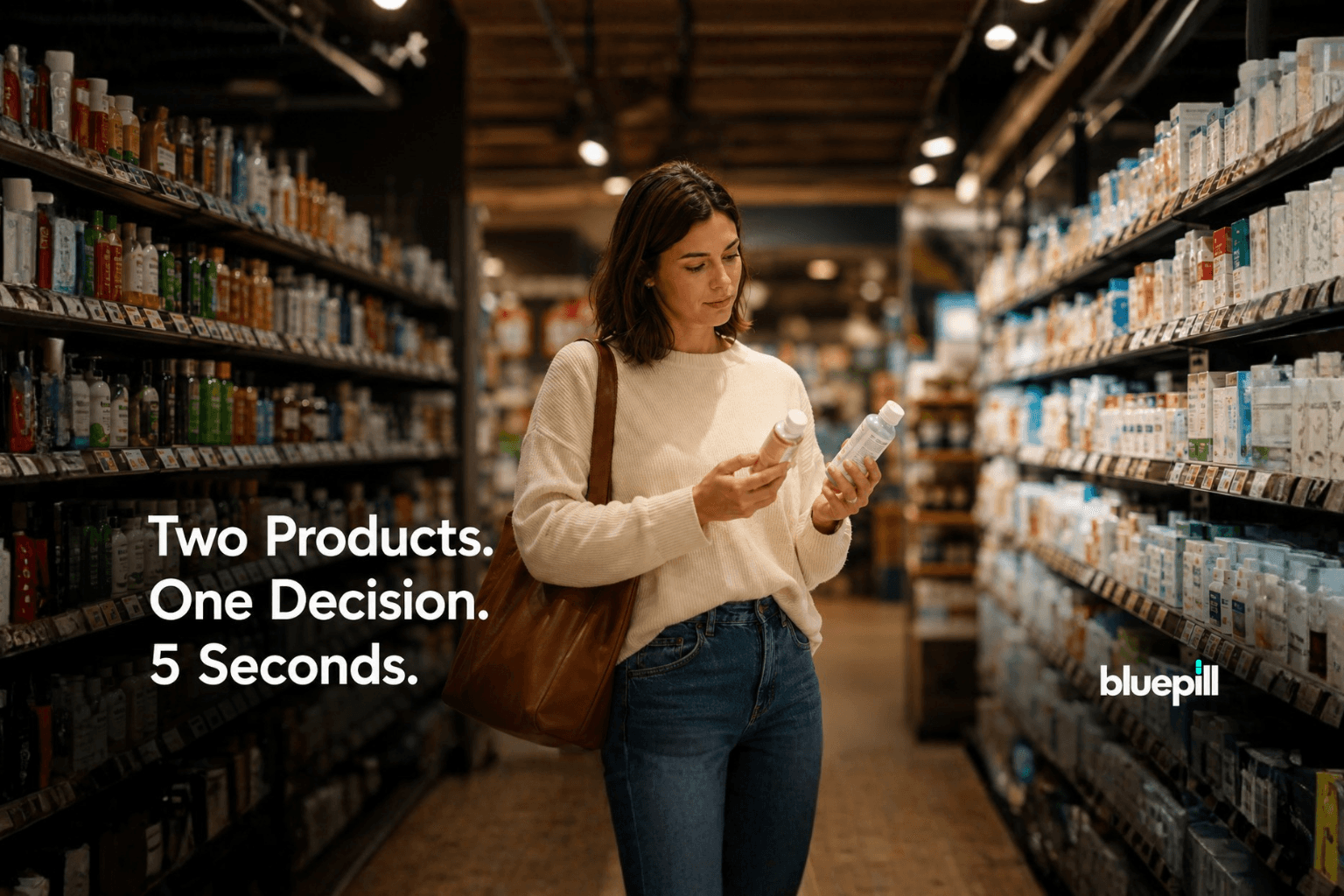
Packaging is often the first real conversation between a brand and a shopper. Before they read your website, watch your ad, or hear your product story, they see the pack; and in a retail aisle, the shopper may only give it a few seconds. In that time the pack has to get noticed, explain what the product is, communicate the main benefit, make the claim believable, justify the price, build trust, and help the shopper choose.
That's why pack testing matters before retail launch. A package may look beautiful in design review, win internal approval, and still confuse shoppers, fail to land its claim, or get lost on shelf next to a familiar brand. Pack testing surfaces those issues before they become expensive; before production runs, retailer commitments, and trade conversations make the design hard to change.
In the AI era, packaging research can also move earlier. AI consumer panels, synthetic personas, and behavioral simulations let teams test pack concepts, claims, and purchase reactions before running larger human validation. That's where BluePill helps, brands can ask AI consumers what they think about packaging designs, claims, product concepts, and purchase decisions, so brand, innovation, packaging, and insights teams catch weak routes early and reduce retail launch risk.
What Is Pack Testing?
Pack testing is the process of evaluating packaging before launch to understand how consumers respond, whether the package communicates clearly, stands out, builds trust, and supports purchase intent.
A good pack test evaluates front-of-pack design, claim visibility and believability, benefit hierarchy, product clarity, visual appeal and shelf standout, brand recognition, perceived quality, price-value fit, purchase intent, competitive comparison, and consumer confusion points.
This matters most for CPG, FMCG, food, beverage, beauty, wellness, personal care, healthcare, and household; categories where packaging isn't a container but a sales asset.
Why Pack Testing Matters Before Retail Launch?
Retail launch is expensive. By the time a product reaches the shelf, the brand has typically invested in product development, design, production, inventory, distribution, trade conversations, retailer support, and media. If the packaging doesn't work, the brand may not catch the problem until it's already costly to fix.
Common packaging issues that escape internal review:
• Consumers don't understand the product.
• The main benefit isn't visible enough.
• The claim is noticed but not believed.
• The design doesn't stand out.
• The pack looks cheaper or pricier than intended.
• The price feels too high for the perceived value.
• The audience doesn't feel the product is for them.
Pack testing catches these issues earlier, while the package can still be improved without paying the cost twice.
Start With the Packaging Decision
Before running a pack test, define the decision. Are you:
• Choosing between design routes?
• Testing whether the pack is clear?
• Evaluating claims?
• Checking whether it feels premium?
• Comparing against competitors?
• Preparing for retail launch?
• Trying to improve shelf standout?
The decision shapes the test. Choosing a design means comparing routes on the same criteria. Testing claim hierarchy means seeing what shoppers notice and understand first. Preparing for retail means testing the pack in a competitive context, not in isolation.
Good pack testing isn't "which design do you like?" It's "which package helps the shopper choose?"
Test First Impression
Shoppers process packaging quickly, so capture the immediate reaction before asking detailed questions:
• What's your first impression?
• What do you notice first?
• What type of product do you think this is?
• What feeling does the package create?
• Does it make you want to learn more?
This reveals what the pack communicates before the consumer overthinks. A package may look modern, but if shoppers can't tell whether it's a snack, supplement, beverage, or meal replacement, the design needs work.
Test Product Clarity
A package must make the product easy to understand. If shoppers can't quickly tell what it is, they move on:
• What do you think this product is?
• How would you describe it in your own words?
• Which category does it belong to?
• Who is it for?
• What do you think is inside the pack?
This is especially critical for new categories, innovative products, functional foods, wellness products, and premium beauty; where attractive design often outruns clear product communication.
Test Benefit Communication
A brand may want to communicate many things, but shoppers usually remember a few. Pack testing reveals which:
• What benefit stands out most?
• What do you think this product does for you?
• Which claim or message is most noticeable?
• Which part of the package feels most important?
• Is the main benefit clear?
A brand may want the pack to say "high protein," but shoppers may notice "low sugar" first. A beauty brand may aim for "barrier repair," but consumers see "hydration." That may be fine, but the team needs to know whether the intended benefit hierarchy is actually landing.
Test Claim Visibility and Believability
Claims do real work on the pack, but only if they're both visible and believable. An invisible claim doesn't help; a noticed-but-doubted claim hurts trust.
• Which claim do you notice first?
• How clear is this claim?
• How believable is it?
• What proof would you need?
• Does anything feel exaggerated or vague?
Especially important for health, wellness, performance, beauty, sustainability, and science-led claims:
• "Supports gut health" - may need proof.
• "Clean energy" - may need explanation.
• "Clinically inspired" - may sound premium but vague.
• "Better-for-you" - may feel too generic.
• "High protein" - may work better tied to a use case.
Test Shelf Standout
A package never sits alone in retail. Shelf standout measures whether it gets noticed against competitors:
• Would this pack stand out on shelf?
• What makes it noticeable, or easy to miss?
• How does it compare with other products in the category?
• Would you pick it up to learn more?
• Does it look different in a useful way?
A package can look strong in isolation and disappear on shelf. The opposite can also happen, visually distinctive but failing to communicate trust or category. Test for both: visibility and meaning. Standing out only helps if the shopper understands why the product matters.
Test Perceived Quality
Consumers use packaging as a shortcut to judge whether a product is premium, affordable, healthy, effective, natural, clinical, fun, safe, or trustworthy:
• How would you describe the quality of this product based on the package?
• Does the pack feel premium, affordable, or value-led?
• Does it feel trustworthy?
• Modern or outdated?
• Does it support the expected price?
• What kind of brand is this?
The design needs to match the intended positioning. Premium needs design that supports the price. Health-focused needs design that builds trust. Family products need cues of safety and clarity. Fun snacks need appetite appeal and energy.
Test Price-Value Fit
Packaging directly shapes how consumers perceive price. A product can feel expensive if the pack doesn't communicate value, or credible at a premium price if the design, claims, and proof work together:
• What price would you expect for this product?
• Does the packaging make it feel worth the price?
• What would justify a higher price?
• Does the pack feel too basic, too premium, or just right?
• Would you buy it at the expected price?
Pre-launch is the moment to catch the mismatch. A low-value pack at a premium price slows trial. A premium pack at an affordable price is often a competitive advantage, if you know about it.
Test Audience Fit
A design route that works for one audience may not work for another:
• Who do you think this product is for?
• Does this package feel made for you?
• Which type of consumer would be most interested?
• Who might ignore it?
• Does the design match the intended audience?
Packs can attract the wrong audience or confuse the intended one; a parent product that looks too adult, an athlete product that looks too casual, a sensitive-skin product that looks too clinical.
Test Purchase Intent
Pack testing should always come back to whether the package supports buying behavior:
• How likely would you be to pick this up?
• How likely to consider buying it?
• How likely to try it once?
• How likely to buy again?
• What would make you more likely to buy?
Don't read intent alone. Interpret it alongside clarity, believability, perceived value, audience fit, and competitive context. High interest with low trust isn't the same as high interest with high trust, and they need different fixes.
Test Against Competitors
Consumers compare. Pack testing should too:
• Which package would you choose, and why?
• How does this compare with competitors?
• What does this pack do better? Worse?
• Which feels more trustworthy?
• Which feels higher quality?
• Which feels more relevant to you?
A design that looks good in isolation may feel weak next to known brands. Or it may reveal an opportunity; if competitors all look similar, a differentiated package stands out; if competitors overuse vague claims, a clearer claim builds trust.
Use Open-Ended Questions
Open-ended questions reveal natural language and unexpected reactions, the why behind the rating:
• What do you like most about this package?
• What do you dislike?
• What feels confusing?
• What would you change?
• What does this package make you expect?
• What concern would you have before buying?
• How would you describe this product to a friend?
A rating shows which package performs better. Open-ended responses show what to improve.
What a Complete Pack Test Should Cover
A thorough pack test evaluates twelve things:
• Product understanding - can consumers quickly tell what it is?
• Benefit hierarchy- do they notice the most important benefit first?
• Claim clarity - are claims easy to understand?
• Claim believability - do consumers trust them?
• Visual appeal - does the design attract interest?
• Shelf standout - will it get noticed against competitors?
• Brand fit - does it match the brand's positioning?
• Audience fit - does it speak to the right consumer group?
• Perceived quality - does it feel premium, healthy, trustworthy, or affordable as intended?
• Price-value fit - does the pack support the price?
• Purchase intent - does it make consumers more likely to buy?
• Competitive strength - does it have a clear reason to win?
How BluePill Helps With Pack Testing
BluePill evaluates packaging earlier and faster using AI consumers. Test packaging concepts, front-of-pack messages, claims, visual hierarchy, product clarity, audience fit, trust signals, price-value perception, purchase barriers, competitive comparisons, and segment-level reactions.
Most useful when teams have multiple design routes and need quick feedback before final human validation:
• Brand teams - sharper packaging strategy.
• Insights teams - fewer research bottlenecks.
• Innovation teams - connect product concepts to packaging earlier.
• Marketing teams - align packaging with campaign messaging.
The biggest win is timing: BluePill helps teams improve packaging while it's still easy to change.
When to Use Human Pack Testing
AI pack testing accelerates early feedback. Human validation still matters for high-stakes retail decisions. Use human research when you need:
• Final packaging validation.
• Retailer-ready evidence.
• Statistical confidence.
• Physical shelf testing.
• Eye-tracking or shopper-behavior studies.
• Real product handling feedback.
• In-store testing.
• Post-launch performance measurement.
The best workflow is usually AI first, then human validation. Compare early routes, claims, and clarity with AI consumers; validate the strongest options with human research when the decision warrants it.
Common Pack Testing Mistakes
Asking only what people like. Liking isn't buying.
• Testing the pack in isolation only. Retail packaging needs competitive context.
• Ignoring claim believability. Visibility only matters if the claim is believed.
• Skipping product clarity. A beautiful package can still fail if shoppers don't understand what it is.
• Waiting too long to test. If the pack is finalized, research only confirms what's now expensive to fix.
• Relying on internal preference. Brand teams often love packs that shoppers don't understand.
A Practical Pack Testing Workflow
Start with the retail decision - choosing a design, testing claims, improving clarity, or preparing for launch.
Test early routes with AI consumers - compare concepts, claim hierarchy, and first impressions.
Refine the strongest designs - improve unclear benefits, weak claims, trust signals, and visual hierarchy.
Test against competitors - check standout and reason to win.
Validate with human research - shopper studies, surveys, or retail testing when the decision warrants it.
Measure after launch - sales, shelf performance, conversion, reviews, and retailer feedback.
This sequence avoids packaging decisions made too late or only on internal opinion.Final Takeaway
Pack testing helps brands evaluate packaging before retail launch; whether it's clear, appealing, believable, trustworthy, differentiated, and likely to support purchase. For consumer brands, packaging isn't only a design asset; it's a decision-making tool at the shelf.
In the AI era, teams can test packaging earlier with AI consumer panels and behavioral simulations; surfacing what shoppers see, understand, and trust before retail commits the design.
The best packaging doesn't just look good. It helps consumers quickly understand, trust, and choose the product.Frequently Asked Questions
What is pack testing?
Pack testing evaluates how consumers respond to packaging before retail launch. It measures whether the package is clear, noticeable, believable, and competitive on shelf, and whether it supports purchase intent.When should pack testing happen?
As early as possible. Testing while designs are still being explored gives teams time to fix weak routes; testing after the pack is finalized usually just confirms expensive problems. AI consumer panels make early-stage testing feasible without the cost of full human research.What should a pack test measure?
Twelve things: product understanding, benefit hierarchy, claim clarity, claim believability, visual appeal, shelf standout, brand fit, audience fit, perceived quality, price-value fit, purchase intent, and competitive strength.Can AI replace traditional packaging research?
No, but it can come first. AI consumer panels are ideal for fast, early feedback on concepts, claims, and design routes. Human pack testing still delivers final validation, eye-tracking, shopper behavior data, and the retailer-ready evidence high-stakes decisions need.What are the most common pack testing mistakes?
Asking only what people like, testing the pack in isolation, ignoring claim believability, skipping product clarity, testing too late to change anything, and relying only on internal preference.
Related Blogs
May 29, 2026
Message Testing: How to Find the Best Claim, Hook, or Value Proposition
May 29, 2026
AI Personas: How Brands Use Synthetic Consumers for Faster Research

May 29, 2026
Advertising Market Research: How to Validate Ads Before Launch
May 29, 2026