Learn when to use surveys, interviews, focus groups, and AI consumer panels for primary market research, and how brands can test concepts, claims, packaging, and messages faster.
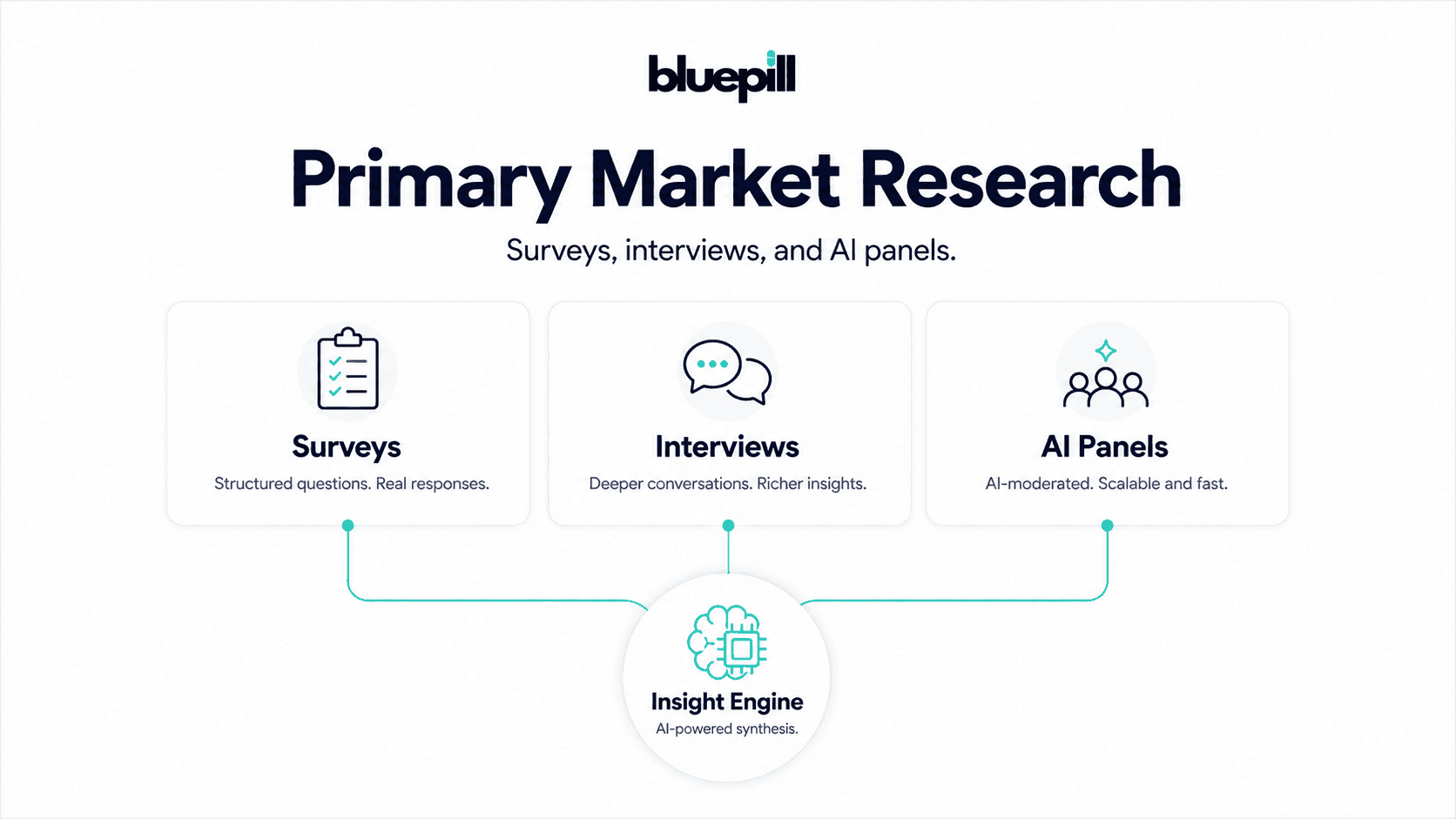
Primary market research helps brands learn directly from the people they want to serve.
It is different from reading market reports, studying competitors, or looking at industry trends. Those are useful, but they are based on existing information.
Primary research creates new insight for a specific decision.
For consumer brands, this matters because the most important questions are often very specific.
Will consumers understand this product?
Will they believe this claim?
Which package feels more trustworthy?
Which message creates interest?
Which audience is most likely to buy?
What would stop someone from choosing us?
Is this concept ready for launch?
These questions cannot always be answered by a market report or competitor analysis. They require direct consumer feedback.
Traditionally, primary market research has included surveys, interviews, focus groups, product testing, and consumer panels. These methods still matter. But now teams also have a new option: AI consumer panels.
AI panels, synthetic personas, and behavioral simulations allow teams to test product concepts, packaging, claims, and messages much earlier in the process. They help teams learn faster before investing in larger human studies.
That is where BluePill helps.
BluePill lets brands ask AI consumers what they think about products, packaging, claims, messages, campaigns, and buying decisions. It helps consumer insights, brand, innovation, and marketing teams use primary research thinking earlier, faster, and more often.
What Is Primary Market Research?
Primary market research is research collected directly for a specific business question.
It is usually created by talking to, surveying, observing, or testing with the target audience.
For example, a brand may use primary research to understand:
Whether consumers like a new product idea
Which claim feels most believable
What packaging design communicates fastest
How much people may be willing to pay
What would make consumers switch from a competitor
Which message should lead a campaign
Which segment has the strongest purchase intent
Primary research is useful because it is specific to the decision in front of the team.
A market report may tell you that functional beverages are growing. Primary research can tell you whether your functional beverage concept is clear, believable, and worth buying.
A trend report may show that consumers care about clean ingredients. Primary research can tell you whether your clean ingredient claim actually builds trust.
Primary Research vs Secondary Research
Primary research and secondary research both matter, but they serve different purposes.
Secondary research uses existing information. This can include market reports, competitor research, public data, social listening, customer reviews, search trends, and category analysis.
Primary research collects new information for a specific question.
The simple difference is this:
Secondary research helps you understand the market context.
Primary research helps you understand consumer response to your specific idea.
A strong brand often uses both.
First, secondary research helps identify the opportunity.
Then, primary research helps test whether the brand’s product, claim, package, or message can capture that opportunity.
Why Primary Market Research Matters
Primary market research matters because internal opinions are not enough.
A founder may believe the product benefit is obvious.
A designer may believe the package is clear.
A marketing team may believe the message is strong.
A product team may believe the claim is credible.
A sales team may believe the market is ready.
But consumers decide differently.
They see the product for the first time.
They compare it with current options.
They judge whether the claim is believable.
They decide whether the price feels worth it.
They ask whether the product fits their life.
Primary research brings the consumer into the decision before the decision becomes expensive to change.
The Main Types of Primary Market Research
Primary market research can take many forms, but for consumer brands, the most useful methods usually include:
Surveys
Interviews
Focus groups
Human consumer panels
Product testing
Concept testing
Packaging testing
Claims testing
Message testing
AI consumer panels
Each method has a different role.
The right choice depends on the question, stage, budget, timeline, and level of confidence needed.
When to Use Surveys
Surveys are useful when teams need structured feedback from many people.
They are good for measuring patterns.
Use surveys when you want to understand:
How many consumers prefer one concept
Which claim scores highest
How strong purchase intent is
Which segment responds best
How consumers rate packaging options
What price range feels acceptable
How awareness or perception differs by group
Surveys are useful because they create measurable data.
For example, if a brand is choosing between three product concepts, a survey can help compare appeal, relevance, believability, differentiation, and purchase intent across a larger sample.
Surveys are also useful when stakeholders need numbers to support a decision.
When Surveys Work Best
Surveys work best when the team already has clear options to test.
They are less useful when the team is still exploring vague ideas.
For example, a survey works well when you can show respondents a clear product concept, package, claim, or message.
It works less well if the team does not yet know what problem it is solving or what audience it wants to target.
A good survey should measure more than liking.
It should ask:
Do consumers understand the idea?
Is it relevant?
Is the claim believable?
Is the product different enough?
Would they buy it?
What would stop them?
What would they compare it with?
Which segment responds best?
Surveys become more predictive when they focus on buying decisions, not just opinions.
Where Surveys Can Fall Short
Surveys can be misleading if they are poorly designed.
Common problems include:
Leading questions
Vague concepts
Unclear answer options
Too many questions
No price context
No competitive comparison
Overreliance on average scores
Asking only whether people like the idea
Consumers may also overstate purchase intent in surveys.
Someone may say they would probably buy a product, but when faced with price, alternatives, and real choice, they may behave differently.
This is why surveys should be designed carefully and supported by other research methods.
BluePill can help teams test survey questions and concepts with AI consumers before launching a human survey. This helps identify confusing language, missing objections, and weak claims earlier.
When to Use Interviews
Interviews are useful when teams need depth.
They help explain why consumers think, feel, or behave a certain way.
Use interviews when you want to understand:
Customer motivations
Unmet needs
Purchase triggers
Decision context
Emotional barriers
Language consumers use
Why people switch or stay loyal
What makes a product feel trustworthy
Why consumers reject an idea
Interviews are especially useful early in the research process.
They help teams discover what they may not know yet.
For example, a snack brand may interview parents and discover that the real concern is not only health. It is whether the child will actually eat the snack, whether it creates mess, and whether it feels safe to pack every day.
That insight can improve product design, packaging, and messaging.
When Interviews Work Best
Interviews work best when the team needs to explore a problem deeply.
They are useful before writing a survey, before finalizing a concept, or when the team does not yet understand the consumer’s world.
Good interview questions ask about real behavior.
Instead of asking, “Would you buy this product?” ask:
Tell me about the last time you bought something like this.
What were you trying to solve?
What did you compare?
What almost stopped you?
Why did you choose that product?
What would make you switch?
Real stories are usually more useful than abstract opinions.
Interviews are also useful for understanding language. Consumers often describe problems differently than brands do.
That language can later improve ads, product pages, packaging, and claims.
Where Interviews Can Fall Short
Interviews are rich, but they are small in scale.
A few interviews can reveal themes, but they cannot prove how common those themes are across the market.
Interviews can also be affected by interviewer bias, respondent politeness, or unclear questioning.
That is why interviews are best used for exploration, not final measurement.
A common workflow is to use interviews to discover themes, then use surveys or panels to measure how broadly those themes apply.
When to Use Focus Groups
Focus groups are useful when teams want to observe discussion and reaction.
They help reveal how consumers talk about a product, claim, package, or campaign when they hear other views.
Use focus groups when you want to explore:
First impressions
Emotional reactions
Language and associations
Confusion or skepticism
Group-level discussion
Creative reactions
Category perceptions
Concept strengths and weaknesses
Focus groups can be useful for early-stage product ideas, packaging routes, campaign concepts, or brand repositioning.
For example, a beauty brand may use a focus group to understand whether a claim feels scientific, confusing, premium, or exaggerated.
Where Focus Groups Can Fall Short
Focus groups are not always representative.
A few strong voices can influence the discussion. Some people may avoid disagreeing. Group dynamics can shape responses.
Focus groups are also slower and more expensive than some other early research options.
They are best used when the team needs qualitative depth, not when the team needs statistically reliable measurement.
AI-powered focus group alternatives can help teams explore similar questions earlier before deciding whether human focus groups are needed.
When to Use Human Consumer Panels
Human consumer panels are useful when teams need feedback from real respondents at scale.
Panels can be used for:
Concept testing
Packaging testing
Claims testing
Message testing
Ad testing
Brand tracking
Product feedback
Usage and attitude studies
Human panels are valuable when the brand needs direct human data and measurable confidence.
For example, a CPG brand preparing for a major retail launch may need to validate purchase intent with a human panel before investing in production and retail support.
Human panels are also useful when stakeholders, retailers, or leadership need formal evidence.
Where Human Panels Can Fall Short
Human panels take time and budget.
Recruiting the right audience, programming the study, collecting responses, and analyzing results can slow down early-stage decision-making.
Because of this, teams often test fewer ideas.
A brand may have ten concepts but only enough budget to test three with a human panel. That means the team may narrow internally before consumers ever see all the options.
AI consumer panels can help solve this early-stage problem.
When to Use AI Consumer Panels
AI consumer panels are useful when teams need fast, directional feedback before human validation.
They allow teams to simulate how different consumer segments may respond to ideas before running a full traditional study.
Use AI panels when you need to:
Screen many product concepts
Compare packaging routes
Test multiple claims
Explore message options
Identify likely objections
Understand segment differences
Improve survey questions
Prepare for human research
Test campaign ideas before media spend
Learn while the decision is still flexible
BluePill is built for this workflow.
It lets teams test product concepts, packaging, claims, messages, campaigns, and buying decisions with AI consumers that represent different audience types.
When AI Panels Work Best
AI panels work best in the early and middle stages of decision-making.
They are especially useful when the team has many options and needs to narrow them.
For example:
A food brand has eight product ideas and wants to identify the strongest three.
A beauty brand has five claims and wants to know which feel most believable.
A DTC brand has several landing page messages and wants to test clarity.
A CPG team has multiple package routes and wants to understand which one communicates faster.
A marketing team has campaign hooks and wants to know which ones may create interest.
BluePill helps teams learn quickly before investing in formal human research.
Where AI Panels Have Limits
AI panels should not replace every form of primary research.
They are best for exploration, screening, and simulation.
Use human research when you need:
Final validation
Statistical confidence
Real product usage feedback
Taste, texture, or fragrance testing
Regulatory or legal support
Retailer-ready evidence
Sensitive topic exploration
In-market behavior measurement
For example, AI consumers can evaluate whether a flavor concept sounds appealing, but they cannot taste the product.
AI can help test whether a packaging claim feels believable, but human validation may still be needed before a major launch.
The strongest approach is often AI first, then human validation.
Surveys vs Interviews vs AI Panels
Each method answers a different kind of question.
Surveys are best when you need structured measurement.
Interviews are best when you need depth and context.
AI panels are best when you need fast exploration and iteration.
Use surveys when you need to know how many.
How many people prefer this concept?
How strong is purchase intent?
Which segment scores highest?
Use interviews when you need to know why.
Why do consumers hesitate?
Why does this claim feel unclear?
Why do people choose a competitor?
Use AI panels when you need to know what to test next.
Which ideas are worth validating?
Which claims are weak?
Which package routes need improvement?
Which segment may respond best?
The methods are not enemies. They work best together.
A Hybrid Primary Research Workflow
A modern primary research workflow can use multiple methods.
Start with AI panels.
Use BluePill to test rough ideas, compare options, and identify likely objections.
Use interviews for depth.
Talk to real consumers to understand motivations, habits, language, and deeper context.
Use surveys for measurement.
Validate the strongest concepts, claims, packages, or messages with structured human data.
Use in-market data after launch.
Measure sales, conversion, repeat purchase, and campaign performance.
This workflow gives teams speed, depth, and confidence.
It also helps avoid wasting human research budget on weak ideas.
Example: Testing a New Product Concept
Imagine a food brand wants to launch a new breakfast product.
The team has several ideas, but budget only allows one or two to move into human testing.
A practical workflow could look like this:
Use BluePill to test all early concepts with AI consumers.
Identify which concepts are clearest, most relevant, and most believable.
Interview real consumers to understand morning routines and purchase barriers.
Run a survey to validate the strongest concepts with a larger audience.
Use the results to choose the launch concept.
This is stronger than relying only on internal judgment or jumping straight into a large study.
Example: Testing Packaging and Claims
Imagine a beauty brand has three packaging designs and six possible claims.
A hybrid primary research process can help.
Use BluePill to test which claims feel believable and which packaging route communicates fastest.
Then use interviews or focus groups to explore deeper reactions.
Then use a survey or human panel to validate the final options.
This helps the brand improve packaging and claims before production.
Example: Testing Campaign Messages
A marketing team may have several campaign messages before launch.
Use BluePill to compare message clarity, relevance, believability, and likely objections.
Then use a small human survey or A/B test to validate the strongest options.
This helps the team avoid spending media budget on weak messaging.
Common Primary Research Mistakes
One common mistake is choosing the method before defining the decision.
The business question should come first. The research method should follow.
Another mistake is using surveys too early.
If the team does not yet understand the consumer problem, interviews or AI exploration may be better first.
Another mistake is relying only on interviews.
Interviews provide depth, but they do not show how common a pattern is.
Another mistake is using AI as final proof.
AI is useful for fast learning, but human validation still matters for high-stakes decisions.
Another mistake is testing too late.
Primary research is most useful when there is still time to improve the product, package, claim, or message.
How BluePill Helps With Primary Market Research
BluePill helps teams bring primary research thinking earlier into the decision process.
Instead of waiting weeks to test every idea with humans, teams can use BluePill to simulate consumer reactions quickly.
Teams can test:
Product concepts
New SKUs
Packaging designs
Brand claims
Campaign messages
Ad hooks
Landing page copy
Customer segments
Purchase barriers
Competitive alternatives
Flavor and variant ideas
For insights teams, BluePill reduces bottlenecks.
For brand teams, it improves positioning and claims.
For innovation teams, it helps screen product ideas.
For marketing teams, it improves campaign quality before media spend.
BluePill is especially useful before human research because it helps teams decide what is worth validating.
Final Takeaway
Primary market research helps brands collect direct consumer feedback for specific business decisions.
Surveys, interviews, focus groups, human panels, and AI consumer panels all have a role.
Surveys help measure patterns.
Interviews help explain motivations.
Focus groups reveal discussion and reactions.
Human panels provide real respondent validation.
AI panels help teams explore and improve ideas faster.
The best method depends on the decision, stage, risk, timeline, and budget.
In the AI era, the strongest workflow is often hybrid.
Use AI panels to test more ideas earlier.
Use interviews to understand deeper human context.
Use surveys and human panels to validate the strongest options.
BluePill helps consumer brands make this workflow practical by giving teams a faster way to ask AI consumers what they think before launch.
The best primary research does not only collect answers.
It helps teams make better decisions while there is still time to change the outcome.
Related Blogs
May 29, 2026
Message Testing: How to Find the Best Claim, Hook, or Value Proposition
May 29, 2026
AI Personas: How Brands Use Synthetic Consumers for Faster Research

May 29, 2026
Advertising Market Research: How to Validate Ads Before Launch
May 29, 2026