Learn what market research means for modern consumer brands, why it matters, and how AI consumer panels help teams test products, packaging, claims, and messages faster.

Market research is the process of understanding consumers, markets, competitors, and buying behavior before making important business decisions.
For consumer brands, market research helps answer one very important question.
Will people care enough to buy?
That question sits behind almost every major decision a brand makes.
Should we launch this product?
Which audience should we target?
Which packaging design should we choose?
Which claim feels most believable?
Which message will make people pay attention?
Which price point feels acceptable?
Which product variant has the best chance of success?
Market research helps teams answer these questions with evidence instead of guesswork.
In the past, market research was often treated as a slow and formal process. A team would create a research brief, recruit respondents, run surveys or focus groups, wait for analysis, and then receive a report.
That still has value.
But consumer brands now move much faster. Product teams need feedback earlier. Marketing teams need to test messages before campaigns go live. Innovation teams need to screen more ideas. Insights teams are expected to support more decisions with less time and budget.
This is why market research is changing.
Modern market research is no longer only about long reports and one-off studies. It is becoming faster, more continuous, and more connected to everyday brand decisions.
AI is also changing how teams learn from consumers.
With AI consumer panels and synthetic personas, brands can now test ideas earlier, simulate consumer reactions, and improve products, packaging, claims, and messages before running full human validation.
This is where BluePill helps.
BluePill lets brands ask AI consumers what they think about product concepts, packaging, claims, campaigns, and messages. It helps consumer insights, brand, marketing, and innovation teams learn faster and make better decisions before launch.
Why Market Research Matters
Most consumer brand decisions involve uncertainty.
A team may believe a new product is exciting, but consumers may not understand it.
A packaging design may look beautiful internally, but shoppers may miss the main benefit.
A claim may sound strong to the brand team, but consumers may not believe it.
A campaign message may feel clever, but it may not drive action.
Market research reduces this uncertainty.
It helps brands understand what consumers want, what they notice, what they trust, what they reject, and what may influence their purchase decisions.
Without research, brands often rely too heavily on internal opinions.
The founder likes one idea.
The agency prefers another direction.
The sales team pushes for a different claim.
The leadership team chooses what feels safest.
The marketing team follows past campaign logic.
These inputs can be useful, but they are not a substitute for consumer understanding.
Market research brings the consumer into the decision before the decision becomes expensive to change.
What Market Research Helps Consumer Brands Understand
Market research can help answer many different types of questions.
For consumer brands, the most useful questions usually fall into a few areas.
1. Who Is the Consumer?
Before a brand can sell well, it needs to understand who it is selling to.
Market research helps teams understand consumer segments, behaviors, needs, motivations, and barriers.
For example:
Who is most likely to buy this product?
What problem are they trying to solve?
How often do they buy in this category?
What brands do they already trust?
What makes them switch?
What keeps them loyal?
What language do they use to describe their needs?
This is the foundation for positioning, messaging, product development, and channel strategy.
A common mistake is assuming that everyone is the target audience. In reality, most products work better for specific segments.
BluePill helps teams explore this by simulating how different AI consumer personas respond to the same product, claim, package, or campaign. This helps brands understand which audiences may be most receptive before investing in deeper validation.
2. What Does the Consumer Need?
A product succeeds when it solves a real consumer need.
That need can be functional, emotional, social, or situational.
A functional need may be convenience, better taste, cleaner ingredients, lower price, or higher performance.
An emotional need may be confidence, comfort, excitement, relief, pride, or trust.
A social need may be status, identity, belonging, or self-expression.
A situational need may be something that matters in a specific moment, such as a quick breakfast, a post-workout snack, a skincare routine, a family meal, or an energy boost during work.
Market research helps brands understand which needs matter most and how strongly consumers feel about them.
This matters because brands often overestimate how important their product benefit is.
A team may care deeply about a feature, but the consumer may not.
A brand may emphasize innovation, while consumers may simply want trust.
A product may promote quality, while the shopper may be looking for convenience.
Good research separates what the brand wants to say from what the consumer needs to hear.
3. Will the Product Concept Work?
A product concept is more than an idea.
It usually includes the target audience, problem, benefit, reason to believe, use case, and sometimes price or format.
Market research helps teams understand whether a concept is clear, relevant, different, believable, and likely to drive purchase interest.
A strong concept should answer:
What is this product?
Who is it for?
What problem does it solve?
Why is it better or different?
Why should the consumer believe it?
When would the consumer use it?
Would they actually buy it?
This is where concept testing becomes important.
Traditional concept testing can be slow and expensive, especially when teams have many early ideas. BluePill helps brands test more concepts earlier using AI consumers. Teams can compare different ideas, understand objections, and improve weak concepts before moving into full human research.
This makes the product development process more efficient.
4. Which Message Will Resonate?
A good product can still fail if the message is wrong.
Consumers do not respond only to what a brand sells. They respond to how the brand explains it.
Market research helps teams test messages, claims, headlines, product descriptions, ads, and value propositions before launch.
This is important because small language changes can affect consumer response.
One claim may feel clear.
Another may feel exaggerated.
One message may create trust.
Another may create confusion.
One headline may drive interest.
Another may sound generic.
Message testing helps teams understand what consumers actually take away from the communication.
BluePill helps teams test messages with AI consumers before media spend. A marketing team can compare campaign hooks, ad copy, landing page messaging, and product claims to see which routes feel most relevant, believable, and motivating.
5. Does the Packaging Communicate Clearly?
For many consumer brands, packaging is one of the most important marketing assets.
It has to work quickly.
A shopper may only give the package a few seconds of attention. In that moment, the package must communicate the product, benefit, brand, quality, and reason to buy.
Market research helps teams test whether packaging is doing its job.
It can reveal:
What consumers notice first
Whether the product is easy to understand
Which claims stand out
Whether the design feels premium or affordable
Whether the pack creates trust
What feels confusing
Which design is more likely to drive purchase intent
This is especially important for CPG, FMCG, beauty, food, beverage, wellness, and healthcare brands.
BluePill helps teams test packaging ideas with AI consumers before production or retail rollout. Teams can compare design routes, claim hierarchy, visual cues, and product descriptions earlier in the process.
6. What Are the Barriers to Purchase?
Consumers may like an idea and still not buy it.
This is why market research should not only measure interest. It should also uncover barriers.
Common barriers include:
Price feels too high
The claim is not believable
The product is hard to understand
The benefit is not important enough
The package does not create trust
The consumer already has a preferred brand
The product does not fit a regular use case
The idea feels too similar to alternatives
Barriers are often more useful than positive feedback.
Positive feedback tells a team what is working. Barriers tell a team what must be fixed.
BluePill helps teams identify possible objections early by asking AI consumers why they would or would not buy, what feels unclear, and what would make the idea stronger.
Types of Market Research
There are many different types of market research, but most fall into a few broad categories.
Primary Research
Primary research is research collected directly from consumers for a specific business question.
This includes surveys, interviews, focus groups, concept tests, packaging tests, message tests, and product testing.
Primary research is useful because it is specific to the decision a team needs to make.
For example, a brand may want to know whether a new protein cereal concept is strong enough to launch. A primary research study can test the actual concept with the actual target audience.
Secondary Research
Secondary research uses existing information.
This can include market reports, trend reports, competitor analysis, public data, customer reviews, social listening, and category performance data.
Secondary research is useful for understanding the market context. It can show where the category is going, what competitors are doing, and what trends may matter.
But secondary research is usually not enough by itself. It may tell a brand that a trend is growing, but it may not tell whether the brand’s specific product, claim, or package will work.
Quantitative Research
Quantitative research uses numbers to measure patterns.
It is useful for questions like:
How many people prefer this concept?
What percentage would consider buying?
Which claim scores highest?
Which audience segment has stronger purchase intent?
How does awareness compare across brands?
Surveys are one of the most common forms of quantitative research.
Quantitative research is useful when teams need measurable evidence. But it works best when the questions are clear and the concept being tested is strong enough to measure.
Qualitative Research
Qualitative research helps teams understand the why behind consumer behavior.
This includes interviews, focus groups, open-ended responses, and discussion-based research.
It is useful for understanding motivations, emotions, language, objections, confusion, and unmet needs.
Qualitative research is especially helpful early in the process, when teams are still trying to understand the consumer problem or improve an idea.
AI-Powered Research
AI-powered research is a newer layer in the market research process.
It uses AI consumers, synthetic personas, and behavioral simulations to help teams test ideas faster.
With AI-powered research, teams can explore:
How consumers may react to a product concept
Which claim may feel more believable
Which packaging route may be clearer
Which message may create stronger interest
Which segment may respond best
What objections may appear before launch
AI-powered research is best used for early exploration, rapid screening, and idea refinement.
It should not replace every human study. But it can help teams make better use of human research by improving ideas before they are validated.
The Modern Market Research Workflow
The old market research workflow was often slow and linear.
A team created an idea, ran research, waited for results, made a decision, and moved forward.
The modern workflow is more iterative.
A team can create multiple ideas, test them quickly with AI consumers, improve the strongest ones, and then validate with human research when needed.
This creates a better process.
Instead of using research only at the end, teams can use research throughout the decision cycle.
For example:
Before finalizing a product concept, test multiple versions.
Before choosing a package, compare design routes.
Before launching a campaign, test messages and hooks.
Before investing in a new SKU, understand purchase barriers.
Before running a large survey, use AI to improve the research design.
This is where BluePill fits naturally.
BluePill helps brands bring consumer feedback into the process earlier, when there is still time to change the idea.
How BluePill Helps With Market Research
BluePill helps consumer brands modernize market research by making early consumer feedback faster and easier.
Teams can use BluePill to test:
Product concepts
New SKUs
Packaging designs
Brand claims
Marketing messages
Ad copy
Campaign ideas
Customer segments
Purchase drivers
Consumer objections
Flavor and variant ideas
Instead of waiting weeks for every early-stage study, teams can ask AI consumers what they think and quickly understand likely reactions.
For insights teams, this helps reduce research bottlenecks.
For brand teams, it helps improve positioning and claims.
For innovation teams, it helps screen and refine product ideas.
For marketing teams, it helps test messages before media spend.
The result is not research for the sake of research. It is faster, better decision-making.
What Market Research Cannot Do Alone
Market research is powerful, but it is not magic.
It cannot guarantee a successful launch.
It cannot remove all risk.
It cannot perfectly predict every consumer behavior.
It cannot fix a weak product by itself.
It cannot replace strong strategy, distribution, creative, or execution.
What it can do is reduce uncertainty.
It can help teams understand what is more likely to work, what needs improvement, and where the biggest risks are.
AI-powered tools like BluePill make this easier by helping teams learn earlier and test more options before decisions become expensive.
When Should Consumer Brands Use Market Research?
Consumer brands should use market research whenever the decision is important, uncertain, and expensive to reverse.
This includes:
Launching a new product
Entering a new category
Testing a new SKU
Choosing packaging design
Writing product claims
Planning a campaign
Changing positioning
Expanding into a new audience
Testing price sensitivity
Understanding why consumers are not buying
Research is especially valuable before a team commits budget, production, retail support, or media spend.
The earlier the research happens, the more useful it becomes.
Final Takeaway
Market research is the process of understanding consumers and markets so brands can make better decisions.
For consumer brands, it helps answer questions about demand, audience, product appeal, messaging, packaging, claims, price, and purchase behavior.
In the AI era, market research is becoming faster and more continuous.
Traditional methods like surveys, interviews, focus groups, and concept tests still matter. But AI consumer panels now make it possible to test ideas earlier, compare more options, and improve decisions before full human validation.
BluePill helps brands bring this modern research workflow into their teams.
It gives consumer insights, brand, marketing, and innovation teams a faster way to understand how consumers may react before launch.
The best brands do not wait until the end to ask consumers what they think.
They ask earlier, learn faster, and make better decisions before the market decides for them.
Related Blogs
May 29, 2026
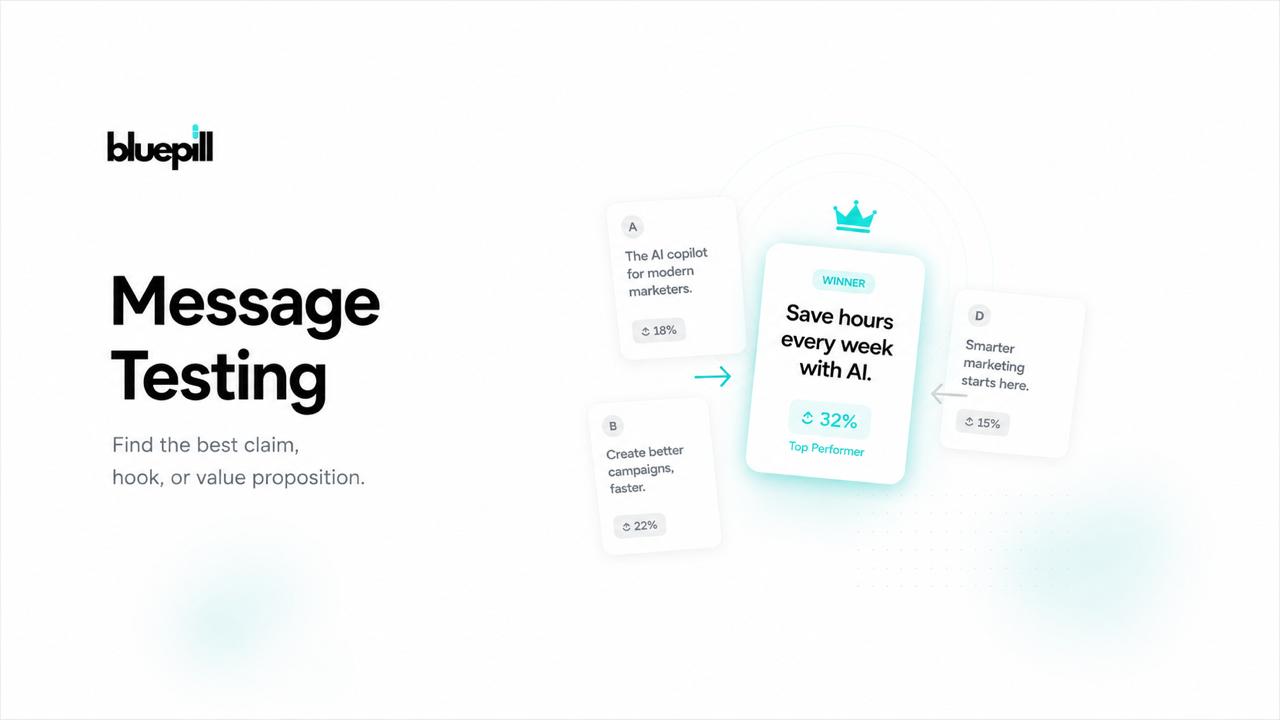
Message Testing: How to Find the Best Claim, Hook, or Value Proposition
May 29, 2026
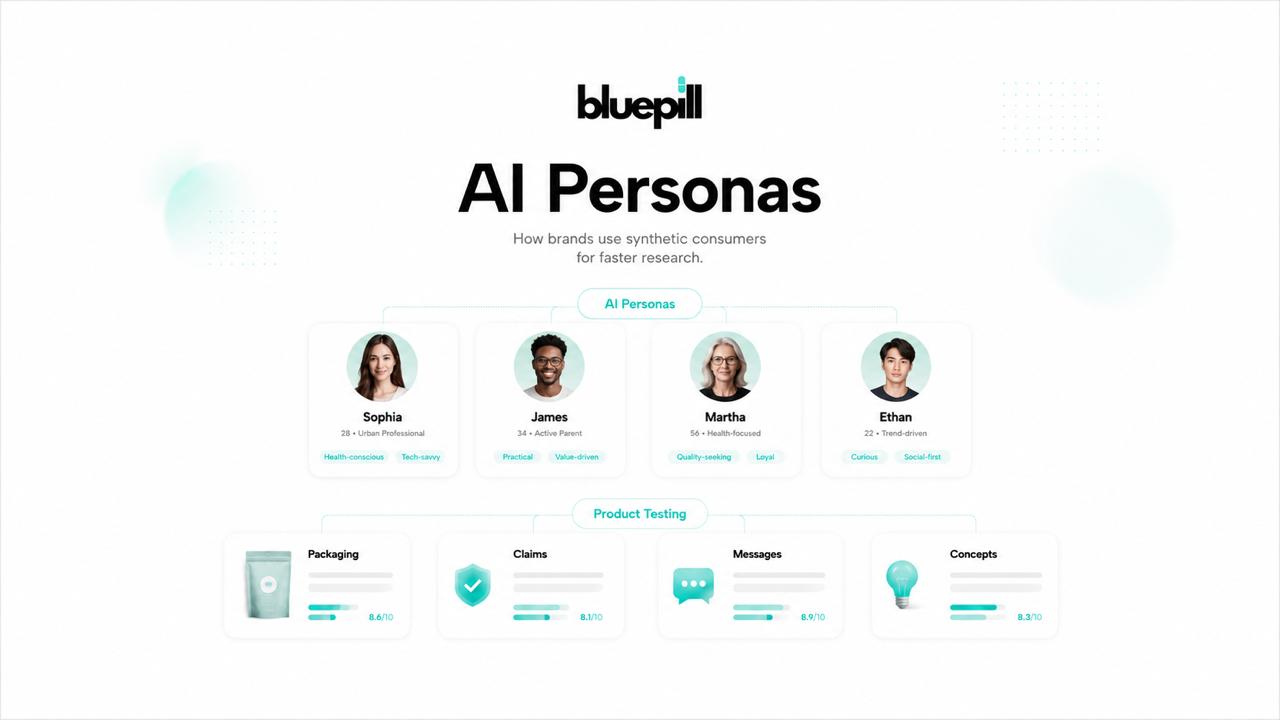
AI Personas: How Brands Use Synthetic Consumers for Faster Research

May 29, 2026
Advertising Market Research: How to Validate Ads Before Launch
May 29, 2026